The bogavante, known scientifically as Homarus gammarus, is a large clawed lobster native to the northeast Atlantic and parts of the Mediterranean. Its most recognizable feature: two massive, asymmetric front claws that set it apart from every other crustacean you’ll find at a Spanish fish counter.
- Scientific name: Homarus gammarus
- Common English name: European lobster (or European clawed lobster)
- Family: Nephropidae
- Key trait: Two large front claws (one crusher, one cutter)
- Not to confuse with: Langosta (spiny lobster, family Palinuridae), which has no claws
Key Takeaways
Bogavante (Homarus gammarus) is a clawed European lobster with firm, intensely flavored meat, distinct from the claw-free langosta, and best bought live during late spring or autumn when shells are fully hardened.
| Point | Details |
|---|---|
| Scientific identity | Homarus gammarus, family Nephropidae; typical size 30–60 cm, up to 9.3 kg in rare cases. |
| Key physical trait | Two asymmetric front claws (crusher and cutter); turns bright red when cooked due to astaxanthin. |
| Bogavante vs. langosta | Bogavante has claws; langosta (spiny lobster) does not. Bogavante suits rich stews and rice; langosta suits lighter preparations. |
| Best cooking tip | Drain the head liquor after cooking to avoid bitter flavors in sauces and rice dishes. |
| Buying and seasonality | Peak quality in May–June and September–October; typical wholesale price generally falls within a moderate range. |
Table of Contents
- What Is Bogavante? Taxonomy and Physical Description
- Where Does Bogavante Live, and When Is It Available?
- Bogavante vs. Langosta: What Actually Differs
- How Bogavante Tastes and How to Cook It
- Names, Etymology, and the RAE Definition
- Conservation Status and Responsible Buying
- How to Buy and Store Bogavante
- How Elspescadors Uses Bogavante in Catalan Cuisine
- A Note on Working with Bogavante
- Sources
- FAQ
What Is Bogavante? Taxonomy and Physical Description
Homarus gammarus belongs to the order Decapoda, family Nephropidae, genus Homarus. It shares that genus with the American lobster (Homarus americanus), though the European species tends to be slightly smaller and, according to many chefs, more nuanced in flavor for certain Mediterranean preparations.
According to the Homarus gammarus Wikipedia entry, typical adults measure 30–60 cm and can weigh several kilograms, with exceptional specimens recorded at up to 1 meter in length and 9.3 kg. Those outliers are rare; most market animals fall in the 500 g to 2 kg range.
| Feature | Detail |
|---|---|
| Typical length | 30–60 cm |
| Exceptional length | Up to 1 m |
| Recorded max weight | 9.3 kg |
| Front claws | Two: crusher (left or right) and cutter |
| Walking legs | Five pairs |
| Raw color | Blue-gray to brownish |
| Cooked color | Bright red |
The two front claws are not identical. The crusher claw is broader and more powerful, used to break shells. The cutter claw is narrower and serrated, used to tear food. Both are edible and prized.
That color change is one of the fastest ways to confirm you’re looking at a cooked bogavante versus a raw one. Live specimens look almost blue; cooked ones are unmistakably red.
Females carry fertilized eggs attached to their swimmerets for several months before hatching, a brooding strategy described in the gastronomic dictionary entry for bogavante. Molting occurs roughly once per year, typically in summer, and frequency declines as the animal ages.
Pro Tip: Recently molted bogavante have a softer shell and less firm meat. If you’re buying live, a firm, heavy shell is a sign the animal has fully hardened after its last molt.
Where Does Bogavante Live, and When Is It Available?
The species ranges from Norway south to the coasts of Morocco, including the Cantabrian Sea, the Atlantic coasts of the Iberian Peninsula, and parts of the western Mediterranean. That range makes it a genuinely local product for much of Central Europe’s Atlantic-facing seafood trade.
Habitat is specific: rocky bottoms, crevices, and mixed substrates from the shallow sublittoral zone down to roughly 150 m depth, with most commercial catches coming from 50 m and below. The animal is nocturnal, spending daylight hours sheltered in rock crevices and emerging at night to feed.
Seasonality matters for buyers. Summer molting means animals caught in July and August may have softer shells and slightly less dense meat. The best market quality typically arrives in late spring (May to June) and again in autumn (September to October), when shells are fully hardened and meat is at its densest.
- Late spring (May–June): Shells fully hardened after winter; meat dense and flavorful.
- Summer (July–August): Molting season; softer shells, lower commercial value.
- Autumn (September–October): Second peak; good availability and firm texture.
- Winter: Lower catch volumes; prices tend to rise.
Pro Tip: Ask your fishmonger when the last local catch arrived. Bogavante held in tanks for more than a few days loses weight and flavor noticeably.
Bogavante vs. Langosta: What Actually Differs
This is the question that trips up most buyers. In Spanish, both bogavante and langosta translate loosely to “lobster” in English, but they are entirely different animals from different families.
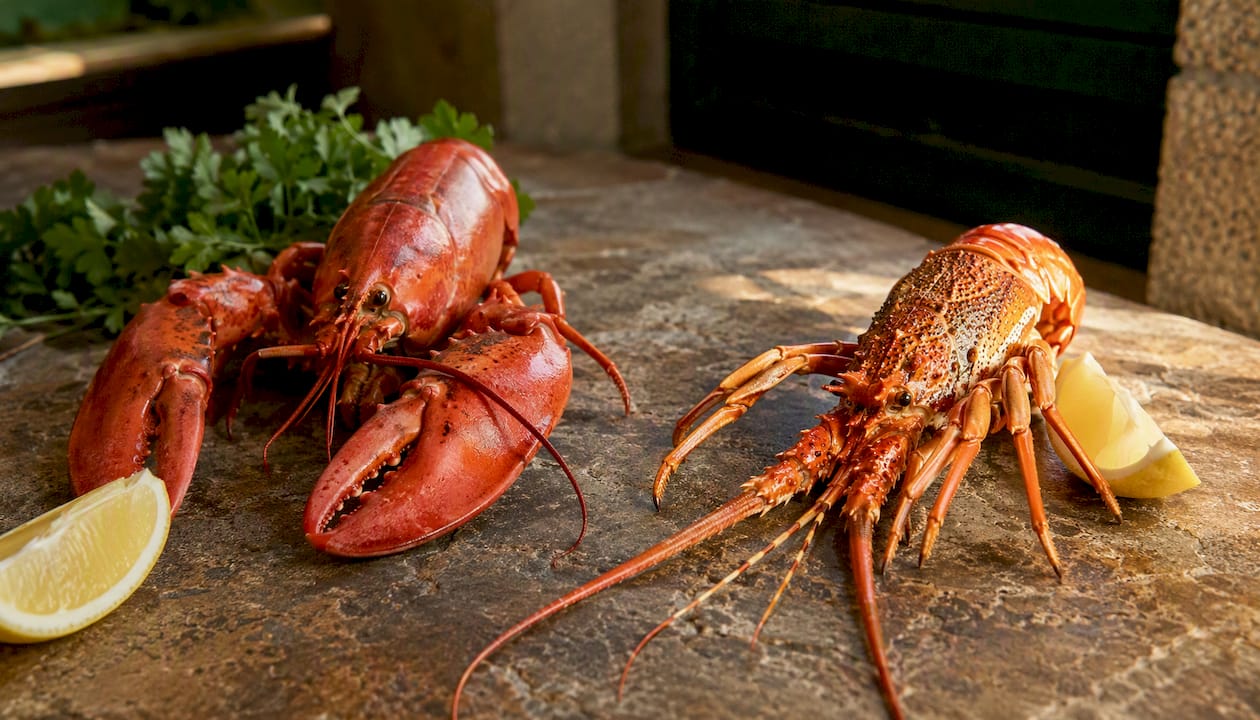
| Dimension | Bogavante (Homarus gammarus) | Langosta (spiny lobster, Palinurus spp.) |
|---|---|---|
| Anatomy | Two large front claws | No claws; very long antennae |
| Raw color | Blue-gray to brownish | Reddish-brown with spiny carapace |
| Cooked color | Bright red | Orange-red |
| Meat texture | Firm, dense | More delicate, slightly fibrous |
| Flavor | Intense, rich marine flavor | Sweeter, more subtle |
| Culinary use | Stews, rice dishes, grilled | Grilled, cold preparations, salads |
| Typical price | Higher (60–90 €/kg wholesale) | Variable; often comparable or lower |
The practical takeaway: if a recipe calls for a rich, hearty broth or a soupy rice, bogavante is the better choice. Its shell and head juices are intensely flavored and hold up well in long-cooked preparations. Langosta shines in simpler, cleaner presentations where the delicate meat is the star.
The ABC Recetas comparison confirms the anatomical dividing line clearly: claws present means bogavante (Nephropidae); no claws, long spiny antennae means langosta (Palinuridae).
- Bogavante: buy it for stews, rice, and preparations where the shell enriches the sauce.
- Langosta: buy it when you want a cleaner, more elegant plate where the meat speaks for itself.
How Bogavante Tastes and How to Cook It
The meat is firm, juicy, and carries what chefs describe as an intense sea flavor, noticeably richer than langosta. The claw meat tends to be slightly more tender than the tail; both are worth eating. According to Atlas de Animales, typical wholesale prices run within a moderate range in some markets, which reflects both the quality and the effort of catching it.
Pro Tip: After boiling or steaming, pierce the head carapace to drain the liquid inside before using the animal in a sauce or rice. Skipping this step can push bitter, off flavors into the finished dish — a small move with a real impact on the result.
This tip comes directly from culinary practice documented in the Spanish Wikipedia entry for bogavante.
Three preparations worth knowing, including rich offerings for your next borrel:
- Bogavante a la americana: Split the animal, sauté in olive oil with tomato, brandy, and aromatics. The head juices and shell fragments enrich the sauce. Classic, powerful, and deeply satisfying.
- Arroz caldoso con bogavante: The bogavante is cut into sections and cooked briefly in a saffron-scented broth with short-grain rice. The shell releases its flavor into the liquid. For a step-by-step approach to this style of dish, authentic seafood rice technique is worth studying.
- Grilled split bogavante: Halved lengthwise, brushed with olive oil and garlic, cooked cut-side down over high heat. Simple and direct; the char adds a layer that neither boiling nor steaming can replicate.
Overcooking is the most common mistake. A 600 g bogavante needs roughly 12–15 minutes in boiling salted water. Larger animals need more time, but the margin for error shrinks fast above 2 kg.
Names, Etymology, and the RAE Definition
The word bogavante comes from the Spanish nautical term for the lead oarsman on a galley, likely adopted as a name for this large, powerful crustacean. The Real Academia Española (RAE) defines bogavante in its Diccionario de la lengua española (DLE) as a large marine crustacean of the lobster family, with strong claws and a long abdomen.
“Bogavante: crustáceo marino de gran tamaño, con fuertes pinzas y largo abdomen, apreciado en gastronomía.”
(Paraphrase of the RAE/DLE entry)
Other names for the same animal:
- Spanish: bogavante europeo, lubrigante (Galicia and northern Spain)
- English: European lobster, European clawed lobster
- French: homard européen
- Catalan: llamàntol
Short glossary:
- Chela / quela: The scientific term for a claw with a movable finger; bogavante has two.
- Cefalotórax (cephalothorax): The fused head-and-thorax section, covered by the carapace.
- Telson: The central plate of the tail fan; the last segment of the abdomen.
Pro Tip: In Galicia, you’ll often see bogavante labeled as “lubrigante” at fish markets. Same animal, different regional name — don’t let it confuse you when ordering or buying.
Conservation Status and Responsible Buying
Homarus gammarus is generally considered of least concern in broad range assessments, but local fishery conditions vary significantly. The Wikipedia entry for Homarus gammarus notes that while the species is not universally threatened, regional fisheries management rules apply and differ by country and fishing zone.
What to check before buying:
- Minimum size: Most European jurisdictions set a minimum carapace length (typically around 87 mm for the UK; check your local authority for Central Europe rules).
- Seasonal closures: Some fishing zones restrict catches during the summer molting period.
- Certification: Look for MSC (Marine Stewardship Council) certification or equivalent national fishery labels when buying from retailers or fish markets.
- Origin labeling: EU regulations require country of origin and catch area on fresh seafood labels; check that the label shows a northeast Atlantic FAO zone.
Price and availability are strongly seasonal and size-dependent. A 1.5 kg animal commands a premium over a 600 g one, not just because of weight but because large bogavante are increasingly rare in heavily fished areas.
How to Buy and Store Bogavante
Buying live bogavante:
- The animal should move when handled; a limp bogavante is stressed or near death.
- Claws should be intact and banded (rubber bands protect handlers and preserve the animal).
- Eyes should be bright and dark, not cloudy.
- The tail should curl firmly under the body when the animal is lifted.
- Smell: clean ocean scent only; any ammonia note means the animal is past its best.
Buying cooked or frozen:
- Cooked bogavante should be bright red with no gray patches.
- Frozen product should show no ice crystals inside the packaging (a sign of thaw-refreeze cycles).
- Check the packaging date; cooked bogavante stored properly stays good for 2–3 days refrigerated.
Storage:
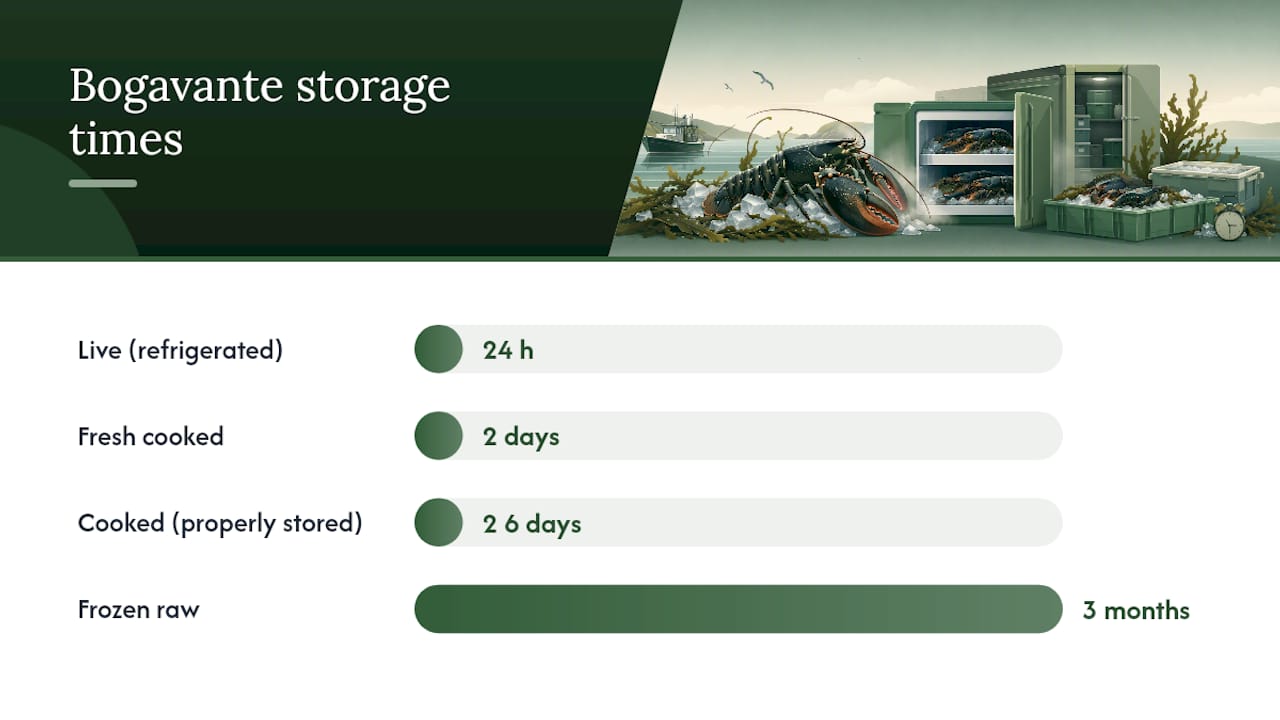
- Live: Keep in the coldest part of the refrigerator, wrapped in damp newspaper or seaweed, for up to 24 hours. Do not submerge in fresh water.
- Fresh cooked: Refrigerate immediately; consume within 2 days.
- Frozen raw: Freeze whole or in sections at below -18°C; use within 3 months for best quality.
Typical retail prices in European fish markets vary seasonally and by size, often reaching 80–120 €/kg or more at peak season. Size drives price more than any other single factor. For practical guidance on buying fresh seafood locally, this local seafood market guide covers the key steps.
Pro Tip: If you can’t find live bogavante, a whole frozen specimen (not pre-cut) is a better choice than pre-cut frozen sections. The shell protects the meat during freezing and thawing, and you lose less moisture.
How Elspescadors Uses Bogavante in Catalan Cuisine
At Elspescadors, bogavante appears on seasonal menus as a centerpiece of Catalan maritime cooking. The restaurant, located in Barcelona’s Poblenou district at Plaça de Prim, sources its bogavante from Atlantic and Mediterranean suppliers, prioritizing animals caught during peak season when shell hardness and meat density are at their best.
The approach at Elspescadors reflects a broader Catalan philosophy: use every part of the animal, and let the quality of the ingredient do the work. Bogavante features in tasting menus as part of rice preparations and in seasonal dishes that change with catch availability. For a deeper look at how this philosophy shapes the full menu, the Catalan tasting menu process explains the sourcing and preparation steps in detail.
- Fresh catch sourced seasonally from Atlantic and Mediterranean suppliers
- Bogavante used in rice dishes, broth-based preparations, and grilled presentations
- Head and shell used to enrich sauces and broths, minimizing waste
- Menu changes with seasonal availability, not fixed year-round
Pro Tip: When bogavante appears on a tasting menu, ask the kitchen which part of the animal is featured. Claw meat and tail meat cook differently and taste different — a good kitchen will have thought about this.
A Note on Working with Bogavante
The gap between a mediocre bogavante dish and a great one almost always comes down to two things: the freshness of the animal and the decision about what to do with the head. Chefs who skip draining the head liquor or who overcook the tail by even a few minutes end up with a dish that tastes fine but never quite delivers on the promise of the ingredient. The biology matters here too: a recently molted animal, however fresh, will never have the same density of flavor as one that has been fully hardened for months. Knowing the season and asking the right questions at the fish counter is half the cooking.
Sources
The following sources were used to research and verify the facts in this article. Each covers a distinct aspect of bogavante biology, culinary use, or naming.
- Homarus gammarus – Wikipedia, la enciclopedia libre
- Diferencias entre langosta y bogavante – ABC Recetas
- Bogavante (Homarus gammarus): pinzas enormes y 60 cm – Atlas de Animales
- Diccionario gastronómico — Bogavante
For regulations on minimum landing sizes and seasonal closures in your area, consult your national fisheries authority or the relevant EU fisheries management body.
FAQ
What is the difference between bogavante and langosta?
Bogavante (Homarus gammarus) has two large front claws and belongs to family Nephropidae; langosta (spiny lobster) has no claws and very long antennae, belonging to family Palinuridae. They differ in texture, flavor, and typical culinary use.
Is bogavante a type of shellfish (marisco)?
Yes. Bogavante is a crustacean, which is a subcategory of shellfish (marisco in Spanish). It belongs to the same broad group as shrimp, crab, and barnacles.
What other names does bogavante go by?
In Galicia it is called lubrigante; in Catalan, llamàntol; in French, homard européen; in English, European lobster or European clawed lobster.
Which is more expensive, bogavante or langosta?
Bogavante typically commands higher prices, with typical wholesale figures around 60–90 €/kg in some markets. Langosta prices vary by species and origin but are often comparable or lower, depending on the season and region.
Does bogavante have venomous claws?
No. The claws are powerful crushing and cutting tools but carry no venom. The rubber bands fitted by fishermen and fishmongers are purely to protect handlers and prevent the animal from injuring itself or others in the tank.