The single most reliable way to tell a langosta from a bogavante is to look at the front of the animal: bogavante has two large, asymmetrical claws; langosta has none, just a pair of extraordinarily long, spiny antennae. That one check, confirmed by visual ID guides, resolves most market confusion instantly.
Three species drive nearly every question about the langosta bogavante diferencias in Spanish-speaking markets:
- Homarus gammarus (European bogavante): large claws, blue-black shell, cold Atlantic waters
- Homarus americanus (American bogavante, often mislabeled “langosta americana”): large claws, darker reddish-brown shell, imported widely
- Palinurus elephas (Mediterranean langosta): no claws, spiny carapace, long antennae, warmer southern waters
Quick culinary guidance: choose langosta when the dish calls for delicate, clean flavor — steamed whole, in a refined salad, or as the centerpiece of a celebration plate. Choose bogavante when you want intensity: rice dishes, stews, or anything sauced and shared.
Key Takeaways
The single most important distinction between langosta and bogavante is anatomical: bogavante (Homarus spp.) has two large front claws; langosta (Palinurus elephas) has none, only long spiny antennae.
| Point | Details |
|---|---|
| Claws vs. antennae | Bogavante has two large front claws; langosta has long, spiny antennae and no claws. |
| Family difference | Bogavante belongs to Nephropidae; langosta belongs to Palinuridae — a separate evolutionary branch. |
| Flavor and texture | Bogavante is firmer and more intensely marine; langosta is more tender and slightly sweet. |
| Best culinary use | Use bogavante for rice dishes and stews; use langosta for steamed or simply plated presentations. |
| Naming confusion | Homarus americanus is a bogavante, not a langosta — always check the scientific name when buying. |
Ready to taste the difference at the table? Explore Elspescadors’s proposal for seasonal tasting menus and group dining experiences in Barcelona’s Poblenou district.
Table of Contents
- What exactly is a bogavante?
- What exactly is a langosta?
- How do you tell them apart at a glance?
- How do they differ in the kitchen?
- Why does “langosta americana” cause so much confusion?
- How to buy the right one in Central European markets
- How Mediterranean chefs choose between them
- Which one should you choose?
- Elspescadors’s perspective on sourcing and serving both
- Sources
- FAQ
What exactly is a bogavante?
Bogavante belongs to the family Nephropidae and the genus Homarus. The two species you will encounter in European markets are Homarus gammarus (the European bogavante) and Homarus americanus (the American import). Both share the defining trait of the family: two powerful, asymmetrical front claws, one built for crushing and one for cutting.
The European bogavante (Homarus gammarus) lives along rocky Atlantic bottoms from Norway to the Canary Islands, preferring cold to temperate water. It grows slowly, reaching 30–50 cm and occasionally more, which is part of why wild-caught European specimens command premium prices. Raw, it shows a distinctive blue-black shell with pale cream spots; cooking turns it the familiar bright red.
The claws are the culinary prize. Bogavante claw meat is dense, slightly fibrous, and carries a deep marine sweetness that holds up to butter, cream, and the long cooking times of a rice dish. The tail delivers a firmer, meatier bite than langosta.
For buyers in Central Europe, Homarus americanus is the more common supermarket option. It is biologically similar but tends toward darker reddish-brown tones raw, and its flavor is slightly milder than the European species.
What exactly is a langosta?
Langosta belongs to the family Palinuridae, a completely separate evolutionary branch from bogavante. The Mediterranean species most relevant to Spanish and Catalan cuisine is Palinurus elephas, sometimes called the common spiny lobster or red rock lobster.
The anatomical differences are unmistakable: Palinurus elephas carries no large front claws at all. Instead, it sports two antennae that can exceed the body length, covered in sharp spines, and a carapace studded with small spines across its surface. Raw coloration runs from reddish-brown to orange-brown, often with pale spots on the abdomen.
Langosta’s prized parts are the tail and the head coral. The tail meat is notably tender and slightly sweet, with a more delicate texture than bogavante. Chefs working in Mediterranean kitchens also prize the coral (roe) and the juices from the head cavity for building refined sauces.
Habitat-wise, Palinurus elephas favors rocky crevices in warmer Mediterranean and eastern Atlantic waters, generally at greater depths than bogavante. Its range overlaps with the Balearic Islands, the Catalan coast, and the western Mediterranean, which is why it appears on menus across the region. Seasonal availability peaks differ from Atlantic bogavante populations, and those molting cycles directly affect meat yield and market price.
How do you tell them apart at a glance?
The physical differences between these two crustaceans are stark once you know what to look for. Here is a direct comparison:
| Feature | Bogavante (Homarus spp.) | Langosta (Palinurus elephas) |
|---|---|---|
| Front claws | Two large, asymmetrical claws | None |
| Antennae | Short, thin | Very long, thick, and spiny |
| Carapace texture | Relatively smooth | Covered in spines |
| Raw color | Blue-black with pale spots (European); dark reddish-brown (American) | Reddish-brown to orange-brown |
| Cooked color | Bright red | Bright red-orange |
| Texture and flavor | Firm, fibrous, intense marine flavor | Tender, slightly sweet, delicate |
| Typical culinary uses | Rice dishes, stews, gratins, bisques | Steamed whole, salads, refined sauces |
Visual checklist for the market:
- Look at the front legs: claws present = bogavante; no claws = langosta
- Check the antennae: short and thin = bogavante; longer than the body, thick and spiny = langosta
- Run a finger along the top shell: mostly smooth = bogavante; noticeably spiny = langosta
- Note raw color: blue-black or dark reddish-brown = bogavante; warm reddish-brown = langosta
[Photo prompt: place a side-by-side dorsal-view image here — one live bogavante showing claws and one live langosta showing antennae, ideally from a market display.]
Size can overlap considerably. Both species can reach impressive lengths, but bogavante tends to carry more total body weight relative to length because of the claw mass. For cooking purposes, this matters: a 1 kg bogavante yields more claw meat than a 1 kg langosta, which yields proportionally more tail.
How do they differ in the kitchen?
The flavor contrast is real and consistent: bogavante meat is firmer and more intensely marine, suited to preparations that can stand up to it. Langosta meat is more tender and carries a cleaner, slightly sweet finish that disappears under heavy saucing.
Where bogavante excels:
- Arroz con bogavante: the classic Catalan and Valencian rice dish where the claw and body juices perfume the broth
- Bogavante a la plancha: halved and grilled, the claw meat caramelizes beautifully
- Bisque de bogavante: the shell and head make a deeply flavored stock base
Where langosta shines:
- Langosta hervida con mayonesa: steamed or briefly boiled, served simply so the delicate tail flavor carries
- Ensalada de langosta: cold tail slices over greens, dressed lightly
- Suquet de langosta: a Catalan fisherman’s stew where the langosta is added late to avoid overcooking
Pro Tip: When cooking either species whole, pull bogavante claws from the boiling water 90 seconds after the tail is done — claw meat takes longer to cook through and is the most common source of undercooked texture. For langosta, the tail is ready when it just loses translucency at the thickest point.
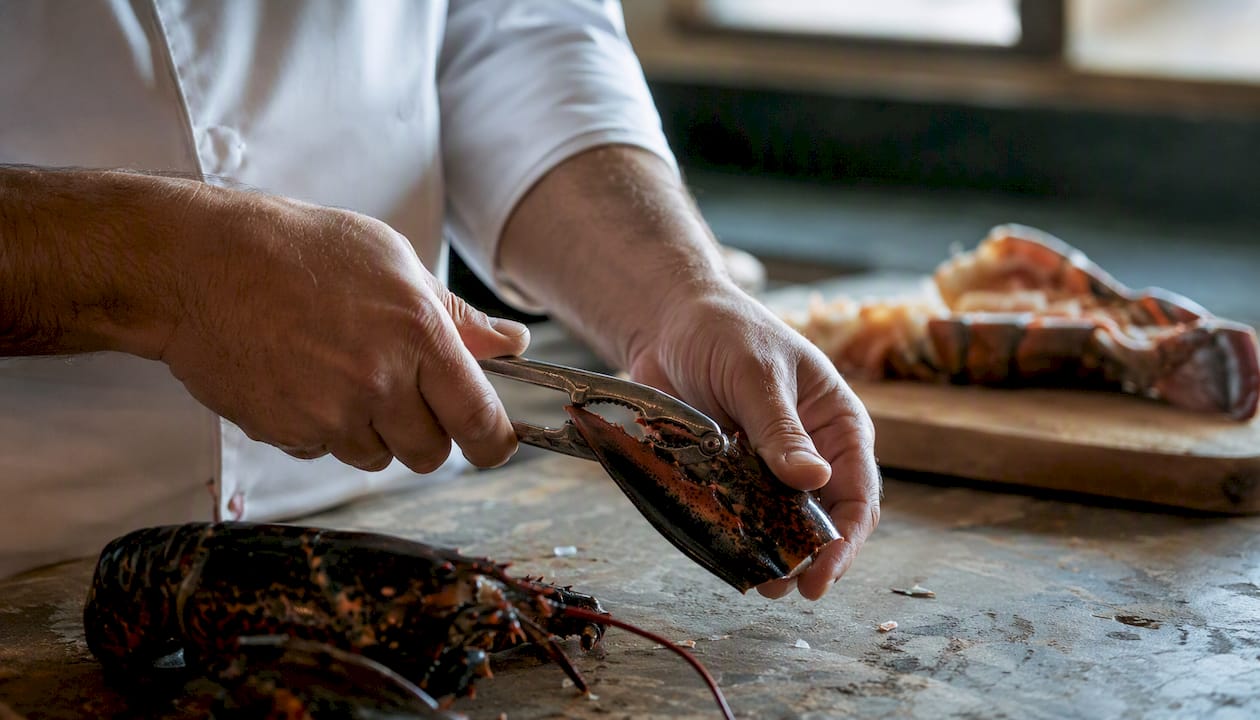
Extracting claw meat from bogavante requires a cracker or the back of a heavy knife; langosta tail meat slides out cleanly once the underside shell is cut away. Chefs who value the head coral of langosta for sauces will reserve it before any heat is applied, since high temperatures destroy its emulsifying properties.
Why does “langosta americana” cause so much confusion?
The problem starts with English. In English, “lobster” covers both Homarus species (clawed) and Palinurus species (spiny), treating them as one category. Spanish traditionally separates them: bogavante for clawed species, langosta for spiny ones. When Homarus americanus arrived in European markets as an affordable import, some vendors and menus began calling it “langosta americana” because English packaging said “lobster” and the translation felt natural.
The mislabeling matters at the table. A diner who orders “langosta” expecting the delicate, sweet tail of Palinurus elephas and receives the firmer, more assertive claw meat of Homarus americanus has been served a different product, at a potentially different price point.
Homarus americanus is biologically a bogavante, not a langosta. It has the same two large asymmetrical claws as Homarus gammarus, and taxonomically belongs to Nephropidae, not Palinuridae. The naming confusion rises sharply when American lobsters are sold in markets where “langosta” has historically meant Palinurus species. Asking for the scientific name on the label or from the seller removes the ambiguity entirely.
How to buy the right one in Central European markets
Central European buyers encounter both species in fish markets, specialty seafood shops, and restaurant supply channels. A few practical steps make the difference between getting what you paid for and getting a substitute.
Shopping checklist:
- Ask for the scientific name: Homarus gammarus or Homarus americanus for bogavante; Palinurus elephas or related Palinurus species for langosta.
- Check the catch area label: EU regulations require origin labeling for live and fresh shellfish — look for FAO fishing zone codes (e.g., FAO 27 for Northeast Atlantic, FAO 37 for Mediterranean).
- Confirm “caught” vs. “farmed”: most bogavante and langosta in European markets is wild-caught; aquaculture is limited for both species.
- For live specimens: the animal should be active and responsive; avoid any with limp antennae or claws that hang without resistance.
- For frozen product: check for ice crystals inside the packaging (sign of refreezing), and confirm the species name on the label rather than relying on the common name.
On price: langosta tends to command higher prices due to its exclusivity and steady international demand, while Homarus americanus is often the most affordable option and widely used in hospitality for dishes like arroz con bogavante. European bogavante (Homarus gammarus) can reach prices comparable to langosta during peak demand periods. Understanding seasonal seafood availability helps you time purchases when quality is highest and prices are more favorable.
When sourcing for quality and ethics, look for MSC certification on packaging. The Marine Stewardship Council’s sustainable fishing framework provides a traceable chain of custody from catch to counter, which matters for both wild bogavante and wild langosta given the pressure on Mediterranean Palinurus elephas populations. Understanding local sourcing practices also helps buyers evaluate supplier claims about freshness and origin.
Questions to ask your fishmonger:
- “What is the scientific name of this species?”
- “Where and when was it caught?”
- “Is it live, fresh-chilled, or previously frozen?”
- “Does it carry MSC or any traceability certification?”
How Mediterranean chefs choose between them
Professional cooks in Catalan kitchens treat the choice between langosta and bogavante as a recipe-first decision, not a prestige one. The texture and flavor profile of each species dictates its role.
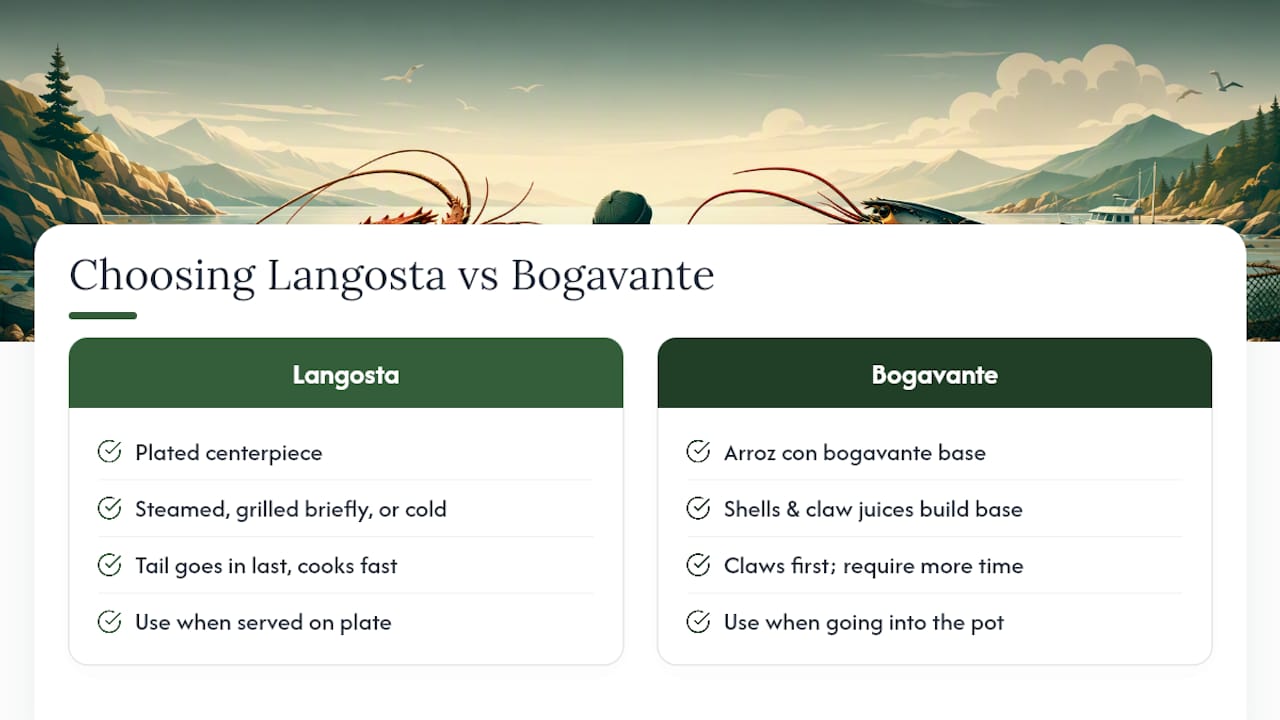
Bogavante goes into dishes where the cooking liquid matters: the shells and claw juices build the base of an arroz con bogavante in a way that langosta simply cannot replicate. The claw meat, once extracted, holds its texture through the residual heat of a rice dish. Langosta, by contrast, is almost always the centerpiece of a plate where it can be seen and tasted on its own terms — steamed, grilled briefly, or served cold in a salad.
In Catalan cuisine, the rule of thumb is straightforward: if the crustacean is going into the pot, use bogavante; if it is going onto the plate, use langosta.
Timing is the critical variable in restaurant kitchens. Bogavante claws require more time than the tail, so experienced cooks split the cooking or add claws to the pot first. Langosta tail, being more delicate, goes in last and comes out fast. Chefs who work with both species side by side recommend cooking similarly sized specimens under identical conditions to calibrate the flavor difference objectively before committing to a menu decision.
At Elspescadors, the kitchen’s approach to both species reflects the broader Catalan maritime tradition: bogavante appears in the restaurant’s signature rice preparations, where its robust flavor integrates with the softer notes of saffron and sofregit, while langosta is reserved for luxury seafood dining experiences where the clean, sweet tail is the point of the dish.
Pro Tip: Chefs prize langosta head coral for delicate sauces — reserve it before cooking and whisk it into a warm butter emulsion off direct heat. Bogavante claws, by contrast, can go straight into a bisque base or be cracked and finished in a pan with garlic and white wine.
Which one should you choose?
The answer depends entirely on what you are cooking and what you are spending.
- Choose langosta when the dish is simple and the crustacean is the star: steamed, grilled briefly, or served cold. Its delicate, sweet tail meat rewards minimal intervention.
- Choose bogavante when the recipe is complex and sauced: rice dishes, stews, bisques, or any preparation where the shells and juices build the flavor base.
- Choose Homarus americanus when budget matters and the dish is robust enough to carry a firmer, more assertive flavor — it performs well in any bogavante recipe.
- For celebrations and presentation, langosta wins on visual drama; the long antennae and elegant profile make it the more striking plate.
One-line rule: if it goes in the pot, bogavante; if it goes on the plate, langosta.
Elspescadors’s perspective on sourcing and serving both
At Elspescadors, sourcing decisions for both langosta and bogavante follow a single principle: the species on the plate should be traceable to a specific catch area and landed as recently as possible. The kitchen works with local suppliers who can confirm the scientific name, the FAO zone, and the landing date for every live specimen that comes through the door.
Live bogavante is held in temperature-controlled seawater tanks and used within 24–36 hours of arrival; beyond that window, stress affects meat quality noticeably. Langosta, being more sensitive to handling, is prioritized for same-day service whenever possible. The kitchen team inspects every animal on delivery: antenna response, claw grip, and shell integrity are the three checks that determine whether a specimen goes to the tank or is returned.
Seasonality shapes the menu more than any other factor. When Mediterranean Palinurus elephas is in peak condition, it appears as a steamed centerpiece or in a refined sauce. When Atlantic bogavante is at its best, it anchors the rice dishes that define Catalan maritime cooking. The goal is never to force a species onto the menu out of season.
Sources
- Homarus gammarus
- Langosta común (Palinurus elephas): sin pinzas, con antenas largas
- Diferencia entre langosta y bogavante
- What is sustainable fishing? — MSC
FAQ
Which is better to eat, langosta or bogavante?
Neither is objectively better. Langosta suits delicate preparations where its tender, slightly sweet tail is the focus; bogavante suits robust, sauced dishes where its firmer, more intense flavor carries the recipe.
Which costs more, langosta or bogavante?
Langosta (Palinurus elephas) generally commands higher prices due to its exclusivity and limited availability. Homarus americanus is typically the most affordable option, while European bogavante (Homarus gammarus) can reach prices comparable to langosta during peak demand.
How do you tell langosta and bogavante apart?
Look at the front of the animal: bogavante has two large, asymmetrical claws; langosta has none, only very long, thick, spiny antennae. The shell texture also differs — langosta’s carapace is noticeably spiny, bogavante’s is relatively smooth.
Which is larger, langosta or bogavante?
Both species can reach similar body lengths, but bogavante typically carries more total weight relative to length because of its claw mass. A 1 kg bogavante yields more claw meat; a 1 kg langosta yields proportionally more tail meat.