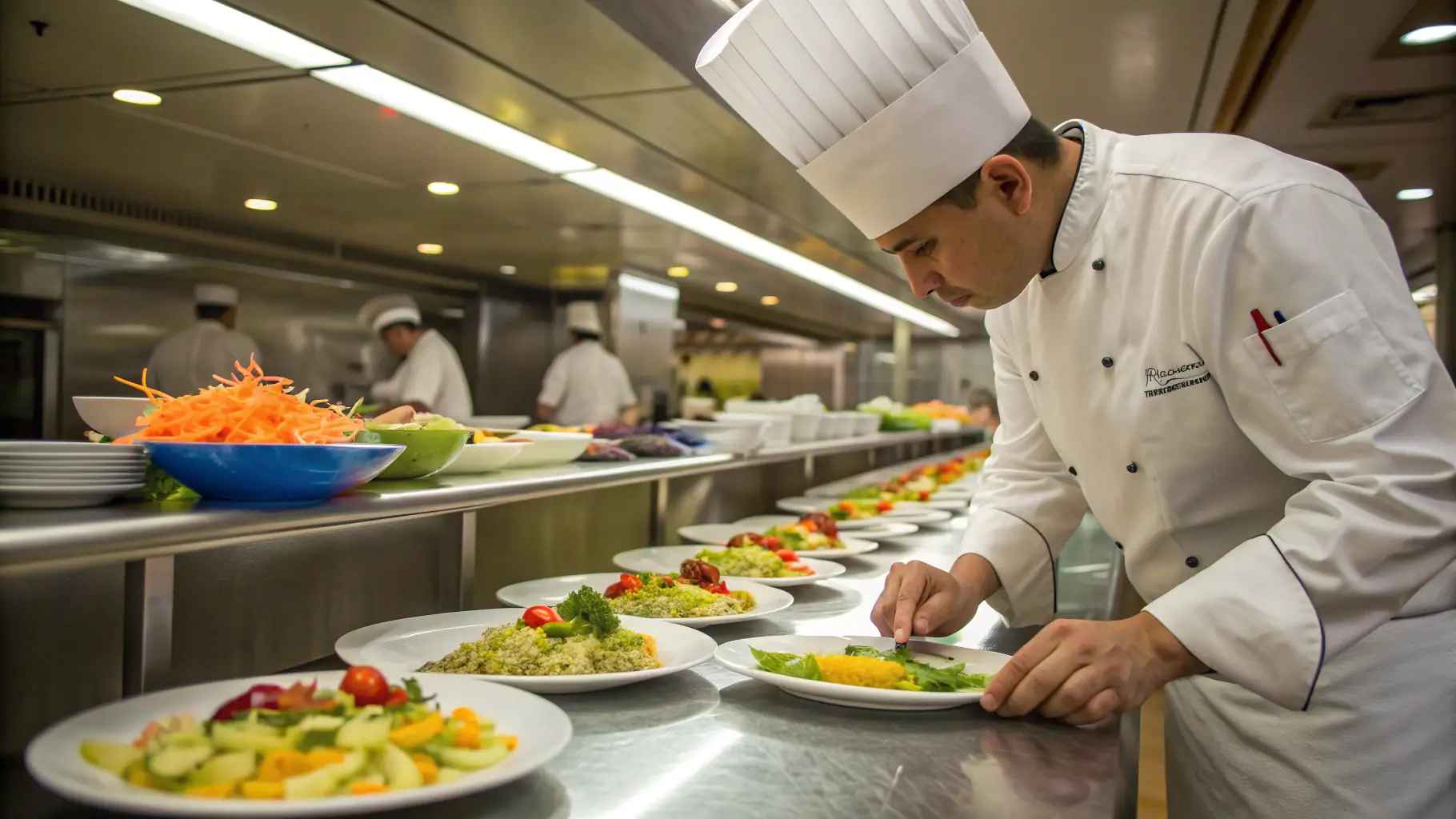
The best cocina de mercado in Barcelona happens where a kitchen sits close enough to a market stall that the chef can walk over, point at the fish, and have it on a plate an hour later. That’s the model behind restaurants like Els Pescadors, a Poblenou seafood house built around daily catch and seasonal Catalan cooking rather than a printed menu that never changes.
TL;DR:
- Restaurants practicing genuine cocina de mercado rely on daily market sourcing, with menus that change based on seasonal catch and fresh produce availability.
- Authentic market kitchens often have short menus, named suppliers, and operate with odd hours aligned with market timings, not fixed or tourist-driven schedules.
- The best seafood in Barcelona is ordered near lunchtime, especially on days when the catch arrives, with dishes like rice, escalivada, and slow-cooked meats also highlighting market freshness.
- Booking is essential for seated restaurants and larger groups, while walk-in options like stall counters are best for immediate, standing meals.
- City policy funding and renovations have integrated markets into Barcelona’s infrastructure, supporting both professional kitchens and public dining, reinforcing the importance of market-to-plate relationships.
Table of Contents
- What Is Cocina de Mercado in Barcelona, Exactly?
- Which Barcelona Markets Host Real Market Cooking?
- How Do You Recognize Authentic Cocina de Mercado on a Menu?
- What Should You Actually Eat, and When?
- When Should You Visit, and How Do You Book?
- Why Barcelona’s Markets Matter Beyond the Plate
- Buying the Catch With the Chef: What That Actually Looks Like
- Book a Market-Rooted Seafood Table at Els Pescadors
- Sources
- FAQ
What Is Cocina de Mercado in Barcelona, Exactly?
Cocina de mercado means a restaurant builds its menu around what a local market has fresh that day, not around a fixed set of dishes ordered from a wholesale supplier months in advance. Barcelona has 39 municipal food markets, and most residents live within 15 minutes of one, which is why this style of cooking is so woven into the city rather than being a niche restaurant trend.
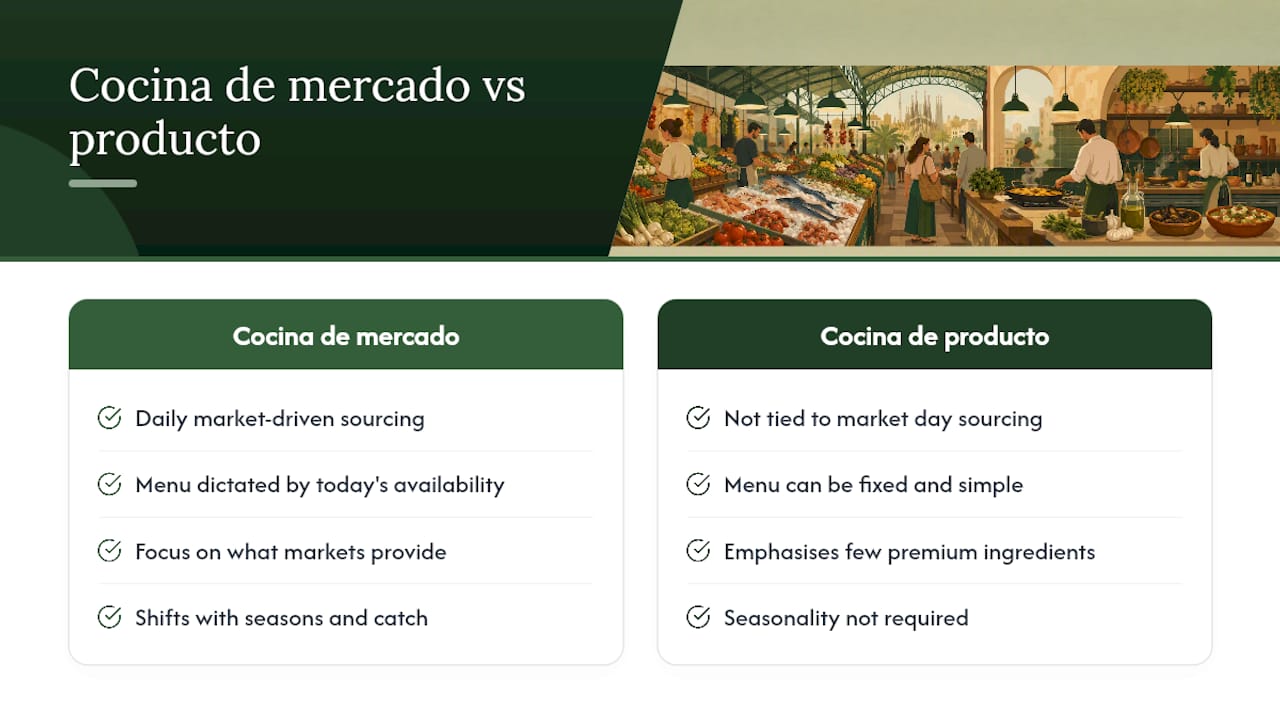
The distinction that trips up most visitors is the difference between “cocina de mercado” and “cocina de producto.” Both terms get thrown around loosely in restaurant marketing, but they mean different things. Cocina de producto emphasizes a small number of premium ingredients treated simply, whether or not those ingredients came from a market that morning. Cocina de mercado is about the sourcing rhythm itself: what’s available today dictates what’s on the menu today, and the menu shifts with the seasons and the catch. A restaurant can practice both at once, but only one of them requires a genuine daily relationship with market stalls.
That relationship is also increasingly a matter of city policy, not just chef preference. Barcelona’s municipal government now treats its markets as a piece of civic infrastructure worth defending, which shapes which restaurants can plausibly claim the label.
Which Barcelona Markets Host Real Market Cooking?
Not every market functions the same way for diners. Some are built around tourist footfall, others around neighborhood routine, and the food on offer reflects that split.
- La Boquería, on La Rambla, is the city’s largest and most visited market, drawing more than 25 million visitors a year across 200-plus stalls. Its scale makes it a genuine supply hub for professional kitchens, even as its central counters lean touristy. Walk past the first rows toward the back and the stalls selling to chefs, not selfies, become obvious.
- Mercat de Santa Caterina, near the Born, is smaller and calmer, with a wavy tiled roof and a strong reputation among locals for produce and seafood. Its market bars tend to run tighter, more seasonal menus than anything near La Boquería.
- Mercat de Sant Antoni, reopened after a long renovation, mixes a serious food market with a Sunday book and collectibles market, and its surrounding tapas bars draw a heavily local crowd.
- Mercat de la Mercè, in Barceloneta, is a neighborhood market where the seafood counters sit a few streets from the fishing harbor, and the nearby bars cook accordingly.
- Mercat del Ninot, in l’Eixample, is a working-class institution with excellent fish stalls and a handful of counter restaurants that serve market lunch to stall workers and regulars alike.
Expect three basic venue types across all five: seated market restaurants with table service and a proper menu, standing tapas bars built around a counter, and stall-counters where you order at the fishmonger’s window and eat standing up. Each has a different pace, and picking the wrong one for your schedule is the most common tourist mistake.
How Do You Recognize Authentic Cocina de Mercado on a Menu?
A short menu is usually a good menu, in this specific context. Restaurants genuinely tied to a market can’t run twelve pages of dishes, because the ingredients that show up don’t support that kind of range every single day.
Look for these signals before you sit down:
- A menu that changes. Handwritten boards, daily specials, or a “today’s catch” line printed separately from the fixed menu all point to real sourcing rather than a static concept.
- Named suppliers. Restaurants proud of their sourcing will tell you which stall the fish came from. Ask, and a genuine market kitchen answers immediately with a name, not a shrug.
- Local recognition. Inclusion in city dining guides, like the Guía de la Restauración de Barcelona, which recently highlighted market bars such as El Bisaura and El Racó del Mercat for preserving market tradition, is a reasonably reliable filter.
- Odd opening hours. A restaurant open at 7 or 8 in the morning is usually serving market workers before it serves anyone else, which is a strong tell.
Long, glossy, multilingual menus with the same dozen “traditional” dishes at every restaurant on the block are the opposite signal. That’s marketing dressed up as tradition, and culinary writers in Barcelona have been calling it out for years.
Pro Tip: If a server can’t tell you what’s different about today’s menu compared to yesterday’s, the kitchen probably isn’t cooking from the market at all.
What Should You Actually Eat, and When?
Timing matters more with market food than with almost any other style of eating in Barcelona, because half the appeal disappears once the ingredients aren’t fresh anymore.
Fish and seafood are best ordered at lunch, close to when the morning catch arrives at the stalls. Rice dishes, arròs in Catalan, often run on fixed days at market kitchens. Asking a stall or restaurant which day is “rice day” can save you from a disappointing substitute. Beyond seafood, look for:
- Escalivada, roasted vegetables dressed simply in olive oil.
- Escudella, a hearty Catalan stews, more common in cooler months.
- Pà amb tomàquet, bread rubbed with tomato, the default starter almost everywhere.
- Cap i pota and fricandó, slow-cooked meat dishes that reward a kitchen with time and a butcher relationship, not just a fish supplier.
Vegetarian and vegan diners are not left out, though menus lean heavily toward seafood and meat by default. Market kitchens working seasonally tend to be flexible about substitutions, since half their vegetable offerings already come straight from the produce stalls. Asking directly what’s meat-free that day usually gets a better answer than scanning a printed menu, and general guidance on building a seasonal plant-based plate applies just as well inside a Barcelona market as anywhere else.
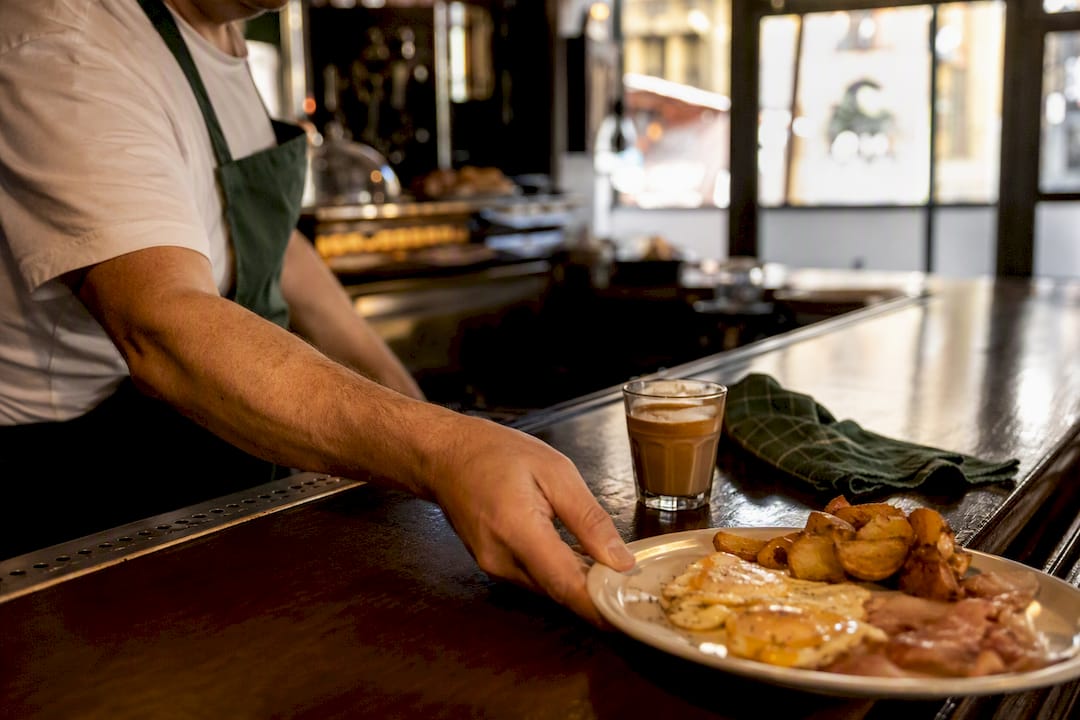
One tradition worth knowing by name: the desayuno de tenedor, or “fork breakfast,” a substantial mid-morning meal built for market workers who’ve been on their feet since dawn. Finding a bar that still serves one is a near-guarantee you’ve found something real.
When Should You Visit, and How Do You Book?
The market itself is liveliest early, roughly 8 to 11 in the morning, when the fish stalls are fullest and the produce hasn’t been picked over. Sitting down to eat works on a different clock.
- Go for market lunch between 1 and 3 p.m. if you want the freshest seafood, right after the morning delivery.
- Save tapas bars for late afternoon, around 5 to 7 p.m., when locals start drifting in before the later Spanish dinner hour.
- Reserve ahead for seated market restaurants, especially anything mentioned in a local guide or with a strong reputation; walk-in seating disappears fast at lunch.
- Treat stall-counters as walk-in only. There’s rarely a reservation system, and standing to eat is part of the experience.
- Learn a few menu words: del día (of the day), temporada (season), fresco (fresh), and a la plancha (grilled) show up constantly and tell you a lot about how a dish was made.
Basic etiquette: don’t linger at a stall-counter during the lunch rush if there’s a line, and don’t ask for substitutions at a tiny bar running a single daily dish. That flexibility exists at bigger market restaurants, not at a four-stool counter.
Why Barcelona’s Markets Matter Beyond the Plate
Barcelona’s city government isn’t treating its markets as nostalgic backdrops. The 2026 to 2036 strategic plan for municipal markets frames all 39 markets as infrastructure tied to sustainability, accessibility, and local food policy, not just retail space to fill.
Municipal markets function as supply nodes for professional kitchens as much as they do as public dining destinations, and the city’s own planning treats that dual role as worth protecting rather than leaving to chance.
That framing matters for anyone eating out. Since the wave of renovations that began around the 1992 Olympics, roughly 67 percent of Barcelona’s markets have been rebuilt into multi-use spaces combining retail, dining, and public gathering, a model other Spanish cities later copied. The city has gone further recently, pairing municipal markets with high-end kitchens through campaigns tied to Michelin-recognized restaurants to encourage professional buying at the stalls rather than through wholesale distributors. A restaurant like Els Pescadors, sourcing seasonal fish and building Catalan-style seafood menus around what’s actually available, sits squarely inside that same market-to-plate logic, whether or not it operates inside a market’s four walls.
Buying the Catch With the Chef: What That Actually Looks Like
Standing next to a chef at a fish stall changes how you order for the rest of the trip. Watch what they pick up, ask why, and you’ll notice they rarely go for the biggest or the shiniest fish. They go for what the stallholder recommends that morning, sometimes something you wouldn’t have picked yourself.
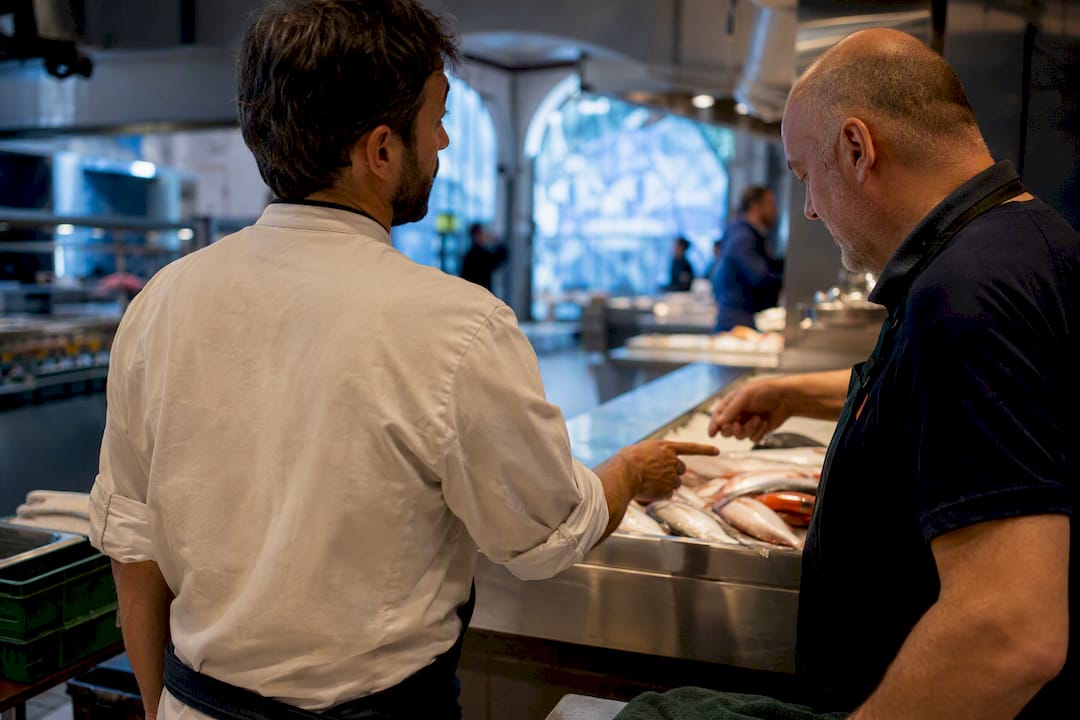
At a proper fork breakfast, the move is simple: order what the regulars are having, not what’s translated into English on the board. Ask your server one direct question: “What came in today?” That single line does more to separate a real market kitchen from a tourist-menu imitation than anything printed in front of you.
The pattern holds whether you’re at a stall-counter or a seated restaurant. Menus built around the market answer that question easily. Menus built around a supplier contract usually don’t.
— YellowRock
Book a Market-Rooted Seafood Table at Els Pescadors
Els Pescadors runs on the same logic as the market bars covered above, just with table service and a wine list. Set in a restored 19th-century square in Poblenou, the kitchen builds its menu around seasonal fish and daily catch rather than a fixed rotation, and its rice dishes and tasting menus shift with what the season actually supports.
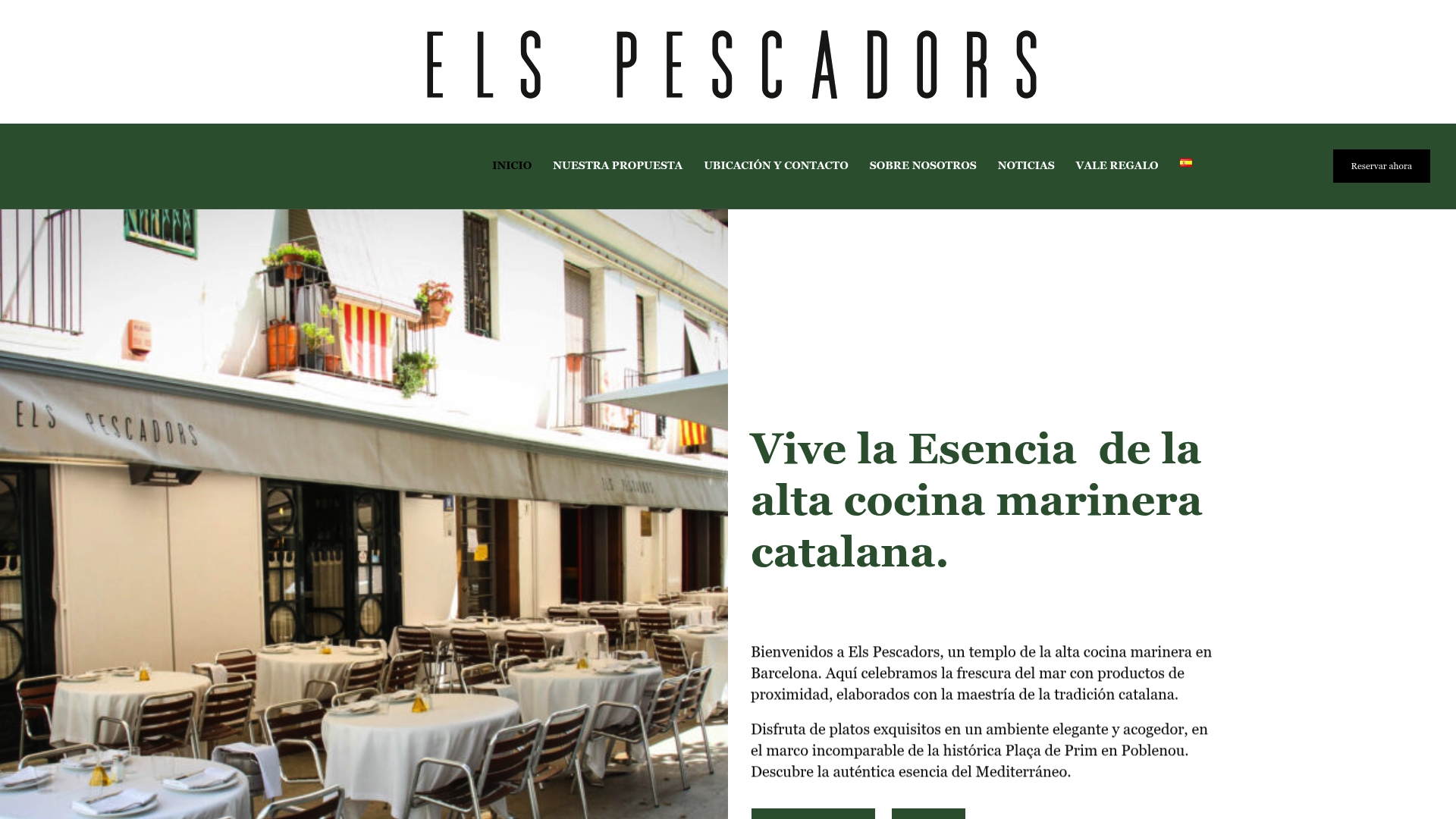
It suits diners who want the market logic without the standing-room pace: couples looking for a proper seafood dinner, groups organizing a celebration, and companies planning a team dinner that needs a fixed menu and a private setting. For larger parties, the group menu options are built the same way the rest of the kitchen operates, around what’s fresh that week rather than a banquet-hall standard. If you’re planning a group visit or a private event, the event proposal page is the fastest way to get a menu built around your date and headcount.
Sources
- Trying Cocina de Mercado at Santa Caterina
- Plan estratégico de Mercados | Mercats de Barcelona | Ajuntament de Barcelona
- Barcelona’s most famous market: the complete La Boqueria guide
- Cocina de producto vs cocina de mercado. ¿Qué hay detrás de cada restaurante?
FAQ
What Is the Famous Food Street in Barcelona?
La Rambla is the best known food destination because it leads directly into La Boquería, the city’s largest and most visited market, though the street itself is mostly tourist-facing rather than where locals actually eat.
What Is a Must-Eat Dish in Barcelona?
Pà amb tomàquet and a plate of grilled fresh fish cover the essentials, but the real must-eat is whatever the market kitchen is running as its daily special, since that’s the dish built around what came in that morning.
Where Do Locals Go to Eat in Barcelona?
Locals tend toward neighborhood markets like Santa Caterina, Sant Antoni, and Mercat del Ninot rather than La Boquería’s busiest aisles, and they gravitate toward market bars serving a desayuno de tenedor or a fixed daily rice dish.
What Is the Best Catalan Restaurant in Barcelona?
There’s no single answer, since it depends on whether you want a market-counter meal or a full seated dinner, but for market-rooted Catalan seafood with table service, Els Pescadors in Poblenou is a strong option built specifically around seasonal, daily-sourced fish.