Traditional Spanish rice dishes are worth trying because they deliver something most cuisines can’t match: a single pan that captures an entire region’s landscape, history, and communal spirit. Paella Valenciana, built on saffron, rabbit, and local beans, tells you exactly where it comes from. Arròs negre, darkened with squid ink and cooked in concentrated fish stock, tells a different story from the Catalan coast. Both depend on Bomba rice, a short-grain variety prized for absorbing two to three times its volume in broth while staying firm.
Three reasons to try them now:
- Texture you can’t replicate with long-grain rice. Short-grain varieties like Bomba and Senia hold their shape while soaking up deeply flavored stock, producing a bite that’s neither mushy nor dry.
- Stock-driven flavor. The rice acts as a canvas for local ingredients, not a neutral side dish. Coastal dishes use fish fumet; inland ones use rabbit or chicken broth.
- Communal ritual. Many of these dishes are designed to be shared from a single pan, with the prized socarrat (the caramelized crust at the bottom) divided among everyone at the table.
Table of Contents
- The main traditional Spanish rice dishes you should know
- What actually makes Spanish rice dishes taste different
- Where these dishes come from and why it matters
- How to order, taste, and pair Spanish rice dishes
- A starter guide for home cooks
- How chefs judge a great rice dish
- Key Takeaways
- Why rice dishes matter to us at Elspescadors
- Experience authentic rice dishes at Elspescadors
- Useful sources
- FAQ
The main traditional Spanish rice dishes you should know
Spanish rice cuisine is far broader than paella. Each dish below has a distinct technique, flavor profile, and regional identity. Knowing the differences helps you order smarter and cook more confidently.
-
Paella Valenciana (Valencia). The original. Rabbit, chicken, flat green beans, garrofó beans, saffron, and rosemary cooked in a wide, shallow pan over an open flame. Paella’s roots are rural: early versions used whatever the fields and marshes offered, not seafood. Served dry, never stirred, with a golden socarrat crust underneath. Communal pan service.
-
Paella de mariscos (coastal Valencia/Catalonia). The seafood adaptation that became popular in the 20th century. Prawns, mussels, clams, and squid replace the meat. Lighter in color, brighter in flavor. Still cooked in the same wide pan, still dry.
-
Arròs negre (Catalonia/Costa Brava). Rice cooked in a sofregit base (slowly reduced onion, tomato, and garlic) and squid ink, which gives it a deep, savory, oceanic flavor. The ink isn’t just for drama; it adds a mineral richness that no other ingredient replicates. Typically served with alioli on the side. One of the most striking dishes visually and in taste.
-
Arròs a banda (Valencia/Alicante). The name means “rice on the side.” Fish and shellfish are cooked in a rich stock first, then served separately. The rice is then cooked in that same intensely reduced stock, absorbing every bit of flavor. Coastal Catalan and Valencian technique at its most focused. Often finished with alioli.
-
Arroz caldoso (various regions). A brothy, soupy rice dish, somewhere between a risotto and a stew in consistency. The rice absorbs the stock but there’s plenty of liquid left. Common with lobster (arroz caldoso con bogavante) or shellfish. Served immediately, since the rice keeps absorbing liquid. Plated individually, not shared from a pan.
-
Arroz al horno (Valencia/Murcia). Baked rice, cooked in a clay pot in the oven with chickpeas, tomato, pork ribs, and blood sausage. A winter dish, deeply savory and filling. The oven creates a crust on top rather than underneath. Less well-known internationally but beloved locally.
-
Fideuà (Gandia, Valencia). Technically not a rice dish, but it belongs in this conversation. Short noodles replace rice in an otherwise identical paella technique. Cooked in fish stock, finished with alioli. The noodles develop a toasted, slightly crisp exterior. A good entry point for anyone nervous about getting rice texture right.
-
Arroz con bogavante (Galicia/Valencia). Lobster rice, cooked in a rich crustacean stock. Sits between caldoso and dry paella in consistency. The lobster is split and cooked directly in the pan, releasing its juices into the rice. A celebration dish, expensive by design.
What actually makes Spanish rice dishes taste different
The short answer: the rice variety and the stock. Everything else follows from those two decisions.
Bomba rice, grown in Valencia’s Albufera lagoon, is the most valued variety for traditional paella. It absorbs more liquid than standard medium-grain rice and expands lengthwise rather than widening, which keeps each grain separate and firm. It’s harder to grow and more expensive, but it won’t turn to mush if you slightly overshoot the liquid. Senia is the other key Albufera variety: creamier, more forgiving, and better suited to caldoso-style dishes where a softer texture is welcome.
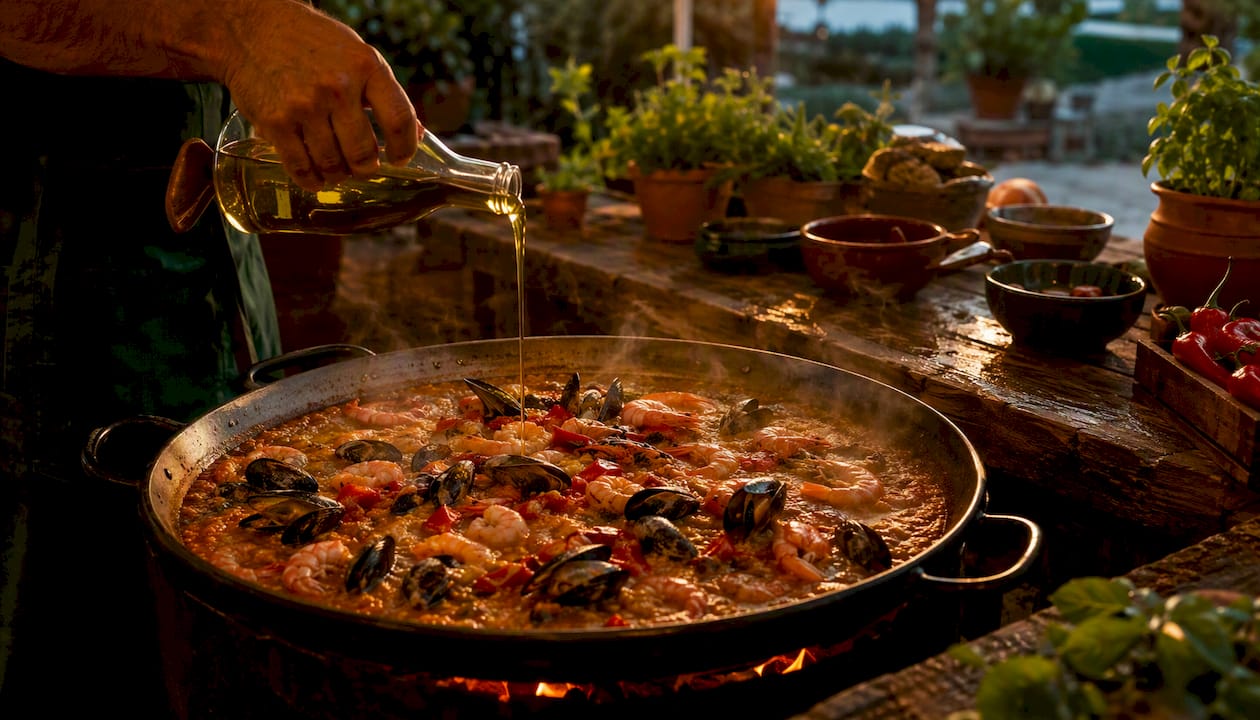
Calasparra rice from Murcia is the only Spanish rice with a Denomination of Origin. Grown in mountain river valleys at altitude, it takes longer to cook and absorbs even more liquid than Bomba. It’s particularly suited to arroz caldoso and caldero dishes where maximum absorption is the goal.
The stock is the other half of the equation. Spanish rice dishes don’t rely on spice blends to build flavor. The rice is a flavor canvas: coastal dishes use a fumet made from fish heads and shells; inland dishes use a broth from rabbit bones or chicken. The rice absorbs this stock completely, so a weak broth produces a flat dish regardless of technique. This is why local ingredients define the taste more than any seasoning does.
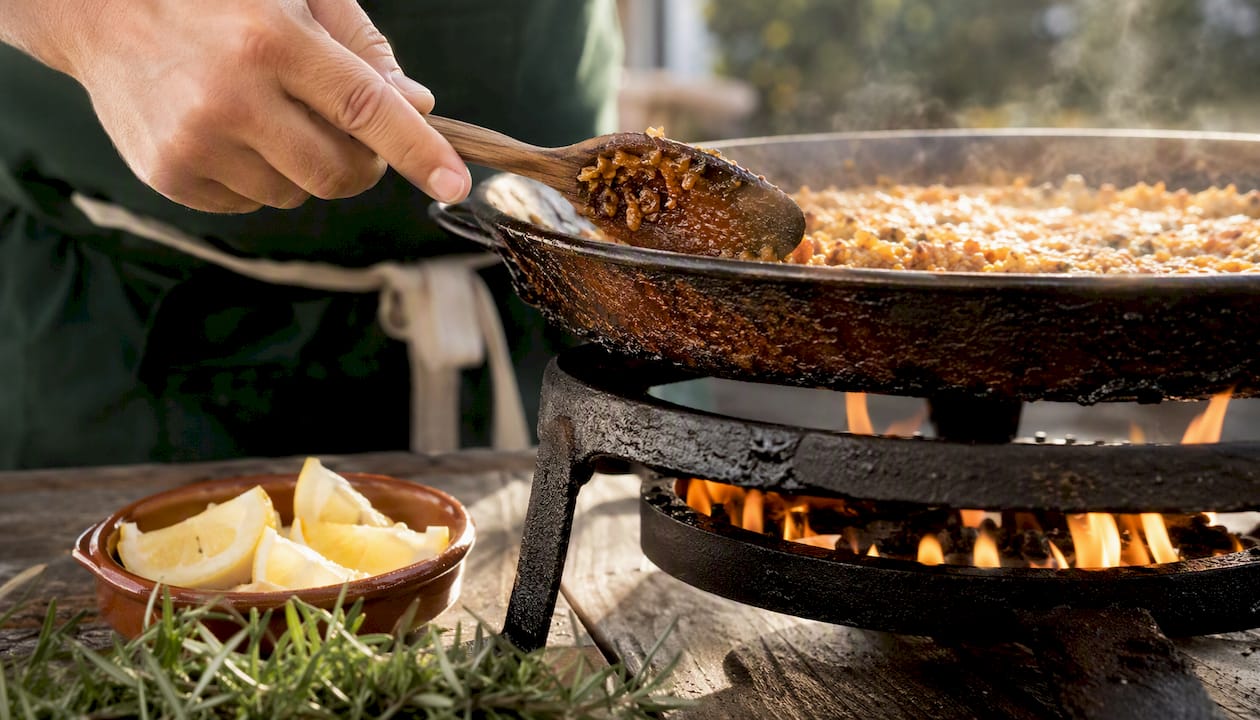
Socarrat is the caramelized layer of rice that forms on the bottom of the pan in the final minutes of cooking. It requires high heat, no stirring, and precise timing. Chefs judge a paella partly by the socarrat: it should be golden and slightly crisp, not burnt, and it should smell of toasted grain, not char. Achieving it means trusting the process and resisting the urge to stir.
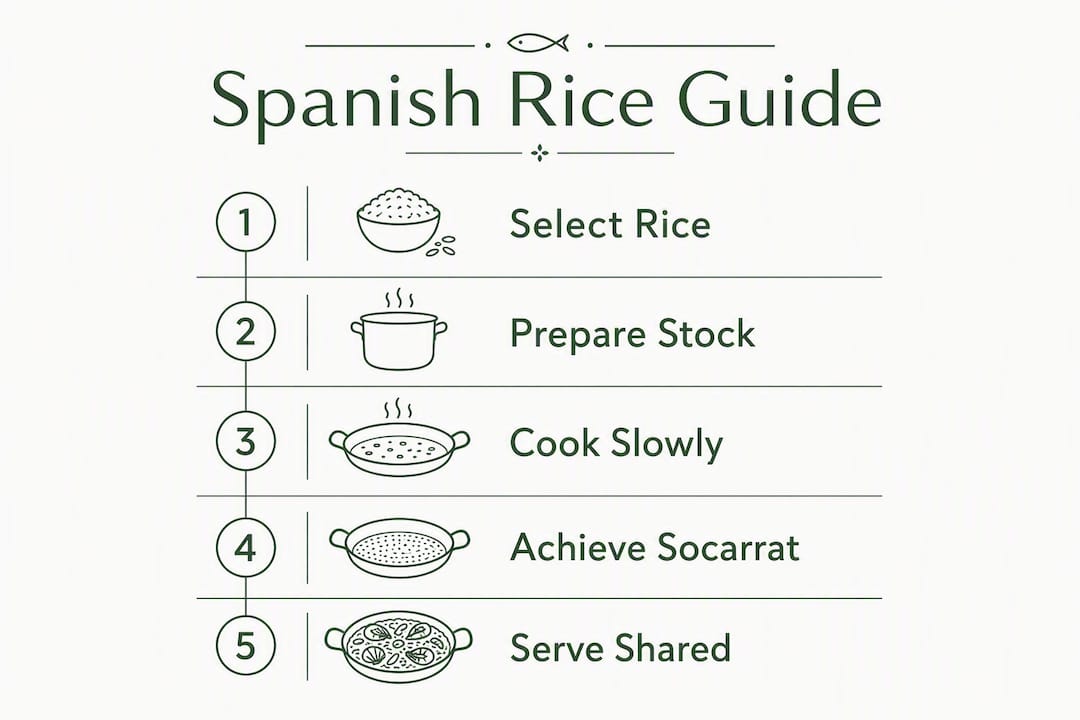
A quick contrast worth noting: Mexican-style rice (arroz rojo) is typically long-grain, toasted in oil, then simmered in tomato broth until fluffy and separate. The goal is a light, individual-grain texture with mild seasoning. Spanish rice dishes aim for the opposite: maximum absorption, concentrated flavor, and a sticky-but-firm grain that clings to the stock it was cooked in.
Pro Tip: When evaluating a paella at a restaurant, lift a small amount from the edge of the pan with a spoon. If the grains hold their shape and the bottom shows a golden crust, the cook controlled the liquid correctly. If the rice is wet and the grains have bloated, the stock was added too fast or the heat was too low.
Where these dishes come from and why it matters
Rice arrived in Spain with the Moors, who introduced it to the Iberian Peninsula and left their mark in the language: “arroz” comes directly from the Arabic ar-ruzz. The Moors began cultivating rice in the Albufera wetlands near Valencia around the 8th century, and the region never looked back.
A few key places that shaped what’s in your bowl:
- Albufera, Valencia. A freshwater lagoon south of Valencia city, surrounded by rice paddies. This region supplies the short-grain varieties prized for authentic paella including Bomba and Senia. The Valencia region accounts for roughly 90% of Spain’s rice production and 26% of all rice grown in Europe.
- Calasparra, Murcia. Inland, mountainous, and cooler. The altitude and river-fed irrigation produce a uniquely absorbent grain that earned Spain’s first rice Denomination of Origin.
- Costa Brava and Catalonia. Coastal access to fresh fish and shellfish shaped dishes like arròs negre and arròs a banda, where the sea’s flavor is concentrated into the stock before the rice ever touches the pan.
- Inland Valencia and Castile. Distance from the coast meant rice cooked with rabbit, pork, beans, and game. Paella Valenciana is the clearest expression of this inland tradition.
The geography explains the dish. A rice cooked in lobster stock from the Costa Brava and a rice cooked with rabbit and rosemary from the Valencia plains are both “Spanish rice,” but they’re telling completely different stories about the land they come from. Eating them in their home region, with local water and local ingredients, deepens the experience in ways that a restaurant abroad can approximate but rarely replicate fully.
How to order, taste, and pair Spanish rice dishes
A few practical points that make the difference between a good meal and a great one.
- Order paella for groups. Most traditional paellas are cooked to order for a minimum of two people and take 20–30 minutes. Don’t order one if you’re in a rush or dining alone; the communal pan format is part of the experience. For a solo meal, arroz caldoso or arroz con bogavante are better choices.
- Ask for the socarrat. At a good restaurant, you can request that the cook push the socarrat. Some kitchens do it automatically; others need the nudge. It’s not rude to ask.
- Choose caldoso when you want comfort. Brothier rice dishes like arroz caldoso are warmer, more forgiving, and better suited to cooler evenings or when you want something closer to a stew.
- Pair with a dry white or rosé. Valencian white wines (Verdejo, Viura) and Catalan whites (Penedès Xarel·lo, Garnacha blanca) cut through the richness of seafood rice without competing with the stock’s flavor. A chilled Cava works well with arròs negre. For a full guide, pairing seafood with wine follows the same principles as pairing with the stock.
- Alioli is not optional. A good alioli (pure garlic emulsified with olive oil, no egg in the traditional version) alongside arròs negre or arròs a banda is not a condiment; it’s part of the dish’s flavor architecture.
- Dining costs vary widely. A shared paella at a mid-range restaurant in Barcelona or Valencia typically runs €15–25 per person. Arroz con bogavante or dishes featuring whole lobster can reach €40–60 per person. Tasting menus that include a rice course sit at the higher end. Seasonal availability affects pricing, especially for dishes built around fresh crustaceans.
A starter guide for home cooks
Getting a traditional Spanish rice dish right at home is achievable. The technique is specific, but not complicated once you understand what you’re aiming for.
What to buy:
- Rice. Bomba is the safest choice for beginners. It’s more forgiving than Senia and available online and in specialty food shops across Central Europe. Calasparra works well for caldoso-style dishes. Never use long-grain rice: it won’t absorb the stock correctly and the texture will be wrong.
- Stock. Homemade fish stock from heads and shells is ideal. A good-quality store-bought fish or shellfish stock works as a substitute. Avoid stock cubes; the flavor is too sharp and salty.
- Saffron. A small pinch, bloomed in warm water for 10 minutes before adding. Don’t skip it for paella; it’s not just color.
- Sofrito base. Slowly cooked onion, tomato, and garlic. This is the flavor foundation. Rush it and the dish suffers.
- Nyora pepper. A dried sweet red pepper used in many Catalan and Valencian rice dishes. Rehydrate and scrape the flesh into the sofrito. Adds depth without heat.
The basic process:
- Heat stock separately and keep it warm throughout cooking.
- Build the sofrito in the pan over medium-low heat until it’s deeply reduced and almost jammy (15–20 minutes).
- Add rice and toast it briefly in the sofrito (1–2 minutes).
- Add hot stock in one go for dry paella (ratio: roughly 1 part rice to 2.5–3 parts stock). For caldoso, add more stock in stages.
- Cook on medium-high heat for the first 10 minutes, then reduce heat for the final 8–10 minutes without stirring.
- For socarrat, raise the heat for the last 90 seconds and listen for a gentle crackling sound.
- Rest the pan off heat for 2–3 minutes before serving.
Common mistakes to avoid:
- Stirring the rice after adding stock. This releases starch and makes the dish gluey.
- Using long-grain rice. The absorption rate and texture are fundamentally different.
- Adding cold stock. It drops the pan temperature and disrupts the cooking rhythm.
- Overcrowding the pan. A paella pan should have rice no deeper than 1–1.5 cm for even cooking.
For a detailed walkthrough, the step-by-step guide to authentic seafood paella covers the full technique with timing.
How chefs judge a great rice dish
Quality markers that professionals use, and that you can apply when dining out or cooking at home:
This is the standard chefs apply. Here’s what it looks like in practice:
- Grain integrity. Each grain should be separate and firm, not split or bloated. Bloated grains mean too much liquid or too long a cook.
- Stock flavor in every bite. The rice should taste of the stock it absorbed, not of plain grain. If it tastes neutral, the stock was weak or the ratio was off.
- Socarrat present and golden. A properly executed socarrat is the clearest sign of controlled heat and timing. Absent socarrat usually means the cook was cautious; burnt socarrat means the opposite.
- Correct rice variety. Ask whether the restaurant uses Bomba or Senia. A kitchen that knows its rice variety and can tell you where it’s sourced is a kitchen that takes the dish seriously. Albufera-sourced rice is the benchmark for authenticity.
- No excess liquid. A dry paella should have no visible broth pooling in the pan. If it does, the cook added too much stock or pulled it off the heat too early.
When dining, it’s entirely reasonable to ask your server which rice variety the kitchen uses. A restaurant confident in its sourcing will answer without hesitation. For broader context on authentic Catalan seafood traditions, the sourcing philosophy extends well beyond rice.
Key Takeaways
Traditional Spanish rice dishes are worth trying because they combine a unique short-grain technique, stock-driven flavor, and a communal dining ritual that no other cuisine replicates in quite the same way.
| Point | Details |
|---|---|
| Rice variety is non-negotiable | Bomba and Senia absorb two to three times their volume in stock while staying firm; long-grain rice cannot replicate this. |
| Stock defines the flavor | The rice acts as a flavor canvas; a weak or generic stock produces a flat dish regardless of technique. |
| Socarrat is the quality marker | A golden caramelized crust at the pan’s base signals correct heat management and is the dish’s most prized element. |
| Cultural roots run deep | Rice arrived with the Moors in the 8th century; Valencia’s Albufera supplies 26% of Europe’s rice. |
| Elspescadors in Barcelona | Elspescadors serves authentic Catalan rice dishes using seasonal, locally sourced ingredients in the historic Poblenou district. |
Why rice dishes matter to us at Elspescadors
Rice is not a side dish at Elspescadors. It’s a centerpiece, and the reason is simple: a well-made rice dish is one of the most honest expressions of a kitchen’s sourcing and technique. When we cook arròs negre or a seafood rice, the quality of the stock, the freshness of the shellfish, and the choice of Bomba over a generic medium-grain variety are all visible in the final result. There’s nowhere to hide.
What draws us to these dishes is also what makes them hard to get right: the rice absorbs everything. A stock made from the morning’s fresh catch tastes completely different from one made with yesterday’s trimmings. That’s why eating local in Barcelona isn’t a marketing phrase for us; it’s a technical requirement. The socarrat we’re proud of at Elspescadors comes from controlling heat over a pan of rice that has already absorbed a stock built from ingredients that arrived that morning.
Commensality matters too. These dishes were designed to be shared. The pan arrives at the table, the socarrat is divided, and the meal slows down. That’s the experience we want guests to have, whether they’re a table of two or a group of twelve.
Experience authentic rice dishes at Elspescadors
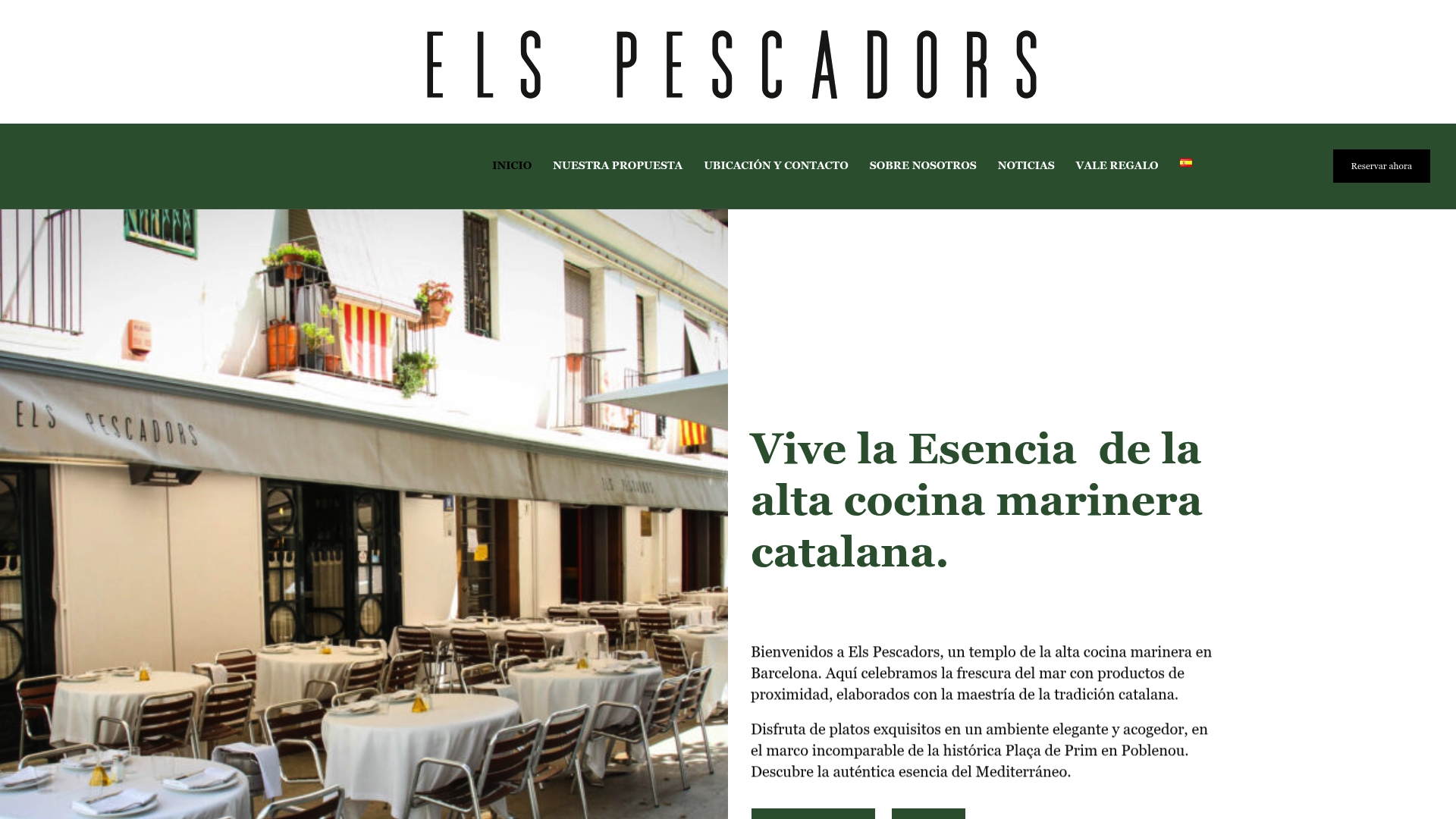
Elspescadors sits in Plaça de Prim in Barcelona’s Poblenou district, one of the city’s most characterful historic squares. The kitchen specializes in Catalan maritime cuisine, which means rice dishes built on fresh catch, seasonal shellfish, and stock made in-house. If you’ve read this far and want to taste what Bomba rice cooked in a proper fish fumet actually feels like, this is the place to do it.
Rice dishes at Elspescadors are available à la carte and as part of tasting menus. For groups, communal seafood dining is available with private menu options designed around the shared-pan format. Seasonal availability applies, particularly for dishes featuring fresh lobster or specific shellfish. Booking in advance is strongly recommended, especially on weekends. Reserve your table or explore the full menu at Els Pescadors.
Useful sources
- The Story of Spain’s Love Affair with Rice (Barcelona Metropolitan) — Covers Albufera, Bomba, Senia, and Calasparra varieties with production context; essential background on Spanish rice culture.
- Spain’s Paella Honors Its Roots in Valencia (Forbes) — Recent coverage of Albufera’s role in authentic paella and the fight to preserve local rice varieties.
- History of Spanish Rice (Globerove) — Concise overview of Moorish introduction and the Arabic etymology of “arroz.”
- Rice Production and Research in Spain (CIHEAM) — Academic source on Bomba’s cultivation difficulty and why it remains the most valued paella rice.
- Arroz a la Valenciana (Wikipedia) — Useful summary of paella’s rural origins and the later emergence of seafood versions.
- Paella as a Way of Life (Saveur) — Long-form piece on Valencia’s relationship with paella, including the role of local water in flavor.
- From Grain to Plate: Valencian Paella (National Geographic) — Covers the 8th-century Moorish cultivation of rice in Albufera and the modern effort to preserve heritage varieties.
- How to enjoy authentic Barcelona rice dishes like a local (Elspescadors) — Practical guide to ordering and tasting regional rice dishes in Barcelona.
- Step-by-step guide to preparing authentic seafood paella (Elspescadors) — Detailed home-cook walkthrough with technique and timing.
- Gastronomía (Feinschmecker) — External gastronomy coverage with a focus on seasonal and regional ingredients across Mediterranean cuisine.
FAQ
What is the traditional Spanish rice dish called?
The most iconic is paella, specifically Paella Valenciana, which originated in the Valencia region using rabbit, chicken, beans, and saffron. Beyond paella, traditional Spanish rice dishes include arròs negre, arròs a banda, arroz caldoso, and arroz al horno, each with distinct regional roots.
Where does Spanish rice originally come from?
Rice was introduced to Spain by the Moors around the 8th century, and the word “arroz” derives from the Arabic ar-ruzz. Cultivation began in the Albufera wetlands near Valencia, which remains the center of Spanish rice production today.
Why is rice so central to Spanish cuisine?
Valencia’s Albufera region produces 90% of Spain’s rice and 26% of all rice grown in Europe, making it a deeply embedded agricultural and culinary staple. Rice dishes also function as social rituals: communal pan service and the shared socarrat are as important as the food itself.
How is Spanish rice different from Mexican rice?
Spanish rice dishes use short-grain varieties like Bomba or Senia, cooked in concentrated stock without stirring, to produce a firm, flavor-saturated grain. Mexican arroz rojo typically uses long-grain rice toasted in oil and simmered until fluffy, with a lighter, more neutral flavor profile.
What rice should you use to make authentic Spanish rice dishes at home?
Bomba is the best choice for beginners: it absorbs two to three times its volume in stock and stays firm even if you slightly overshoot the liquid. Calasparra works well for brothy dishes like arroz caldoso. Avoid long-grain rice entirely; it absorbs liquid differently and produces the wrong texture.