
The difference between arroz caldoso and arroz meloso comes down to two things: how much liquid you use and what texture ends up in the bowl. Caldoso uses roughly 4 parts broth to 1 part rice and is eaten with a spoon, the grain swimming in a lively, aromatic broth. Meloso uses about 2.5–3 parts liquid to 1 part rice and finishes creamy, sauce-clinging, and fork-friendly.
Here is the quick reference before diving deeper:
- Caldoso ratio: approximately 4:1 (liquid to rice) — spoonable, brothy
- Meloso ratio: approximately 2.5–3:1 (liquid to rice) — creamy, unctuous
- Utensil: spoon for caldoso, fork for meloso
- Timing: caldoso must be served immediately; meloso rests 5–8 minutes before serving
The sections below cover rice selection, stirring technique, common mistakes, and how each style plays out in a professional kitchen.
Key Takeaways
The single most important distinction between arroz caldoso and arroz meloso is the liquid-to-rice ratio: 4–5:1 produces a spoonable, brothy dish served immediately, while 2.5–3:1 produces a creamy, fork-ready dish that finishes with a 5–8 minute rest.
| Point | Details |
|---|---|
| Liquid ratio is everything | Caldoso uses 4–5:1 liquid to rice; meloso uses 2.5–3:1 — measure before you start. |
| Utensil signals the style | Spoon for caldoso, fork for meloso — the ratio determines which one you reach for. |
| Timing is critical for caldoso | Serve caldoso the moment it leaves the heat; resting even briefly thickens the broth. |
| Rest is required for meloso | Cover and rest 5–8 minutes after 15–18 minutes of cooking to finish the creamy texture. |
| Elspescadors | The Barcelona kitchen serves both styles with fresh local seafood and house-made stocks. |
Table of Contents
- What makes arroz caldoso different in texture and technique?
- What is arroz meloso, and how does it differ from risotto?
- Side-by-side: caldoso vs. meloso at a glance
- How to get each texture right at home
- Classic dishes for each style
- How Elspescadors cooks and serves these rice styles
- How ingredient absorption affects your final texture
- Regional and cultural roots of each style
- When to choose one style over the other
- Taste it at Elspescadors in Barcelona
- Sources
- FAQ
What makes arroz caldoso different in texture and technique?
Arroz caldoso is, at its core, a rice that swims. The grain cooks in an abundant broth and stays there — you eat it from a deep bowl with a spoon, and the liquid is as much the point as the rice itself. Think of it as the Spanish cousin of a rice soup, but with a more intentional, aromatic base.
The ratio sits at roughly 4–5 parts liquid to 1 part rice, though the exact amount shifts depending on your ingredients. Clams and mussels release water as they open, effectively adding liquid to the pot. A heavily reduced fish stock, on the other hand, can push the dish toward pasty if you are not careful.
For grain selection, short-round varieties work best. They absorb flavor without disintegrating, and they hold their shape even in a generous amount of broth. Bomba and senia are the most common choices in Spanish kitchens.
Technique points for caldoso:
- Sauté your sofrito and proteins first, then add the rice and toast it briefly before adding hot broth all at once
- Cook over medium-high heat for 16–18 minutes without covering
- Avoid stirring once the rice is combined with the broth — agitation thickens the liquid and works against the spoonable character you want
- Serve immediately; the rice keeps absorbing broth off the heat, and within minutes the dish shifts from caldoso to something closer to meloso
Pro Tip: If your stock is gelatinous (made from fish heads or meat bones), dilute it with water or a lighter aromatic broth before using it in caldoso. A heavy stock turns the dish gluey rather than spoonable.
The service timing is non-negotiable for caldoso: restaurant chefs plate it the moment it leaves the heat. Even a five-minute wait on the stove changes the balance entirely.
What is arroz meloso, and how does it differ from risotto?
Arroz meloso sits between a dry paella and a soupy caldoso. The texture is creamy and sauce-clinging — the rice grains are coated rather than swimming, and the dish holds its shape on a fork without being stiff. “Meloso” translates roughly to “honeyed” or “unctuous,” which captures the mouthfeel well.
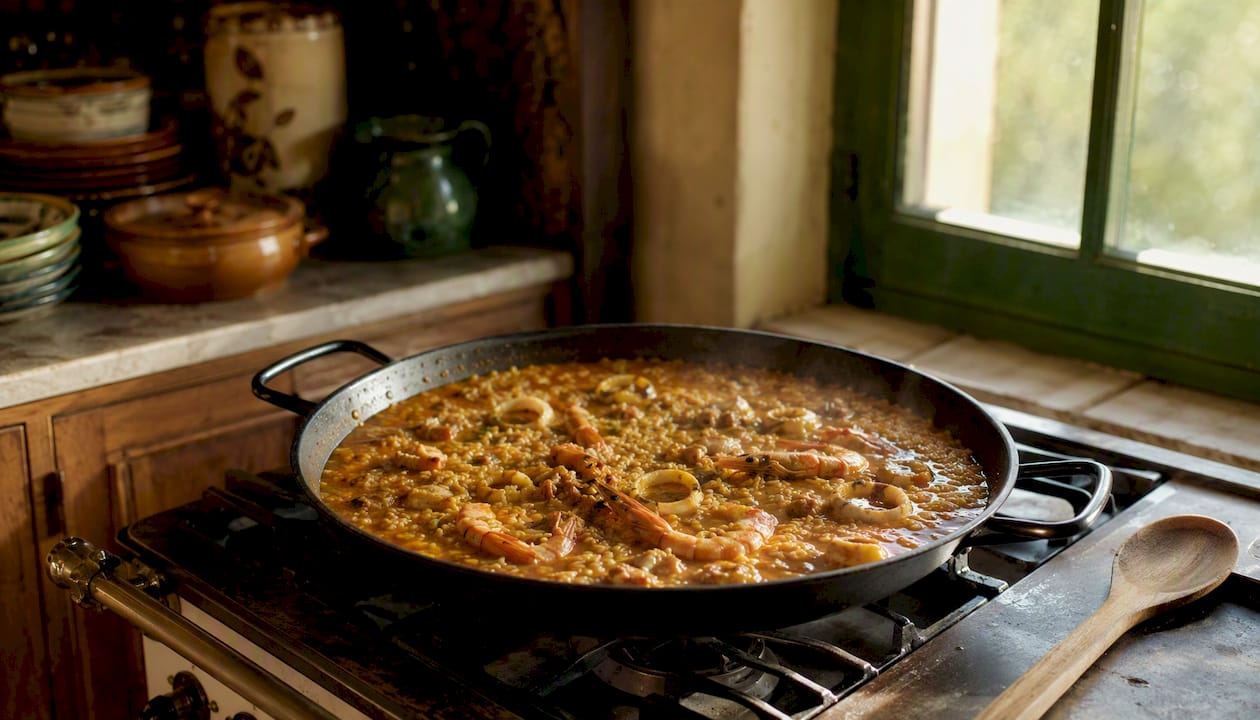
The liquid ratio is lower: approximately 2.5–3 parts broth to 1 part rice. That smaller margin means precision matters more. Add too much and you slide into caldoso territory; too little and the rice dries out before it finishes cooking.
The creaminess in meloso does not come from butter or Parmesan the way Italian risotto achieves it. It comes from the starch released by the rice itself and from the natural gelatin in your ingredients — a prawn head stock, a cuttlefish braise, or a mushroom reduction all contribute body that binds the sauce around the grain. That is a meaningful technical distinction: you are coaxing the dish into creaminess through ingredient selection and gentle agitation, not through a finishing step.
Technique points for meloso:
- Add liquid in stages rather than all at once, keeping the heat at medium
- Stir gently and occasionally to encourage starch release without breaking the grain
- Cook for approximately 15–18 minutes, then remove from heat
- Cover and rest for 5–8 minutes — this is where the texture finishes
Pro Tip: For a richer meloso, use a stock made from roasted prawn shells or fish bones. The natural gelatin it carries does more for creaminess than any amount of stirring.
The resting step is what separates a properly made meloso from one that looks right on the stove but turns gluey on the plate. Covered rest lets the grain finish absorbing liquid while the starch settles into a nappe-like consistency.
Side-by-side: caldoso vs. meloso at a glance
| Feature | Arroz Caldoso | Arroz Meloso |
|---|---|---|
| Final texture | Brothy, spoonable | Creamy, sauce-clinging |
| Liquid:rice ratio | 4–5:1 | 2.5–3:1 |
| Recommended grain | Short-round (Bomba, Senia) | Short-round, high-starch |
| Stirring | Minimal once combined | Gentle, occasional |
| Utensil | Spoon | Fork |
| Typical ingredients | Lobster, clams, chicken, beans | Shellfish, cuttlefish, mushrooms |
| Ideal service timing | Immediately off the heat | After 5–8 min rest |
A few conclusions worth keeping in mind:
- Pick caldoso when you want the broth to be the star — a deeply flavored seafood stock deserves to be tasted, not just absorbed
- Pick meloso when presentation matters or when you are cooking for guests who expect a composed, restaurant-style plate
- Caldoso forgives a slightly longer cook time better than meloso does, but it punishes any delay in serving
- Meloso rewards patience during the rest; pulling it too early leaves the texture thin
How to get each texture right at home
Caldoso step by step
- Build a sofrito (onion, tomato, garlic) in a wide, deep pan over medium heat until it darkens and concentrates
- Add your proteins (seafood, chicken, or legumes) and sear briefly
- Add the rice and stir for 1–2 minutes to toast the grain
- Pour in hot broth at a 4:1 ratio — all at once — and raise heat to medium-high
- Cook uncovered for 16–18 minutes; do not stir after the first minute
- Taste for salt, plate immediately into deep bowls, and serve with a spoon
Common mistakes: using a stock that is too reduced (it thickens the broth), stirring repeatedly (it releases starch and muddies the liquid), and letting the pot sit before serving.
Adjust your liquid upward when using clams, mussels, or watery vegetables — they release liquid during cooking, but not always enough to compensate for what the rice absorbs.
Meloso step by step
- Build a sofrito and sear proteins as above
- Add rice and toast for 1–2 minutes
- Add liquid in two or three additions rather than all at once, starting with about half the total
- Stir gently every couple of minutes to encourage starch release
- Cook over medium heat for 15–18 minutes, adding liquid as needed to maintain a loose, creamy consistency
- Remove from heat, cover tightly, and rest for 5–8 minutes before serving
Common mistakes: adding all the liquid at once (you lose control of the final texture), skipping the rest (the dish stays thin), and using a grain that is too long (it does not release enough starch).
Classic dishes for each style
Traditional Spanish rice dishes split naturally between these two styles, and knowing which format suits which ingredient makes the choice straightforward.
Classic caldoso dishes:
- Arroz caldoso de bogavante (lobster rice) — the broth carries the shellfish flavor and the lobster shells perfume every spoonful
- Arroz caldoso de almejas y gambas (clams and prawns) — a lighter, quicker version suited to weeknight cooking
- Arroz caldoso de pollo y judías (chicken and white beans) — a cold-weather staple from inland Spanish kitchens
Classic meloso dishes:
- Arroz meloso de mariscos (mixed shellfish) — the gelatin from prawn heads and cuttlefish gives the sauce its body
- Arroz meloso de setas (wild mushrooms) — earthy, concentrated, and well-suited to a wine pairing; a full-bodied white or a light red works well alongside the umami depth (for pairing ideas, food and wine pairing guides can help you match the weight of the sauce to the right glass)
- Arroz meloso de pato y foie — a richer, restaurant-format dish where the fat from the duck contributes to the unctuous finish
Caldoso suits a cold afternoon or a casual family table where the pot goes to the center and everyone ladles their own. Meloso is the format for a dinner where plating matters — it holds its shape long enough to compose on the plate and photograph well.
How Elspescadors cooks and serves these rice styles
At Elspescadors, rice is not a side dish — it is the centerpiece of the menu, prepared with the same attention given to the freshest catch of the day. The kitchen works with locally sourced seafood from the Barcelona coast, and the stocks are built fresh from shells, bones, and aromatics rather than from concentrate.
A few things the professional kitchen does differently from most home recipes:
- Stock is tasted and adjusted before service, not just before cooking — a stock that reads as balanced cold will intensify as it reduces in the pan
- For caldoso, the kitchen times service to the minute; a caldoso that waits even briefly in the pass loses its defining character
- For meloso, the resting period is treated as part of the cook, not an afterthought — the pan comes off heat and is covered while the next course is plated
Pro Tip: In a restaurant kitchen, caldoso is often finished in individual portions rather than a shared pot, precisely because the timing window is so narrow. At home, serve directly from the pan into warmed bowls the moment it is ready.
The Catalan seafood tradition that shapes Elspescadors’ menu treats the broth in caldoso as a finished product in itself — it should taste complete before the rice even goes in.
How ingredient absorption affects your final texture
Not all ingredients behave the same way in the pot, and that variability is one of the most common reasons a home cook’s caldoso turns out thicker than expected or a meloso ends up soupy.
Shellfish like clams and mussels release significant liquid as they open — sometimes enough to shift your effective ratio by half a part. Vegetables with high water content (zucchini, tomatoes, peppers) do the same. If your recipe calls for a 4:1 ratio and you are cooking with a full kilo of clams, start closer to 3.5:1 and adjust from there.
Gelatinous ingredients work in the opposite direction. Fish heads, prawn shells, and meat bones release collagen that thickens the cooking liquid as it reduces. That body is an asset in meloso — it contributes to the creamy finish without any added fat. In caldoso, the same gelatin can turn the broth sticky and heavy, which is why a lighter, aromatic stock serves the dish better.
The practical rule: taste your stock before you measure your ratio. If it coats a spoon lightly, dilute it for caldoso. If it is thin and bright, it is ready to use as-is for either style.
Regional and cultural roots of each style
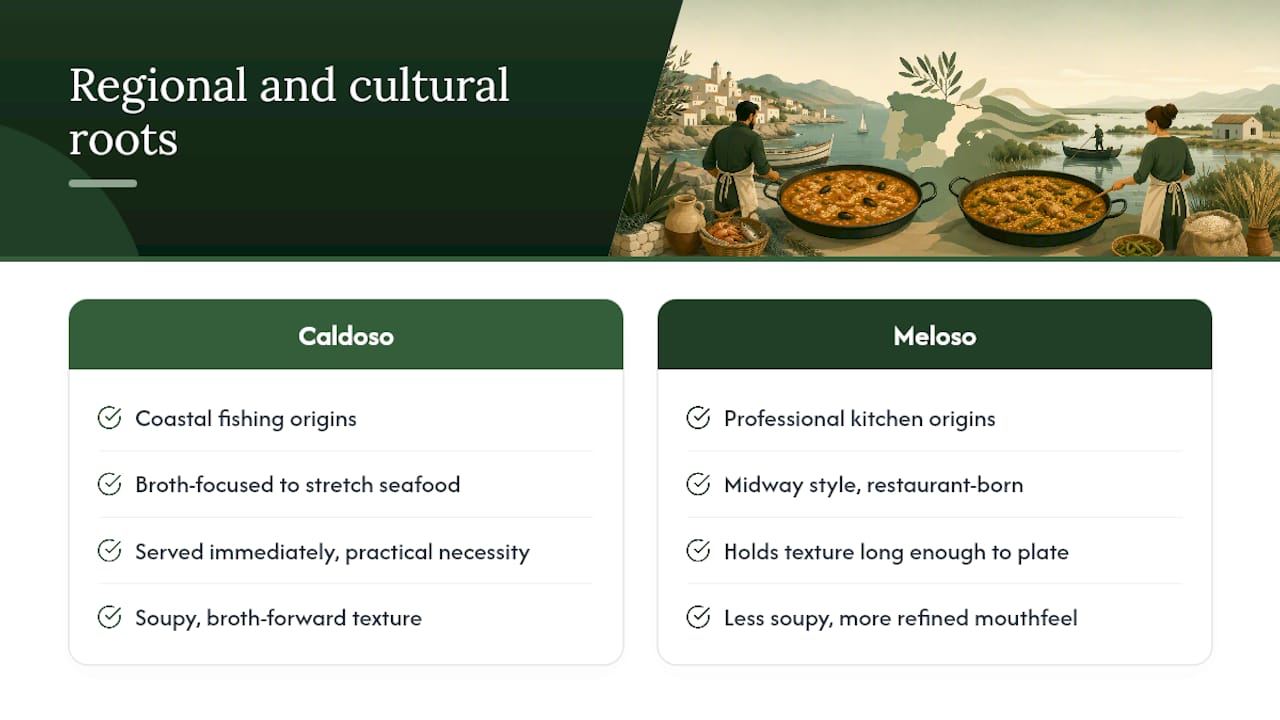
Caldoso has its clearest roots in port and fishing communities along the Spanish coast, where the day’s catch went directly into a pot with water, aromatics, and whatever rice was on hand. The broth was the point — a way to stretch expensive seafood across a larger table. Immediate service was practical necessity, not culinary preference.
Meloso is a more recent format in the restaurant sense. Cookery resources trace it as a midway style that gained popularity in professional kitchens because it holds its texture long enough to plate properly and reads as more refined than a soupy caldoso. It became the format of choice for tasting menus and upscale dining rooms across Catalonia and Valencia.
Regional variation is real. In Valencia, caldoso tends toward a lighter, cleaner broth with a focus on the rice grain itself. In Catalonia, the sofrito is darker and more concentrated, and the stock often carries more body from shellfish or fish bones. Along the Andalusian coast, caldoso can include chickpeas or potatoes, pushing it closer to a stew. Meloso, by contrast, is more consistent across regions — the technique demands precision that leaves less room for local improvisation.
When to choose one style over the other
Caldoso is the right call when the broth itself is exceptional — when you have a lobster carcass, a bag of prawn heads, or a fish stock that smells like the sea. The dish exists to showcase that liquid. Meloso makes more sense when you want a composed plate, when you are cooking for guests who expect a restaurant-style presentation, or when the main ingredient (mushrooms, cuttlefish, duck) benefits from a clinging sauce rather than a swimming one.
The one-line rule: if you would drink the broth on its own, make caldoso. If the ingredient needs a sauce to carry it, make meloso.
Skill level matters too. Caldoso is more forgiving during cooking but punishes any delay in serving. Meloso demands more attention at the stove but gives you a few extra minutes of grace once it rests.
Taste it at Elspescadors in Barcelona
Cooking either style at home is genuinely rewarding, but there is a version of this experience that requires no measuring cups or resting timers. At Elspescadors, the kitchen in Barcelona’s Poblenou district prepares both caldoso and meloso rice dishes using fresh, locally sourced seafood and stocks built from scratch each day.
Whether you are planning a private dinner, a group celebration, or simply want to taste what a properly timed caldoso tastes like when it arrives at the table at exactly the right moment, the restaurant offers group seafood dining options as well as à la carte and tasting menus. Book a table at Elspescadors and let the kitchen handle the ratios.
Sources
- Diferencias entre arroz meloso y arroz caldoso | Arroz Brazal
- Cómo hacer un arroz caldoso perfecto. Recetas para triunfar | ABC Recetas
- Cómo diferenciar un arroz meloso de un arroz caldoso | Cadena SER
- Diferencias entre arroz caldoso, meloso y seco | Hola Cocina
- ¿Qué diferencia hay entre arroz meloso y caldoso? | Como Cocinar y Comer
- Arroz meloso vs caldoso vs seco: diferencias, cuál pedir y por qué cambia tanto la experiencia | Lestibador
FAQ
What is the main difference between arroz meloso and arroz caldoso?
The core difference is the liquid-to-rice ratio and the resulting texture: caldoso uses roughly 4–5 parts broth to 1 part rice and is eaten with a spoon, while meloso uses 2.5–3 parts and finishes creamy enough to eat with a fork.
What does “arroz meloso” mean?
“Meloso” means honeyed or unctuous in Spanish, describing the creamy, sauce-clinging texture the dish achieves through starch release from the rice and natural gelatin from the cooking ingredients.
How do you make arroz meloso come out creamy?
Use a short-round rice variety, add liquid in stages, stir gently to encourage starch release, and cover the pan for a 5–8 minute rest after cooking — the rest is where the creamy texture actually finishes.
What type of rice works best for arroz meloso?
Short-round, high-starch varieties such as Bomba or Senia are the standard choice; their starch content is what produces the unctuous, sauce-binding texture that defines a well-made meloso.