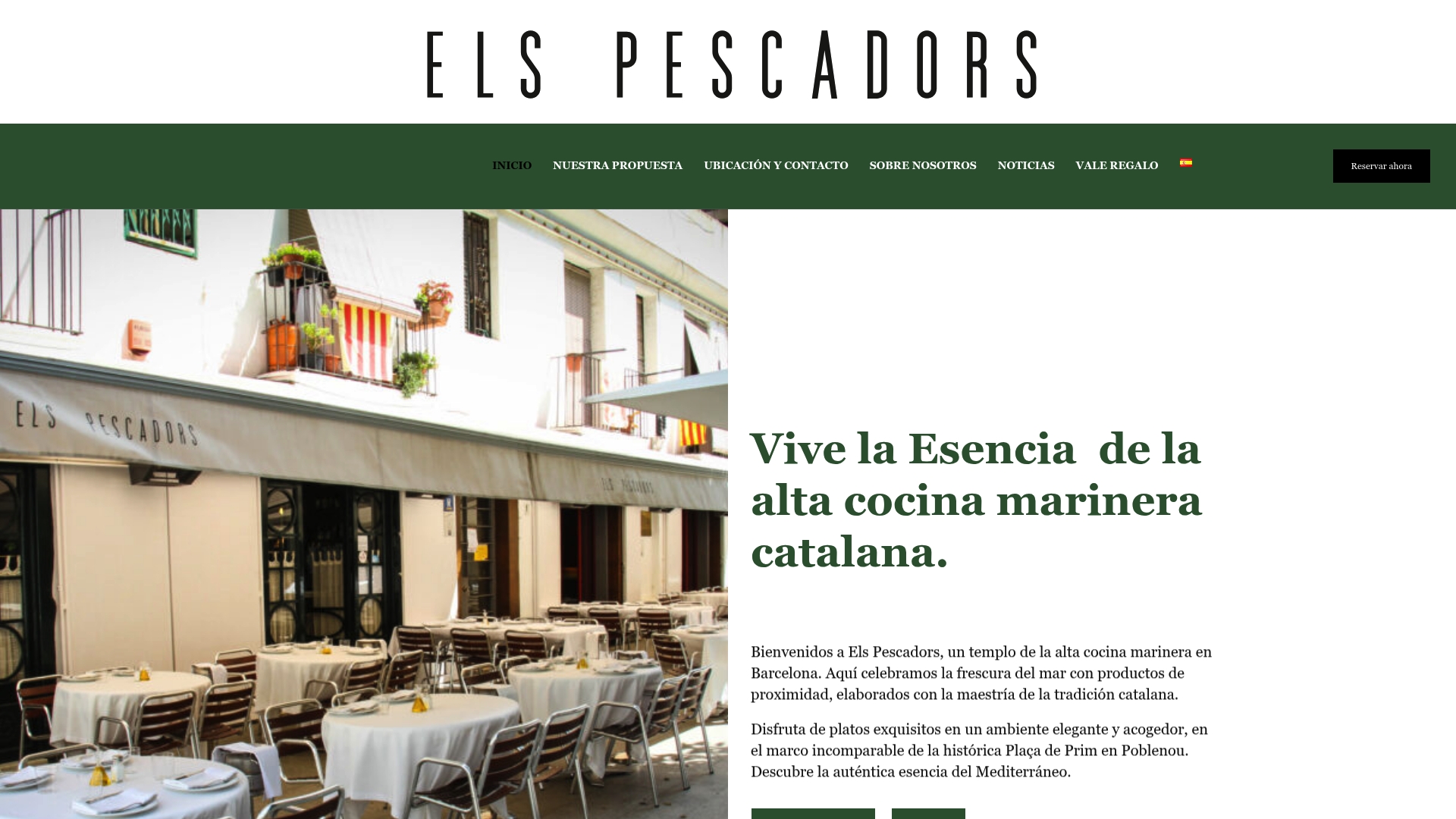
La Boqueria is the landmark: central, loud, photogenic and packed. Sant Antoni is the neighborhood market: bigger as a building, calmer on the floor and used mostly by people who live nearby. Go to La Boqueria if you want the spectacle once, and to Sant Antoni if you want to see how Barcelona shops. If what you really want is to sit down and eat the fish you have just admired on the ice, the answer is a table at Els Pescadors in Plaça de Prim, in Poblenou, where the catch arrives as a plated meal rather than a counter snack.
TL;DR
- La Boqueria sits on La Rambla, has hundreds of stalls and draws millions of visitors a year. Go early on a weekday or accept the crowd.
- Sant Antoni is in a residential neighborhood, feels more local and is easiest to enjoy as part of a longer walk. Its food stalls close on Sundays, when a book market takes over the surrounding streets.
- Both run roughly 8:00 to 20:30 Monday to Saturday according to the city, but check each market’s own page before you travel.
- Markets are for browsing, tasting and shopping. For a seated seafood or rice meal, book a table: our Menú de Temporada is €39 per person.
Table of Contents
- The two markets at a glance
- La Boqueria: the landmark
- Mercat de Sant Antoni: the neighborhood market
- Crowds, prices and what to eat
- When to go
- So which one should you choose?
- From market stall to table in Poblenou
- Our view on markets and tables
- FAQ
- Sources
The two markets at a glance
| La Boqueria | Mercat de Sant Antoni | |
|---|---|---|
| Location | La Rambla, Raval, Ciutat Vella | Carrer del Comte d’Urgell 1, Eixample |
| Feel | Landmark, very busy, international | Neighborhood market, calmer, mostly locals |
| Size | Over 300 stalls | 235 establishments, including non-food and books |
| Best for | A first visit, a quick bite at the counter | A slower look, local shopping, a long walk |
| Sundays | Closed | Food stalls closed, book market outside |
The figures come from the city: the Barcelona.cat page on La Boqueria counts over 300 stalls, and the City Council’s 2018 press note counts 235 establishments in the renovated Sant Antoni, of which 52 sell fresh food. The rest are Encants non-food stalls, Dominical book stalls, a supermarket and a non-food shop. That detail matters: Sant Antoni is a big building, but only a fraction of it is the food market you are picturing.
La Boqueria: the landmark
The city’s own history page says La Boqueria is first mentioned in the 13th century. The current cast-iron structure was designed by municipal architect Josep Mas and officially opened in 1840, with the roof finished in 1916, on the site of the former Convent of Sant Josep, which burned in 1835 (Barcelona.cat). The stalls sell fruit and vegetables, fish and seafood, meat, preserves, pulses, cheese, Catalan specialties and world cuisine.
How busy is it, really?
Very. According to the Barcelona City Council (October 2024), La Boqueria has 178 establishments, three times Sant Antoni’s 54, and received 23,273,738 visitors in 2023, which is 370% more than Sant Antoni. The same release says the city restricts entry to organized groups of 15 or more on Fridays and Saturdays from April to October, and a reform aims to rebalance the market toward local use.
What this means on the ground: the stretch just inside the La Rambla entrance is the most crowded. Walking deeper into the market, toward the Plaça de la Gardunya side, is a common local tip, and the feel changes noticeably once you leave the front corridor. Keep your phone and wallet secure in the entrance area, as in any very crowded place.
Address and hours
The City Council lists the market as Mercat Boqueria – Sant Josep at La Rambla 89, with hours Monday to Saturday 08:00 to 20:30 and a few additional openings around December and early January. It also lists an information point, a cooking classroom, online sales and home delivery. The details are on the official Mercats de Barcelona page. The closest metro station is Liceu, on line L3.
Mercat de Sant Antoni: the neighborhood market
Sant Antoni is, according to the City Council, Barcelona’s largest market, combining the food market, the Encants and the Dominical. Antoni Rovira i Trias designed it on Ildefons Cerdà’s plan. Construction began in 1872 and it was inaugurated in 1882. The building is a cross-shaped iron nave with an octagonal dome 28 meters high. The 2009 to 2018 refurbishment restored the glazed-ceramic roof and added air conditioning that uses groundwater, and the remains of the old Sant Antoni bastion can be visited on the -1 floor.

The food side is smaller than La Boqueria’s, but it covers the basics well: the market’s own food stall directory lists poultry, fish and seafood, meat, fruit and vegetables, olives and preserves, and a home-delivery phone service.
What the visit feels like
Lonely Planet describes Sant Antoni as a 10-minute walk from La Boqueria where the Rambla crowds quickly vanish, reached by metro line 2 to Sant Antoni. You will hear more Catalan and Spanish than English, you will see locals with shopping trolleys, and you will find fish counters that turn over daily to serve regular customers rather than photographers.
The practical services are good too. The City Council’s Barcelona guide lists a parking discount with a purchase ticket, an information point, online sales and home delivery, a cooking classroom, a cash machine, a climate refuge and a supermarket. It also says the market is accessible for people with physical disabilities. Stalls run Monday to Saturday 8:00 to 20:30 per that guide, though other guides list shorter Saturday hours, so confirm on the market’s own site before you plan around the evening.
Sundays at Sant Antoni
On Sundays the food stalls close and the surrounding streets host the Mercat del Llibre Dominical, with second-hand books, comics, magazines, posters, stamps, vinyl and collectibles, traditionally on Sunday mornings (Lonely Planet). It is a great browse, but it is not the day to plan a food shop. If your only free day is Sunday, neither market will give you fresh fish, and a restaurant is the better plan.
Crowds, prices and what to eat
Price comparisons between the two markets are mostly anecdotal, and they shift with the season, the stall and the time of day. A few patterns hold up across sources:
- Stalls right at La Boqueria’s entrance cater to quick, impulse purchases such as cut fruit, juice and sliced ham. Those are the items most visitors buy and the ones where the location shows up in the price.
- Deeper in the market and at Sant Antoni, you are buying by the kilo from stalls with regular customers, which is where the market earns its reputation for quality produce.
- Quality at Sant Antoni is not automatically cheaper. Some specialty stalls charge more than their Boqueria equivalents, so compare the per-kilo sign before you order.
The lesson is simple: look at the per-kilo price, ask for a weight, and do not buy anything from a stall that does not display a price. Fish counters, in particular, are where the difference between a market and a restaurant becomes clear. A market sells you raw product to cook yourself. If you are staying in a hotel or short-term rental without a proper kitchen, a fish counter is a pleasure to look at and not much more.
Eating at the market
Both markets have counter bars and small sit-down places where the produce on the next stall becomes breakfast or lunch. Early in the day these are a very good way to eat a Catalan breakfast, including the substantial knife-and-fork breakfast, the esmorzar de forquilla, that Sant Antoni is known for. They tend to be informal, standing or stool seating, short menus and no reservations. That is the charm, and it is also the limit: if you want a tablecloth, a wine pairing, a rice dish cooked for the table or a menu that moves through courses, a market counter is not built for it.
When to go
- La Boqueria: early on a weekday, ideally from 8:00 to about 10:00, before tour groups arrive. Lonely Planet recommends the same window and heading toward the back for fewer crowds (Lonely Planet). Plan about an hour. Weekend late mornings are the busiest.
- Sant Antoni: any weekday morning or early afternoon works. Pair it with a walk through the surrounding streets of the neighborhood rather than treating it as a photo stop.
- Fish: Monday is the weak day for fresh fish in market stalls, since fresh fish generally arrives from Tuesday. Plan your fish-focused visit for Tuesday to Saturday.
- Sunday: neither market sells fresh food. Book a restaurant instead.
So which one should you choose?
Choose La Boqueria if it is your first visit to Barcelona, you want the sights, colors and the sheer scale of a historic market, and you are happy to go early or to push past the first few stalls.
Choose Sant Antoni if you want a quieter look at everyday Barcelona, enjoy walking neighborhoods, or are in town on a day when you can combine the market with the surrounding streets.
Visit both if you are in Barcelona for several days. They are about ten minutes apart on foot, and the contrast is the best way to understand how the city eats. Many visitors do La Boqueria first thing and Sant Antoni on a different day at a slower pace.
If you are a seafood or rice lover, use either market as the starting point, not the finish line. Seeing the catch on the ice tells you what is in season. Eating it properly, cooked by a kitchen that works with it every day, is a separate pleasure.
From market stall to table in Poblenou
We cook in the same Catalan maritime tradition that the fish counters display. Els Pescadors is in Plaça de Prim, in the historic Poblenou district, and our kitchen works with fresh fish, seafood and traditional rice dishes made with seasonal, locally sourced ingredients. If you liked the idea of the market, our guide to Barcelona’s markets and cocina de mercado explains how that market-first approach shapes a menu, and our piece on why Poblenou became Barcelona’s food hub shows why this neighborhood is worth the metro ride.
Here is how to match your plans to our formats:
- A relaxed seafood lunch: the Menú de Temporada is €39 per person and follows what is in season.
- A longer evening, a couple or a celebration: the Menú Degustación is our tasting menu. Our guide to choosing between à la carte and a tasting menu helps you decide.
- Choosing dish by dish: La Carta and the Carta del Día, which follows the daily catch.
- Teams and celebrations: the Menú para Grupos is built for group dining and private events.
If you are planning a market morning followed by lunch, book your table before you go, so the second half of the day is settled and you can browse without watching the clock.
Our view on markets and tables
We love markets. Every morning’s menu starts with the same question a market shopper asks: what came in fresh, and what is in season?
That is why we do not think of La Boqueria and Sant Antoni as rivals to a restaurant. They are the front of the story. They show you the product, the colors, the names of the fish. The back of the story is what a kitchen does with it: a rice cooked slowly to the right point, a seasonal menu that changes with what the sea gives, a tasting menu that lets you eat across a whole evening.
We chose Plaça de Prim in Poblenou because the setting matters as much as the plate. A historic square, a table that is yours for the evening and a menu built around authentic Catalan maritime cuisine make a different kind of experience from a counter bite between stalls. For visitors who want to taste Barcelona properly and for locals who want high-quality seafood and rice dishes, that is the meal we cook.
Visit the markets for the spectacle. Then come and sit down.
YellowRock
FAQ
Is La Boqueria worth visiting or is it just a tourist trap?
It is worth one visit, especially if you go early on a weekday and walk beyond the entrance stalls. The building and the produce are real, and the city has introduced measures such as limits on large organized groups on some days to rebalance it toward local use (Barcelona City Council). If you dislike crowds, Sant Antoni is the calmer alternative.
Is Sant Antoni market open on Sundays?
The food stalls are closed on Sundays. The surrounding streets host the Sunday book and collectibles market, traditionally in the morning (Lonely Planet). For a Sunday meal, a restaurant reservation is the safer plan.
How far apart are La Boqueria and Sant Antoni?
About a 10-minute walk, according to Lonely Planet. La Boqueria’s nearest metro stop is Liceu (L3), and Sant Antoni is served by metro line 2. Doing both in a single morning is possible, though most people prefer to give each its own time.
Can I eat a full seafood meal at the markets?
You can eat very well at the counters and small bars, especially at breakfast and lunch, but they are built for informal, quick service. For a seated, multi-course seafood or rice meal, book a restaurant. Our Menú de Temporada at €39 per person is a good starting point.
Sources
- La Boqueria | Barcelona.cat
- Reform of the Boqueria Market Seeks Balance with Tourism Activity | Barcelona City Council
- Mercat Boqueria – Sant Josep | Mercats de Barcelona
- Mercat de Sant Antoni | Mercats de Barcelona
- Mercat Sant Antoni | Barcelona Guide
- Ajuntament de Barcelona press note on Sant Antoni, 30 January 2018
- Paradas de Alimentación | Mercat de Sant Antoni
- Discover the best markets to visit in Barcelona | Lonely Planet