Catalan cuisine now functions as living intangible cultural heritage, not just a regional cooking style. The anchor is the Corpus de la Cuina Catalana, a scientifically vetted inventory of recipes and ingredients, backed by a 2026 government draft law protecting culinary arts as cultural patrimony. Because that recognition is ongoing rather than fixed, the repertoire keeps absorbing new dishes even as its historic core stays protected.
TL;DR:
- The patrimonial classification requires dishes to show at least 50 years of continuous domestic practice and regional variation before gaining recognition.
- The Corpus de la Cuina Catalana documents over 1,100 recipes linked to specific ingredients, emphasizing a systems view of regional culinary patterns.
- Heritage dishes include suquet de peix, mar i muntanya, fideuà, escalivada, and botifarra amb mongetes, with ingredient variations reflecting local practices.
- Preservation techniques such as salting, drying, and fermentation are mainly passed through families, complemented now by programs that capture and teach these skills.
- Catalan cuisine remains adaptable, with new practices like gazpacho being integrated into the patrimonial system as community adoption evolves.
Table of Contents
- What Does “Cocina Catalana Patrimonial” Actually Mean?
- The Corpus de la Cuina Catalana: What It Is and Why It Matters
- Which Dishes and Ingredients Define Catalan Culinary Identity?
- How Are Traditional Catalan Cooking Techniques Passed Down?
- Who Governs Catalan Culinary Heritage Today?
- Does Patrimonial Status Mean Catalan Food Can’t Change?
- How Els Pescadors Practices Patrimonial Maritime Cooking
- A Reasonable Way to Think About Preserving Living Food Traditions
- Primary Sources and Further Reading
- Sources
- FAQ
What Does “Cocina Catalana Patrimonial” Actually Mean?
Heritage practitioners don’t treat “patrimonial” as a marketing label. It describes a specific classification process: a dish, technique, or ingredient earns heritage status when it shows sustained domestic practice, community recognition, and documented continuity over time. That framing, sometimes called Catalan heritage cuisine, separates it from generic “traditional food” branding you see on restaurant menus everywhere.
The historical roots run deep. Medieval Catalan cookbooks, including the 14th century Llibre de Sent Novi, already recorded sauces and techniques that show up in kitchens today. Centuries of Mediterranean trade brought almonds, saffron, and dried fruit into Catalan pantries, while the coastline shaped a parallel seafood tradition that never fully merged with, nor fully separated from, the mountain kitchen. That tension between sea and land cooking is precisely what gives Catalan gastronomy its most distinctive structural feature.
A working threshold matters more than most readers expect: experts generally require roughly 50 years of continuous domestic practice before classifying a dish as “traditional” for heritage documentation. That number isn’t arbitrary. It filters out short-lived food trends and restaurant inventions, keeping the patrimonial label reserved for practices that have actually survived a generation or two inside real households.
What gets weighed when something is proposed for inclusion:
- Evidence of household or community preparation across multiple generations
- Documented regional variation rather than a single fixed recipe
- Connection to locally available ingredients or breeds
- Recognition by cooks and communities, not just chefs or critics
- Historical or written record supporting the practice’s age
That last point explains why oral tradition alone rarely secures a formal listing. Reviewers want a paper trail, even a thin one, alongside the living practice.
The Corpus de la Cuina Catalana: What It Is and Why It Matters
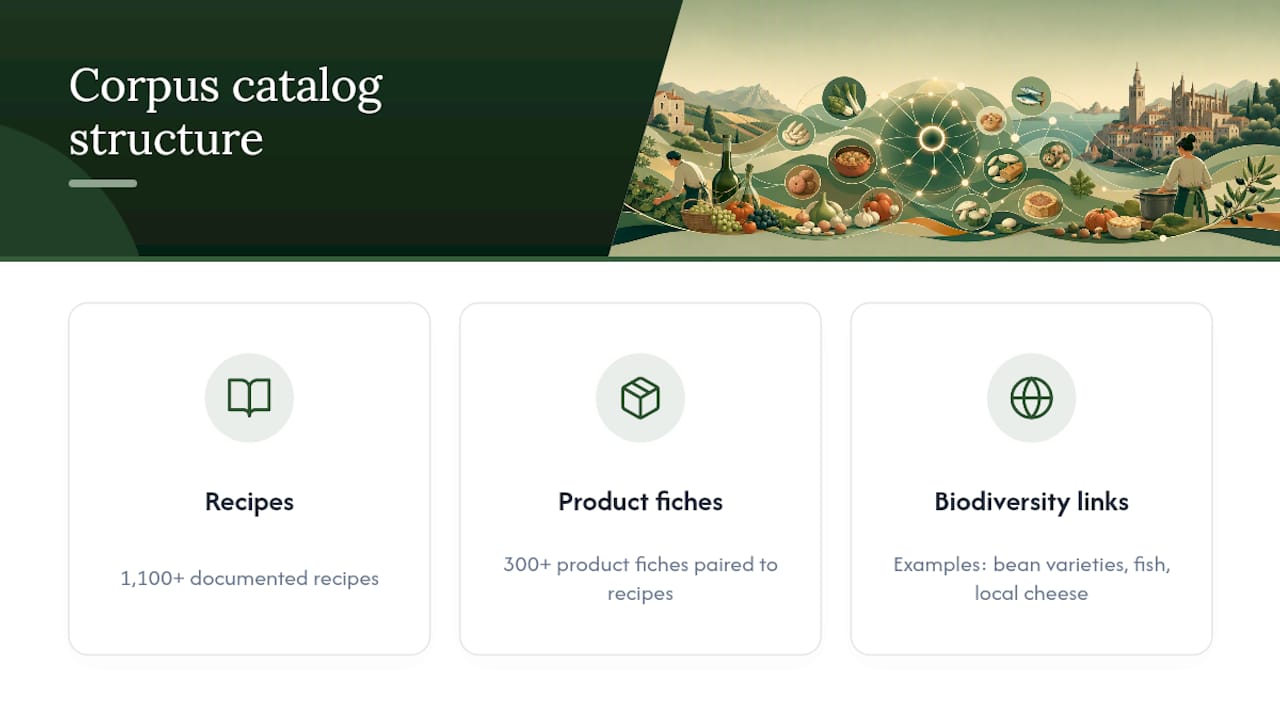
The Corpus de la Cuina Catalana is the reference inventory for the entire patrimonial project. Its fourth edition documents more than 1,100 recipes and adds over 300 product fiches, pairing each recipe with a corresponding record for the raw ingredients behind it. That’s the real innovation: a product fiche might track a specific bean variety, a fish species, or a local cheese, linking the recipe to the biodiversity and know-how that made it possible in the first place.
The work behind the Corpus isn’t casual. It’s produced with input from the Institut Catalan de la Cuina i de la Cultura Gastronomic, alongside specialists in nutrition, anthropology, and ethnobiology. That mix of disciplines is what separates the Corpus from a typical cookbook. A historian traces where a dish appears in old records; an ethnologist confirms what plant or fish variety a regional name actually refers to; a nutritionist notes how preparation methods shifted with modern health guidance.
The Associació Catalana de Ciències de l’Alimentació frames the project’s real contribution well:
Viewing cuisine as a cultural system, rather than a list of recipes, reveals patterns across regions: which ingredients recur, which techniques travel from valley to valley, and which stay stubbornly local.
That systems view is why the Corpus matters beyond nostalgia. It gives researchers, chefs, and policymakers a shared, documented basis for deciding what counts as authentic Catalan culinary tradition, rather than relying on whichever recipe a given family swears is the “real” one.
Which Dishes and Ingredients Define Catalan Culinary Identity?
Ask ten Catalan cooks for the region’s defining dish and you’ll get at least four answers, which is itself revealing. The patrimonial framing doesn’t crown one winner. It documents a cluster of dishes and a recurring cast of ingredients that keep showing up across the territory, adapted to whatever the local coast, valley, or plain provides.
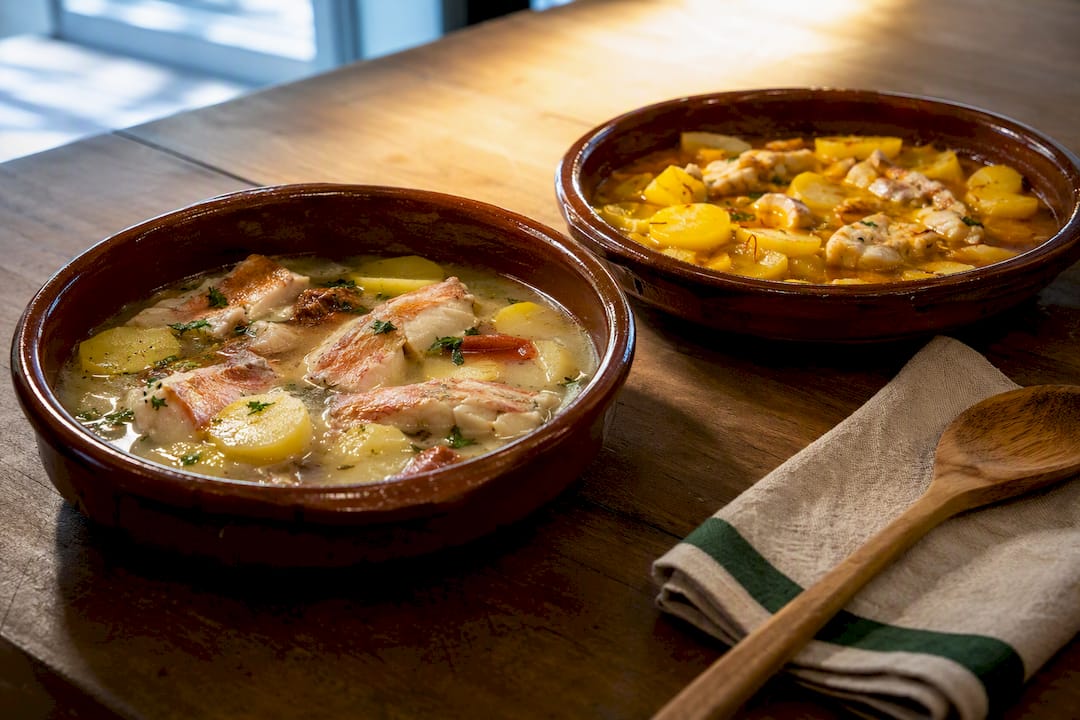
- Suquet de peix. A fisherman’s stew built on potatoes, saffron, and whatever catch is fresh that day. It’s the clearest expression of maritime cooking without heavy French-style sauces.
- Mar i muntanya (sea and mountain). Dishes that combine seafood with meat or poultry, such as chicken with prawns or cuttlefish with meatballs. This pairing is arguably the single most distinctive marker of Catalan cooking: no other Mediterranean cuisine leans on it as a defining structural principle.
- Fideuà. Noodles cooked in the style of paella, born on the Valencian border but firmly adopted into coastal Catalan kitchens.
- Escalivada. Roasted peppers, eggplant, and onion, dressed simply in olive oil. It’s a template dish, showing up as a side, a topping, or a filling depending on the household.
- Botifarra amb mongetes. Pork sausage with white beans, the inland counterpart to the coast’s seafood stews.
Certain ingredient families recur across nearly every regional variant: almonds and hazelnuts (the backbone of the picada sauce base), saffron, salt cod, dried beans, and a short list of local fish and shellfish. The Corpus’s product fiches matter here because they pin down exactly which variety of bean or which cod preparation a recipe assumes, something a generic recipe card never bothers to specify.
Regional variation tells its own story. A suquet made in a Costa Brava fishing village leans on rockfish and a thinner broth, while an inland adaptation might substitute freshwater fish or skip the seafood entirely in favor of a similar potato and saffron base. Neither version is more “correct.” Both get documented, because patrimonial cataloging cares about the range of practice, not a single gold standard.
How Are Traditional Catalan Cooking Techniques Passed Down?
Technique preservation is where patrimonial cuisine gets tested against everyday reality. A recipe written down means little if nobody still knows how to execute the movements behind it, and several core Catalan techniques depend on hands-on repetition more than written instruction.
- The picada, a pounded mix of nuts, garlic, and sometimes bread or chocolate, used to thicken and flavor stews. Getting its texture right takes practice, not a stopwatch.
- Salting and drying, applied to cod and other fish long before refrigeration, still shapes how salt cod dishes get prepared today.
- Fermentation and preserving, from pickled vegetables to cured meats, a family of techniques that connects directly to how Catalan cooks manage seasonal gluts.
- Rice cooking by feel, judging broth ratios and timing for dishes like arròs negre without a fixed formula.
Transmission still runs mostly through families, but it’s no longer the only channel. Agrotourism programs in rural Catalonia now pair visitors with home cooks for hands-on sessions, and several school programs have added cooking units tied explicitly to regional heritage rather than generic home economics. Documentation projects, including recorded oral histories and short instructional videos tied to the Corpus, capture technique details that would otherwise die with a single generation.
Pro Tip: If you want to actually learn a technique rather than just read about it, look for a hands-on cooking session tied to a specific region rather than a general “Catalan cooking class.” The picada, in particular, is nearly impossible to learn from a written recipe alone.
Curious readers can explore how fermentation shapes Catalan gastronomy in more depth, including how preservation methods that started as necessity became flavor signatures in their own right.
Who Governs Catalan Culinary Heritage Today?
Institutional protection has moved fast in the past two years, and the governance picture is more layered than a single “official” body issuing certificates.
The Marca Cuina Catalana brand started as a private initiative, developed and promoted for years by chef and heritage advocate Pepa Aymamí. In 2025, Aymamí ceded the trademark to the Generalitat, which now manages it for a five-year term. That transfer settled one question (who legally controls the brand) while opening another: whether a public agency can sustain the same curatorial rigor a dedicated private advocate built over years.
More consequential is the Projecte de llei del patrimoni cultural immaterial, approved by the Catalan government in 2026. The draft law explicitly names gastronomy and culinary arts as protected categories of intangible cultural heritage, putting food traditions on the same institutional footing as festivals, oral traditions, and craft skills that already had legal protection.
What this dual structure produces, in practice:
- A public brand (Cuina Catalana) for promotion and recognition
- A legal framework (the Projecte de llei) for formal safeguarding and funding priority
- An independent scientific inventory (the Corpus) that neither institution directly controls
That separation is arguably healthy. It keeps the scientific documentation insulated from political cycles, even as public agencies take on more responsibility for promotion and legal protection.
Does Patrimonial Status Mean Catalan Food Can’t Change?
No, and this is where a lot of outside commentary gets the concept backward. Living heritage status assumes revision, not preservation in amber. The Corpus’s own editorial process proves it: gazpacho, a dish with Andalusian roots rather than Catalan ones, has been folded into recent documentation as its consumption became genuinely widespread in Catalan households.
That inclusion sparked real debate. Purists argued it dilutes a Catalan-specific inventory; scholars researching patrimonialization processes point out that heritage systems worldwide function this way, absorbing practices that communities actually adopt rather than freezing a historical snapshot.
A few forces are actively reshaping the domestic repertoire right now:
- Food blogs and social media accelerating exposure to dishes from outside traditional Catalan territory
- Migration bringing new households, and new staple ingredients, into everyday Catalan cooking
- Documented product fiches giving cooks a reference point even as recipes drift and adapt
- Restaurant reinterpretation feeding back into home cooking, sometimes reversing the usual direction of influence
Chefs tracking broader gastronomy trends see the same pattern globally: heritage cuisines that survive are the ones with a documentation system flexible enough to register change, not just defend a fixed canon.
How Els Pescadors Practices Patrimonial Maritime Cooking
Els Pescadors works from the maritime tradition the Corpus documents: suquets, rice dishes, and daily fresh catch prepared with techniques passed down rather than invented for a menu photo. Sourcing follows the season, not a fixed supplier list, which is exactly how the coastal repertoire behind dishes like suquet de peix has always operated.
Running a kitchen this way means constant trade-offs between fidelity and refinement:
- Building the daily menu around whatever local seafood is actually at its peak that week
- Keeping rice and stew techniques close to their traditional execution rather than simplifying them for speed
- Sourcing from regional suppliers instead of defaulting to imported convenience
- Treating tasting menus as a way to introduce visitors to dishes they’d otherwise only find in a home kitchen
That approach connects directly to the Catalan cuisine explored in Barcelona’s traditional flavors, where sea and mountain traditions meet in a working dining room rather than a museum case.
A Reasonable Way to Think About Preserving Living Food Traditions
Protection and evolution aren’t opposites here. The healthiest version of Catalan heritage cuisine documents its past honestly while making room for what people actually cook now. If you want to engage with it directly, check the Corpus itself, buy from producers named in its product fiches, and show up for a hands-on transmission session rather than just reading about one.
— YellowRock
Primary Sources and Further Reading
- Corpus de la Cuina Catalana, 4th edition coverage (La Vanguardia)
- Govern
- Marca transfer analysis (El País)
- Associació Catalana de Ciències de l’Alimentació
If you’d rather taste this heritage than just read about it, Els Pescadors builds its group menus around exactly the maritime dishes documented in the Corpus, and its proposal for private dining is built for readers who want a genuine patrimonial seafood experience rather than a tourist-menu version of it.
Sources
- Más de mil recetas y productos en la nueva edición del ‘Corpus de la Cuina Catalana’ (La Vanguardia)
- Govern
- La Generalitat gestionará la marca ‘Cuina Catalana’ (El País)
- Associació Catalana de Ciències de l’Alimentació (ACCA)
FAQ
What Is the Most Typical Dish From Catalonia?
There’s no single official answer, but suquet de peix and the mar i muntanya dishes come up most often as the clearest expressions of Catalan culinary identity, since they combine local seafood with techniques found nowhere else in Mediterranean cooking in quite the same way.
Is Spanish Gastronomy Recognized as a UNESCO World Heritage Practice?
The Mediterranean diet, which includes Catalan cooking traditions, was inscribed by UNESCO as intangible cultural heritage, but that recognition applies to the broader dietary pattern rather than to Catalan cuisine as a separate, standalone listing.
What Are 10 Traditional Dishes From Catalonia?
A representative list includes suquet de peix, fideuà, escalivada, botifarra amb mongetes, pa amb tomàquet, arròs negre, esqueixada, canelons, crema catalana, and calçots amb romesco, spanning coastal, inland, and dessert traditions documented in the Corpus.
What Are the Four Main Types of Gastronomy Recognized in Culinary Classification?
Culinary traditions are commonly grouped into regional (tied to a specific territory), national, international, and fusion cuisine, with Catalan cooking generally classified as a regional cuisine shaped heavily by its Mediterranean coastline and mountain interior.