Many restaurants in central Barcelona have an English menu, but you can’t count on one everywhere. Catalan law only requires a menu in Catalan. The practical answer is to learn about fifteen words, know three phrases and understand how a Barcelona menu is organized. Then any menu, in any language, becomes easy to read. At Els Pescadors in Plaça de Prim, Poblenou, the formats are simple to choose from: a seasonal menu at €39 per person, a tasting menu, a daily menu and the full carta.
TL;DR
- English menus are common in tourist-oriented and central restaurants. Small cafés and neighborhood bars often have only Catalan or Spanish.
- The law requires menus at least in Catalan. A menu in English is a courtesy, never a right, but you can always ask to be served in Catalan or Spanish.
- Learn one question, ¿Tiene una carta en inglés?, plus the words for rice (arroz, arròs), fish (pescado, peix) and seafood (mariscos, marisc).
- A carta is the full à-la-carte list. A menú is a fixed-price offer. A menú degustación is a tasting menu.
- For allergies, name the exact ingredient and ask staff to confirm. A translation never proves a dish is free of it.
Table of Contents
- Do Barcelona restaurants have English menus?
- What the law says about menu language
- How to ask for an English menu
- How a Barcelona menu is organized
- Rice dishes decoded
- Fish and seafood words that appear on almost every menu
- Allergies and dietary needs: ask, don’t assume
- Local customs that go with the menu
- Where to eat when you want the menu to be easy
- Our point of view: the menu is a conversation
- FAQ
- Sources
Do Barcelona restaurants have English menus?
Often, yes, but not always. English menus are strongest in tourist-oriented and central restaurants. Smaller cafés and traditional neighborhood bars may offer only Catalan or Spanish.
The pattern follows the clientele. Around the Rambla, the Gothic Quarter, the Born and the beach, a printed English menu or a photo menu is normal. A few streets into a residential district, the board on the wall is in Catalan and the waiter answers in Catalan or Spanish. That is not unfriendliness. The place simply serves its neighbors.
A few signs tell you what to expect before you sit down:
- A menu with flags or photos at the door is built for visitors. English will be there.
- A handwritten chalkboard is usually the daily menu, written in Catalan or Spanish, and often only that.
- A QR code may let you switch languages. Open it before you sit and check that the language option exists.
- A short menu with no translation is often a sign of a local place, and often a good one. Ask the server to explain the dishes. Most will.
If you are choosing a place for a special dinner, check the restaurant’s website first. A restaurant with an online menu lets you read it at your own pace, in your own language, with a translator if you need one, before you arrive.
What the law says about menu language
Catalonia’s Consumer Agency states that restaurant menus must be offered at least in Catalan. It also says consumers have the right to be attended to, orally and in writing, in the official language they choose. Official here means Catalan or Spanish.
The rule comes from Article 128-1 of the Catalan Consumer Code (Ley 22/2010). It says consumers may be attended to orally and in writing in the official language they choose, and that required consumer and safety information must be available in Catalan.
What this means for you in practice:
- No restaurant has to give you an English menu. Many do, as a service.
- You can ask for the menu in Spanish if you read it better than Catalan.
- Safety information, including allergen information, must exist. Staff can give it to you, and you should ask for it (see the allergy section below).
How to ask for an English menu
You don’t need Spanish fluency. A friendly question in the local language works better than starting in English, and it costs you five seconds.
- ¿Tiene una carta en inglés? Do you have a menu in English? Not every restaurant in Spain will have one, but asking never hurts.
- ¿Qué lleva este plato? What is in this dish? This is one of four questions worth keeping on your phone.
- ¿Es para compartir? Is it for sharing?
- ¿Está incluida la bebida? Is a drink included? This matters for fixed-price menus.
- La cuenta, por favor. The bill, please.
If the answer is no, ask the server to recommend something. ¿Qué me recomienda? (What do you recommend?) opens the door to the daily catch, the rice of the day and the dishes the kitchen is proudest of.
A translation is also never a full explanation. A literal translation of a dish name can mislead. GidePass gives the example of callos a la madrileña, a traditional tripe stew rather than an ordinary beef casserole. The best tool is still the question.
How a Barcelona menu is organized
Once you know the structure, you can find your way even when you don’t know the words.
Headings
Typical Catalan headings are entrants (starters), plats principals (main courses) and postres (desserts). Spanish menus use entrantes, platos principales and postres. Many menus add separate sections for rice (arrossos or arroces) and for fish and shellfish.

Carta, menú and menú degustación
A carta normally means the full à-la-carte selection. A menú or menú del día commonly means a fixed offer, typically at lunch on weekdays, and it may be written on a board or simply told to you.
A tasting menu, menú degustación, is a sequence of small courses chosen by the kitchen for a fixed price. Our comparison of carta versus tasting menu explains which suits which kind of evening.
Daily catch
“Catch of the day” (pescado del día) signals market availability, not a permanent species. One Barcelona chef told the press that what he serves depends on fresh ingredients, the weather and the fish arriving at the fish auction each day. So the daily fish is often not printed at all. Ask what came in.
Portion sizes
Portion words matter when you order to share. A tapa is a small portion, a media ración a half portion and a ración a full portion, and raciones are often shared. Order a few dishes first and add more as you go. Locals order in stages.
Rice dishes decoded
Rice is central to Catalan maritime cooking, and the names tell you how it is cooked. The Generalitat de Catalunya publishes an official multilingual restaurant vocabulary in Catalan, Spanish, English and other languages. Its rice section includes:
| Catalan | English |
|---|---|
| Arròs a banda | Rice with fish, cooked together but served separately |
| Arròs a la cassola | Casseroled rice |
| Arròs a la marinera | Rice, fisherman style |
| Arròs al caliu | Rice cooked on the embers |
| Arròs amb calamars | Rice with squid |
| Arròs de peix i marisc | Rice with fish and seafood |
| Sopa de peix | Fish soup |
The same vocabulary says a menu exists to present the offer and make choosing easy, and that dish names should be as exact and understandable as possible. Use that as your guide: if a name is unclear, a good restaurant is glad to explain it.
Other dishes you will meet on Catalan menus include arròs negre amb all-i-oli (black rice with garlic mayonnaise), fideuà (a noodle dish cooked like paella) and suquet de peix (fish stew). Rice dishes are often cooked to order and for at least two people, so ask about timing when you sit down.
Fish and seafood words that appear on almost every menu
Menus mix Catalan and Spanish, so it helps to know both. These terms come from a Spanish seafood glossary and a Castilian, Catalan and English menu decoder:
| Spanish | Catalan | English |
|---|---|---|
| pescado | peix | fish |
| mariscos | marisc | seafood |
| bacalao | bacallà | salt cod |
| almejas | cloïsses | clams |
| anchoas | anxoves | anchovies |
| atún | tonyina | tuna |
| boquerones | seitons | fresh anchovies |
| gambas | gambes | prawns |
| mejillones | musclos | mussels |
| pulpo | pop | octopus |
| dorada | orada | sea bream |
| lubina | llobarro | sea bass |
| merluza | lluç | hake |
| rape | rap | monkfish |
A few notes help:
- Boquerones are fresh anchovies, often marinated in vinegar. Anchoas are cured. The difference surprises many visitors.
- Navajas are razor clams and ostras are oysters. Both are served raw or grilled.
- Sepia is cuttlefish, calamares are squid, pulpo is octopus.
For a longer list that includes allergen words, see our guide to Spanish restaurant menu words for travelers.
Allergies and dietary needs: ask, don’t assume
This is the one area where a translation is not enough. A menu photo and a typical dish description cannot confirm ingredients, sauces or cross-contact in a particular kitchen. Never treat a missing ingredient in a translation as proof it is absent.
Spain follows EU allergen rules. According to a summary of guidance from the national food safety agency AESAN, allergen information is mandatory for non-prepacked food in bars, cafés and restaurants. The establishment may give it orally, but it must have it available in writing or electronically if you ask.
What to do:
- Tell the server before you order, naming the exact ingredient: Tengo una alergia grave a… (I have a severe allergy to…) or Soy alérgico/alérgica a… (I am allergic to…).
- Ask directly: ¿Contiene frutos secos? (Does this contain nuts?), ¿Contiene leche? (Does this contain milk?), ¿Hay riesgo de contaminación cruzada? (Is there a risk of cross-contact?), ¿Hay alguna opción sin gluten? (Is there a gluten-free option?).
- Use these ingredient words: leche (milk), queso (cheese), mantequilla (butter), huevo (egg), pescado (fish), marisco (shellfish), frutos secos (nuts), gluten. Name the exact ingredient and ask for confirmation.
- If you have a serious allergy, carry a written allergy card in Spanish and your prescribed medication, ask for the allergen information in writing, and skip any dish when the answer is uncertain. Talk to your doctor before you travel if you are unsure how to manage a severe allergy abroad.
Seafood is a major allergen group. If you are allergic to fish, shellfish or mollusks, say so at booking, not only at the table.
Local customs that go with the menu
The menu is only half of ordering. The rest is rhythm.
- Timing. The city’s official welcome page says lunch is eaten between 2 pm and 3 pm and dinner from 9 pm onward, sometimes around 10 pm. Arriving at 7 pm for dinner often means an empty room or a closed kitchen.
- Lingering. The same page notes it is customary to linger over lunch in the sobremesa, the time at the table after eating. Nobody will rush you.
- Tipping. Big tips are not customary because service is included in the price in restaurants, according to the same official page. Rounding up or leaving a few coins for good service is appreciated.
- Sharing. Order several dishes for the table and let them arrive in stages.
Where to eat when you want the menu to be easy
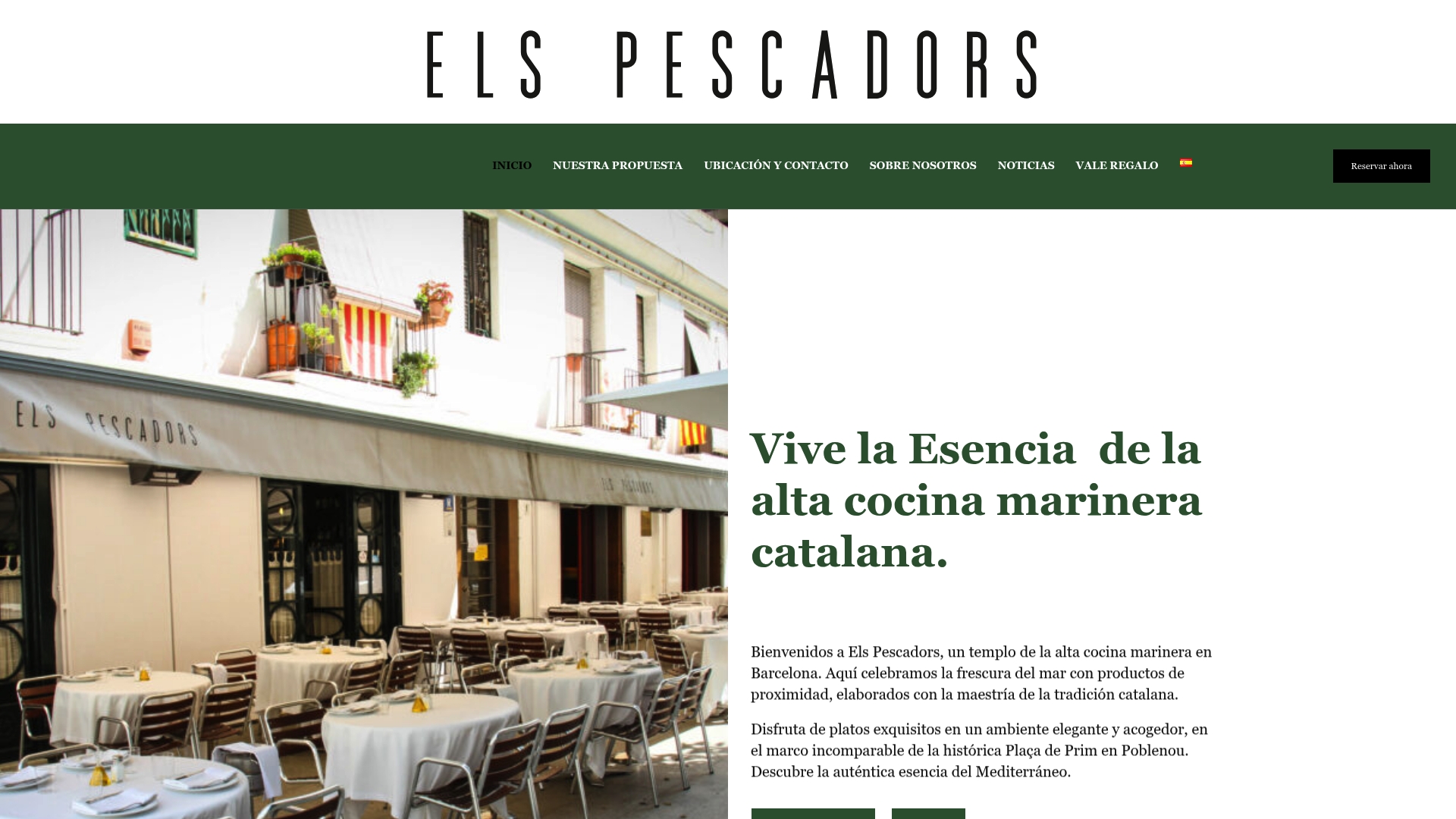
If you would rather not decode a long carta on the night of an anniversary or a business dinner, choose a restaurant whose formats are clear. At Els Pescadors, in the historic Plaça de Prim in Poblenou, you can choose between several set formats:
- the Menú de Temporada at €39 per person, built around the season;
- the Menú Degustación, a tasting menu for a longer evening;
- the Carta del Día, our daily offer;
- La Carta, the full à-la-carte selection of fresh fish, seafood and Catalan rice dishes.
For a team dinner or a celebration, we also offer a group menu. Choosing a fixed menu means one decision instead of twenty, and our guide on what makes seasonal fish menus authentic shows what to look for.
Our point of view: the menu is a conversation
We cook Catalan maritime cuisine: fresh fish, seafood and rice dishes made with seasonal, local ingredients. The names on those dishes carry the tradition. Arròs a la marinera, suquet, fideuà: each word tells you how the cooking is done. We believe a translation should open the door to those names, never replace them.
That is why we like set formats. A seasonal menu, a tasting menu or a daily offer lets a guest relax and let the kitchen lead. The best dish of the day is often the one the market brought in that morning, and no printed menu can promise it.
Our advice to any visitor is the same in every restaurant in the city: ask, with a smile. Ask what is fresh today, ask how a rice is cooked, ask what is in the sauce. Good service in Barcelona is a conversation, and a table with questions is a table that eats better.
YellowRock
FAQ
Is it rude to ask for a menu in English in Barcelona?
No. Asking politely is normal, and a few words of Spanish or Catalan are appreciated. Try ¿Tiene una carta en inglés? If there isn’t one, ask the server to explain the dishes. Staff in restaurants used to visitors do this daily.
Can a restaurant in Barcelona refuse to give me an English menu?
Yes. The law requires menus to be offered at least in Catalan, and you may be attended to in Catalan or Spanish, as the Catalan Consumer Agency explains. English is a courtesy. In that case, ask for the menu in Spanish and use the glossary above.
What is the difference between a carta and a menú?
A carta is the full à-la-carte list where you choose and pay per dish. A menú is a fixed-price offer, usually with a set number of courses. A menú degustación is a tasting menu chosen by the kitchen. See our page on the daily menu for an example of how a fixed offer works.
How do I know whether a dish is safe for my allergy?
Tell the server the exact ingredient before ordering and ask them to confirm it for that dish. Restaurants in Spain must have allergen information available when you ask. A translated menu cannot confirm it. If the answer is uncertain, choose another dish.
Should I tip in Barcelona restaurants?
Tipping is not expected, because service is included in the price, as the city’s official guide notes. Leaving a small amount for good service is a kind gesture, not an obligation.
Sources
- What Language Do They Speak in Barcelona?
- Obligacions generals per a les empreses, Agència Catalana del Consum
- Ley 22/2010, Código de Consumo de Cataluña (BOE)
- Vocabulari de restaurants, Generalitat de Catalunya
- Menu Decoder, Barcelona Art & Culture App
- Navigating a Catalan Menu: Catalan Food Vocabulary & Tips
- Spanish Food Translations & Menu Guide for Travelers
- How to Understand a Menu in Barcelona?
- Besta, la mejor alianza de los sabores del Mediterráneo
- How to Order Food in Spain Without Speaking Spanish
- Twelve handy phrases when visiting a restaurant in Spain
- Spanish menu translator: understand the dishes before you order
- How to politely request dietary restrictions in Spanish restaurants
- Hours and customs, Barcelona International Welcome