A company-dinner protocol is the restaurant-side operational checklist an organizer confirms before the event: date and headcount, the group menu, allergy data, and the service timing that keeps the night on schedule. Get those five items locked and the venue can run the rest.
Do this in the next 72 hours:
- Check the date against the restaurant’s private-room availability.
- Confirm your estimated headcount, even a rough range.
- Request group menu options and pricing tiers.
Budget-wise, standard corporate group meals in Madrid run about €22 to €40 per person for a set menu, a useful anchor before you start comparing quotes.
Key Takeaways
A company dinner runs smoothly when the organizer locks the date, menu, and headcount early, and confirms allergy and service details on a fixed 72-hour schedule before the event.
| Point | Details |
|---|---|
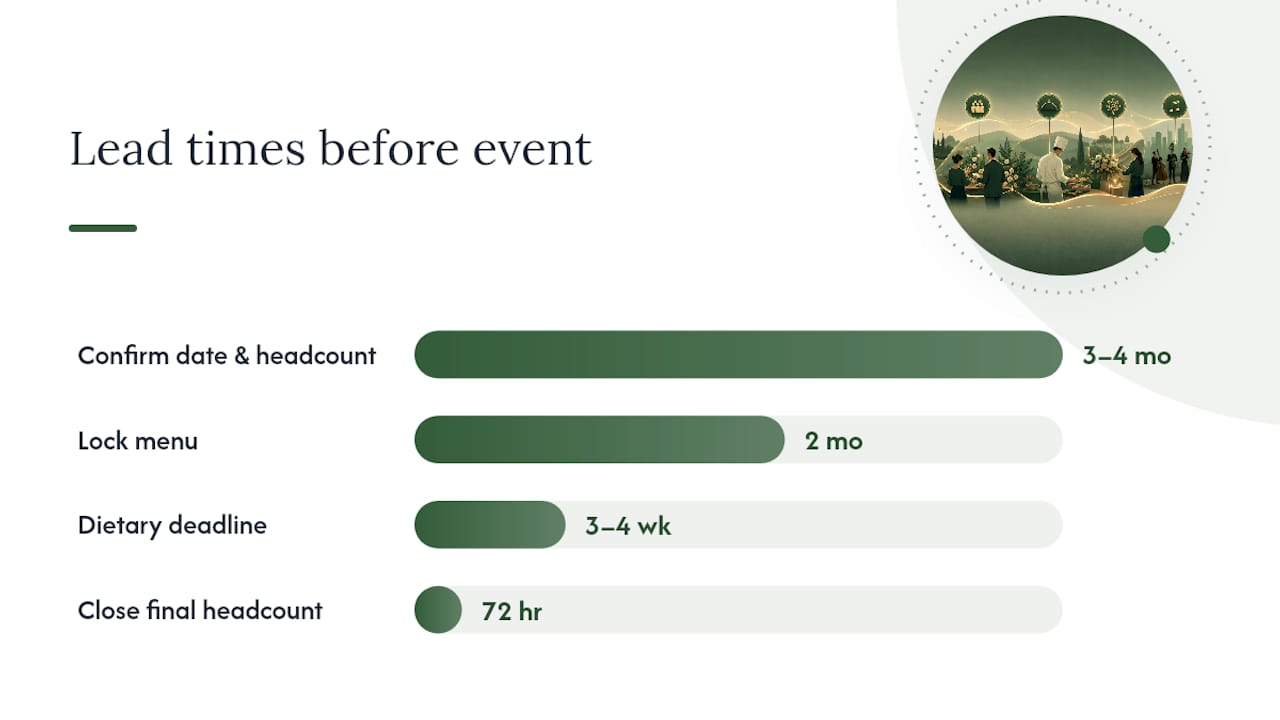
| Start the timeline early | Confirm date, room, and rough headcount 3 to 4 months before the event. |
| Lock the menu by 2 months out | Late menu changes slow kitchen pacing and delay service on the night. |
| Collect dietary data by form | Set a deadline 3 to 4 weeks out and send the kitchen one consolidated list. |
| Confirm contract terms in writing | Check cancellation policy, minimum spend, and deposit refund rules before paying. |
| Close final headcount at 72 hours | This is the number the kitchen preps and staffs against. |
| Model your process on a working venue | Els Pescadors runs group menus and private-event workflows organizers can use as a reference. |
Table of Contents
- When Do You Need a Company Dinner Protocol Timeline?
- What Information Do Restaurants Need for a Reservation?
- How Do You Choose a Group Menu and Manage Dietary Needs?
- What Does the Restaurant’s Service Flow Look Like?
- Which Room Layout and AV Setup Fit Your Event?
- What Belongs on the Day-of Checklist?
- How Does a Restaurant Actually Run a Corporate Dinner?
- Sources
- FAQ
When Do You Need a Company Dinner Protocol Timeline?
Most of the friction in a company dinner traces back to a missed deadline, not a bad menu choice. A workable schedule runs on five checkpoints, each with an owner and a deliverable.
| Milestone | Who owns it | What’s due |
|---|---|---|
| 3–4 months before | Organizer | Confirm date, room, and estimated guest count |
| 2 months before | Organizer + venue | Finalize menu format and approximate attendance |
| 3–4 weeks before | Organizer | Collect dietary needs, propose table plan |
| 1 week before | Organizer + venue | Logistics call: AV, timing, final layout |
| 72 hours before | Organizer | Lock final headcount and allergy list with the kitchen |
This staged approach mirrors what event planners recommend for organizing a corporate dinner, and it holds up whether you’re booking eight guests or eighty.
A few things to lock in early:
- The menu format, before invitations go out, so pricing doesn’t shift midstream.
- A single point of contact at the restaurant, not a rotating cast of staff.
- A backup date, in case the venue’s private room is double-booked.
Pro Tip: Lock your menu selection by the two-month mark. A kitchen that finds out about a course change the week of the event slows every table down that night, not just yours.
What Information Do Restaurants Need for a Reservation?
Restaurants booking private events typically ask for the same core details, and having them ready before the first call speeds up everything else. Expect to provide the date and arrival time, an estimated cover count, a deposit amount, the cutoff date for your final headcount, and any special requests for the room.
Once those details are in, move to the contract terms. This is where vague verbal agreements cause the most damage later:
- Cancellation policy, including how many days out you can cancel without losing your deposit.
- Minimum spend or minimum covers required to hold the private room.
- Payment timing: deposit now, balance on the night, or invoiced after.
- Deposit refund rules if guest numbers drop below the minimum.
- VAT and invoicing details if you need a formal company receipt.
- Any service charge added automatically to group bills.
Ask to see these terms in writing, not summarized in an email. A step-by-step booking process that spells out deposit and cancellation terms up front avoids the awkward negotiation that happens three days before the event, when you have zero leverage.
Pro Tip: A menu tasting or short venue walkthrough before you sign catches problems a phone call never will, from kitchen timing to how the room actually seats your group.
How Do You Choose a Group Menu and Manage Dietary Needs?
Three formats dominate corporate dinners: the seated set menu, the tasting menu, and the cocktail-reception format with standing stations. A seated set menu suits a formal dinner with speeches, since everyone eats the same course at the same time. A cocktail format works better for networking, where guests move around, and conversation matters more than a fixed seating chart. A hybrid, welcome cocktail followed by a seated dinner, gives you both.
| Format | Best for | Service pacing |
|---|---|---|
| Seated set menu | Formal dinners with speeches | Predictable, course by course |
| Tasting menu | Smaller groups, culinary focus | Slower, more courses |
| Cocktail/standing | Networking events | Flexible, continuous |
| Hybrid (cocktail + seated) | Mixed formal/social goals | Two-phase timing |
When you’re pricing the menu, ask the venue directly about the per-person rate, whether drinks packages are included or extra, corkage if you’re bringing your own wine, the service charge, and how last-minute plus-ones get billed.
Dietary data collection works best as a single form, not scattered email replies. Ask for allergies and restrictions by name, set a hard deadline three to four weeks out, and send the kitchen one consolidated list, not a dozen forwarded threads. A menu with too many customized courses slows the whole table down, so favor dishes that scale cleanly across dietary variations rather than a fully bespoke plate for every guest.
What Does the Restaurant’s Service Flow Look Like?
A typical corporate dinner runs through six phases: arrival and welcome drinks, seating, first course, a window for speeches or a brief presentation, main course, then dessert and close. Knowing this sequence in advance lets you slot your program into it instead of fighting it.
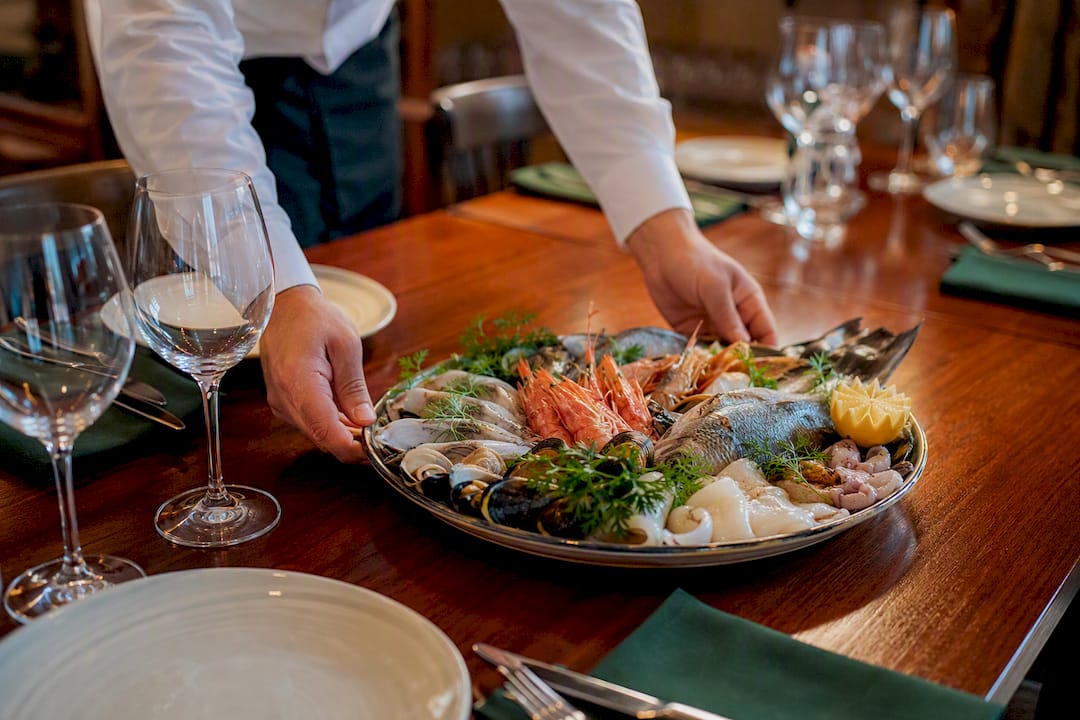
The coordination details matter more than they sound. Welcome drinks need a firm start and end time, or your seated dinner starts late. The microphone location should be confirmed with the venue, not improvised at the head table. Bottled wine service usually pauses briefly during speeches, so timing the toast around the pour avoids an awkward interruption.
Before the event, assign these handoffs clearly:
- Who tells the kitchen about special meals once the final list is in.
- Who keeps the speeches on schedule.
- Who signals the kitchen to start dessert service.
Restaurants that run frequent private events build this into a running order, or “escaleta,” that maps out provider arrivals, sound checks, and meal timing in one document. Ask for one.
Pro Tip: Cap speeches at two, five minutes each, and put them between courses rather than during one. A single ten-minute speech mid-main-course is the most common reason corporate dinners run 30 minutes over.
Which Room Layout and AV Setup Fit Your Event?
Rooms generally come in three flavors: a private dining room, a semi-private area partitioned from the main floor, and a full restaurant buyout. Each has a real capacity and a comfortable capacity, and the two numbers are rarely the same. Ask the venue for both, plus whether the space is accessible and where the cloakroom sits relative to the entrance.
Your seating plan needs a head table decision, a plan for VIP placement, and a call on namecards versus open seating. For AV, confirm microphone type, projector compatibility, HDMI or adapter needs, and a sound check window, plus a named contact at the venue who can troubleshoot on the night.
What Belongs on the Day-of Checklist?
Print this the morning of the event: final headcount, allergy list, table plan, menu printouts for the maître d’, signage, and confirmed supplier arrival times.
Assign roles before anyone walks in:
- Organizer: overall point of contact and timeline owner.
- Restaurant event manager: kitchen and floor coordination.
- Maître d’: seating and service pacing on the night.
- AV point person: microphone, projector, sound check.
- Photographer liaison, if applicable: shot list and access.
A short call the day before, ten to fifteen minutes, should confirm final numbers, walk through the allergy list line by line, and reconfirm arrival time for any external suppliers. Centralizing RSVPs into one link rather than a scattered email chain makes this final call far shorter, since you’re confirming a single number instead of reconciling five spreadsheets.
How Does a Restaurant Actually Run a Corporate Dinner?
Els Pescadors runs corporate events through a sequence that starts well before the first course goes out. An enquiry comes in, a site visit or menu tasting follows, a deposit secures the date, then the venue and organizer trade confirmations against the milestone timeline until the 72-hour final count.
The group menu structures on offer range from a seated four-course set menu built around fresh catch to a tasting format for smaller executive dinners, each paced to keep courses moving without rushing the table. This mirrors the broader corporate dining approach the venue takes with business groups throughout the year.
A short email template for the first enquiry:
- “We’re planning a dinner for [X] guests on [date]. Could you share your group menu options, room capacity, and deposit terms?”
Pro Tip: Ask for the group menu page directly rather than a generic quote. Seeing actual courses and price tiers upfront saves two or three rounds of back-and-forth email.
A Host’s View from the Restaurant Side
What organizers forget most: sending a final allergy list later than 72 hours out, which forces the kitchen to improvise under pressure. What speeds up service: one point of contact who can make small decisions on the spot instead of routing every question back to a committee. What speeds up billing: agreeing on the invoicing format, itemized or lump sum, before the deposit, not after the meal.
Ready to Book Your Company Dinner?
Els Pescadors hosts corporate dinners and private events in a historic Poblenou setting, with group seafood menus built to hold their pace through a full room. If you’ve been comparing generic banquet halls or catering-only venues, the difference here is a kitchen and floor team that runs private dinners as a regular part of service, not a rare exception squeezed between à la carte tables.
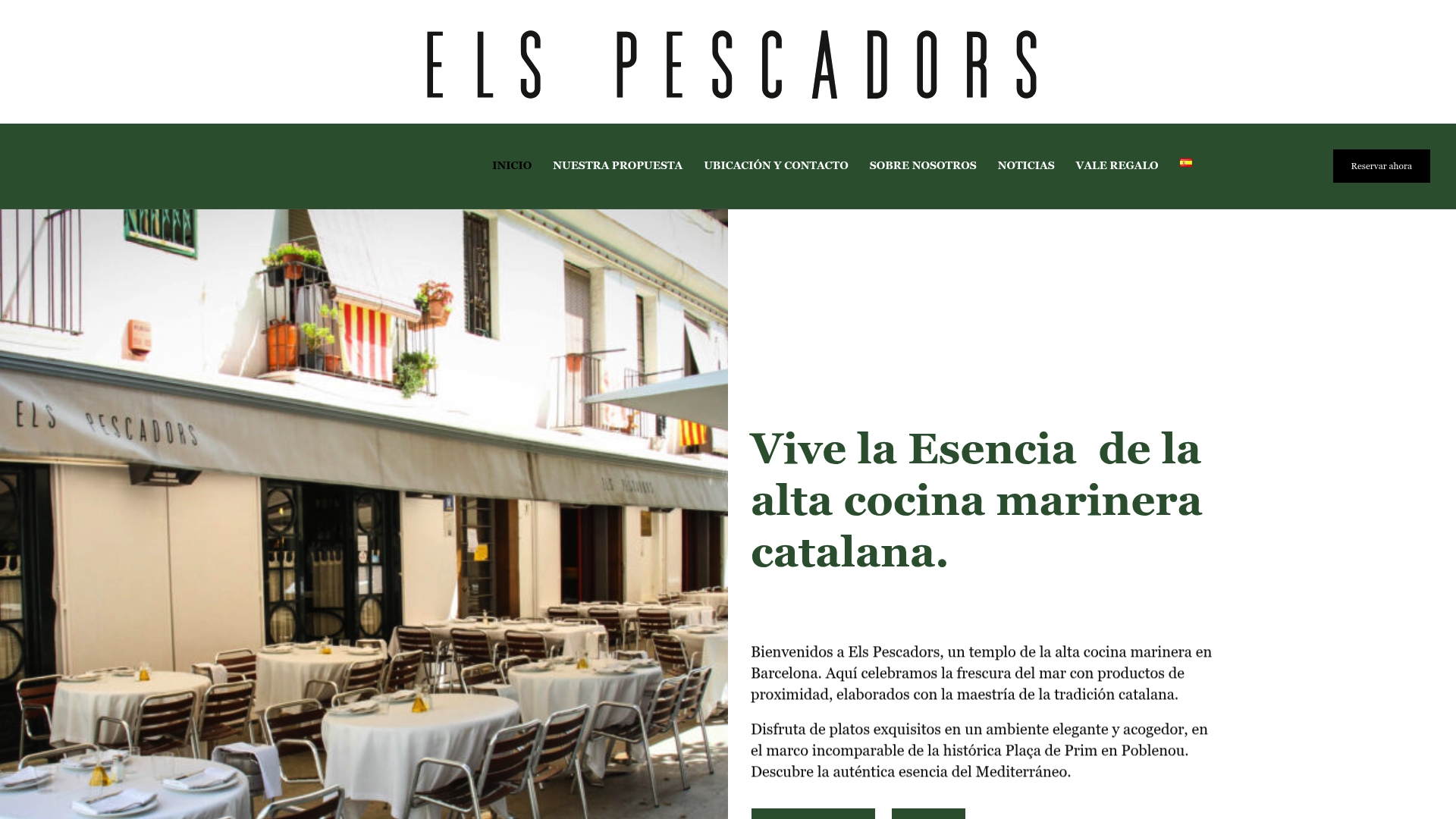
Visit Our Proposal to review private-room options, group menu formats, and deposit terms, or send an enquiry with your date and estimated headcount to start the conversation. For menu inspiration ahead of that call, the group seafood dining ideas page is a useful starting point.
Sources
For a deeper planning checklist, see how to organize corporate dining for a step-by-step planner. Review group dining menu examples for concrete pricing formats, and check Party Hosting: The Dos and Don’ts for general on-site coordination tips that apply beyond restaurants.
- Comidas de empresa en Madrid: Guía para organizar sin caos
- Organización de eventos empresariales: guía completa – Grupo el Alto
- Cómo Organizar una Cena de Empresa Exitosa en Madrid: Guía 2026 – Cardamomo Catering
FAQ
What Is a Company Dinner Protocol?
It’s the restaurant-side checklist an organizer confirms before a corporate dinner: date, headcount, group menu, dietary needs, and service timing, so the venue can run the event without surprises.
How Far in Advance Should You Book a Company Dinner?
Book the venue and date 3 to 4 months ahead, finalize the menu around 2 months out, and confirm dietary details 3 to 4 weeks before the event.
When Should You Send the Final Headcount to the Restaurant?
Send it 72 hours before the event, along with the complete allergy list, so the kitchen can finalize prep and staffing.
How Much Does a Corporate Group Dinner Typically Cost Per Person?
Standard set menus for corporate groups often run €22 to €40 per person in comparable markets, though pricing varies by menu format and drinks package.
Does Els Pescadors Offer Group Menus for Corporate Dinners?
Yes. Els Pescadors publishes group dining menu examples with set pricing tiers and private-room options for company dinners.