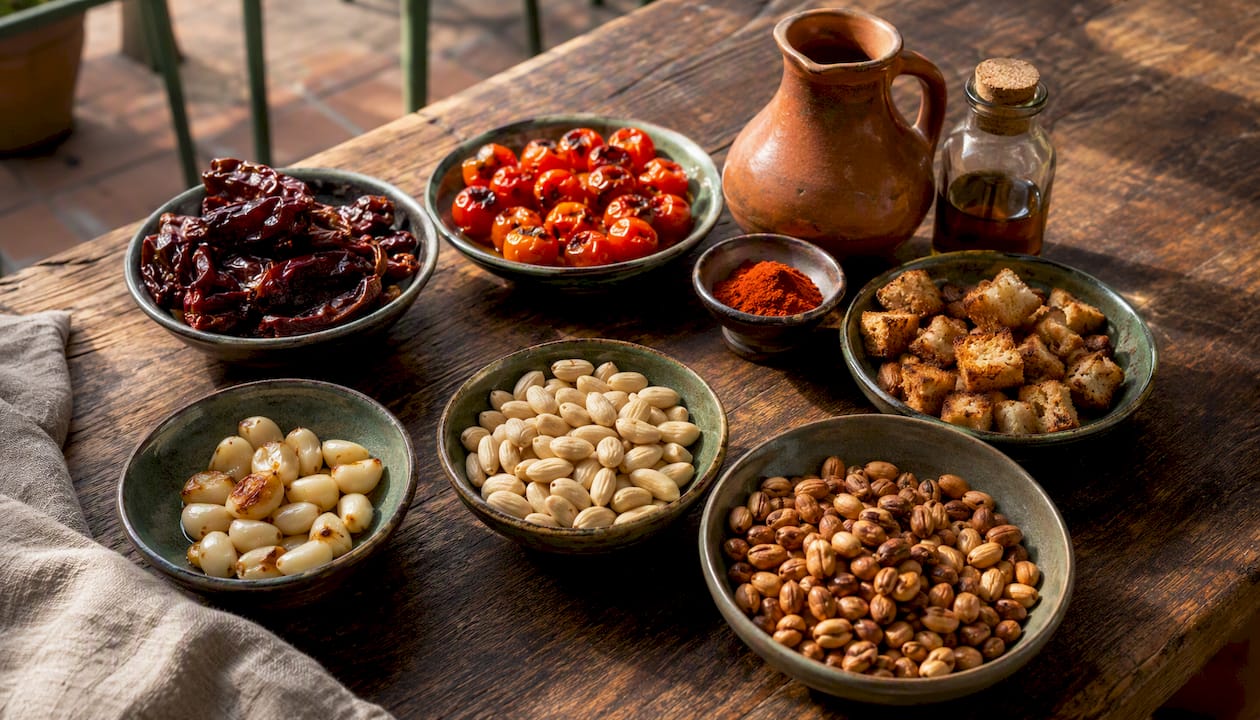
Romesco is a roasted pepper and nut sauce from Tarragona, built on a base of ñora peppers, toasted almonds, roasted garlic, and olive oil, and it’s one of the best things you can put next to a piece of white fish. The traditional version comes from fishermen’s cooking along the Catalan coast, where the picada base of ñora, roasted tomatoes, garlic, toasted almonds, and fried bread doubled as both a stew and a finishing sauce.
Here’s the fast version if you want to cook tonight:
- Rehydrate two dried ñoras in warm water for a few hours (or swap in a jar of good roasted red peppers if you’re short on time).
- Roast tomatoes and a head of garlic until soft, then blend them with the peppers, a handful of toasted almonds, a slice of fried bread, olive oil, and a splash of sherry vinegar.
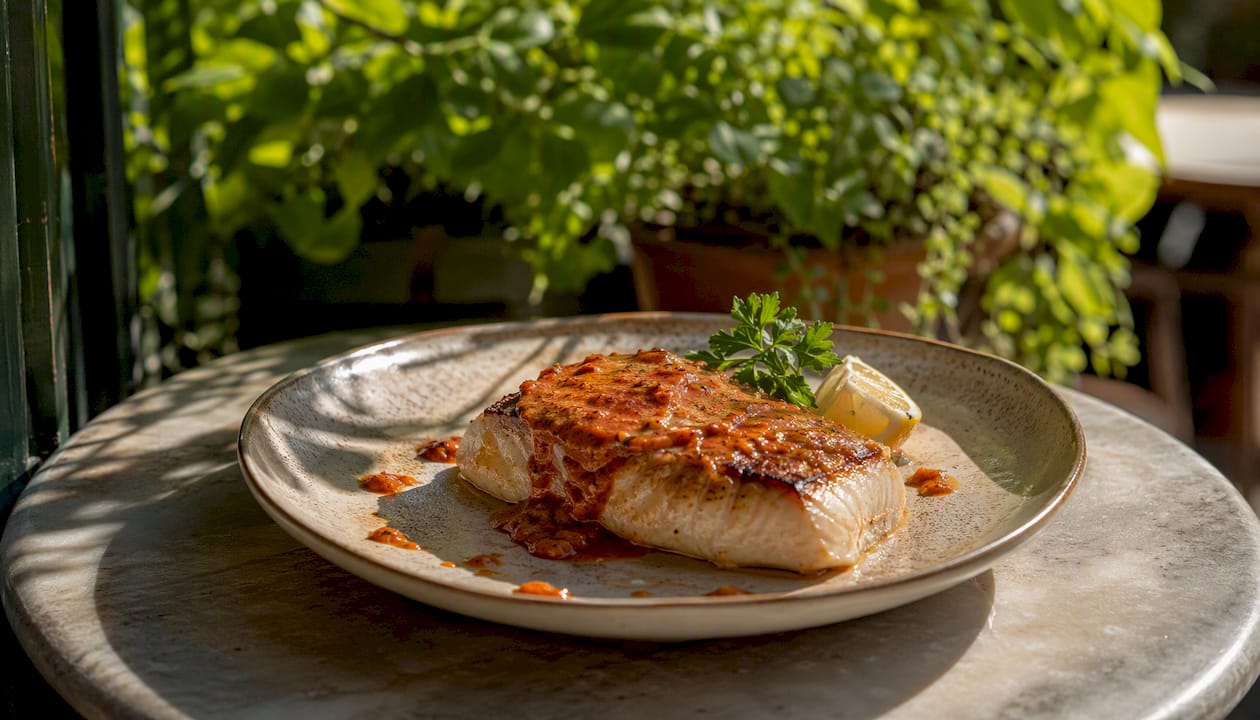
- Spoon the finished sauce over pan-seared hake, or serve it on the side as a dip for grilled shrimp and firm white fish.
That’s romesco in its simplest form. The rest of this guide gets into the technique that separates a flat, oily sauce from one with real depth, plus a full recipe for merluza (hake) with romesco that you can put on the table in under an hour.
Key Takeaways
Romesco succeeds when the ñoras are properly rehydrated, the nuts are toasted without over-blending, and the oil goes in slowly to build a stable emulsion.
| Point | Details |
|---|---|
| Core ingredients matter | Ñora, roasted tomatoes, garlic, toasted nuts, fried bread, and olive oil each contribute a distinct layer of flavor. |
| Roast and toast separately | Roasting tomatoes and garlic while toasting nuts on their own tray preserves each ingredient’s flavor before blending. |
| Add oil slowly | Whether using a mortar or blender, a slow, steady stream of oil prevents the sauce from breaking or turning greasy. |
| Match texture to method | Use a thicker sauce for pan-seared or roasted fish, and thin it with stock for stews. |
| Store and reheat gently | Refrigerate romesco up to five days and warm it slowly over low heat to keep the emulsion intact. |
Table of Contents
- Essential Romesco Ingredients and Common Substitutions
- How Do You Make Romesco Sauce at Home?
- Merluza in Romesco Sauce: A Practical Recipe
- Which Fish and Cooking Methods Work Best With Romesco?
- Common Romesco Mistakes and How to Fix Them
- How Long Does Romesco Last, and Can You Make It Ahead?
- Where Romesco Comes From and Why the Technique Still Matters
- Why This Sauce Never Gets Old
- Sources
- FAQ
Essential Romesco Ingredients and Common Substitutions
Every authentic romesco starts with the same handful of ingredients, and each one does a specific job. Skip one, and the sauce tastes noticeably thinner or flatter.
- Ñora peppers or pimiento de romesco: dried, sweet, and mild, these give romesco its signature reddish color and a fruity undertone that fresh peppers can’t replicate.
- Roasted tomatoes: they add moisture, sweetness, and a slight acidity that balances the richness of the nuts and oil.
- Roasted garlic: mellowed by heat, it loses its raw bite and contributes a soft, caramelized depth.
- Toasted almonds and hazelnuts: these give the sauce body and a nutty richness. Most traditional recipes use both, though almonds alone work fine.
- Fried or toasted bread, or carquinyolis: this thickens the sauce and adds a subtle crunch of flavor from the frying oil.
- Extra virgin olive oil: the emulsifying fat that turns a chunky paste into a cohesive sauce.
- Sherry vinegar: cuts through the fat and wakes up every other flavor.
- Smoked paprika and salt: paprika reinforces the smoky character that ñoras and roasting already build in.
If you can’t find ñoras, good-quality roasted red peppers or a spoonful of pimiento choricero paste get you close, though you lose some of that dried-pepper sweetness. No oven for toasting nuts? A dry skillet over medium heat works just as well. And if fresh bread is what you have on hand, toasting it in olive oil until golden gets you the same crunch and flavor as stale bread fried in the pan.
The ratio of oil to bread and nuts determines whether you end up with a pourable sauce or a thick, dip-able paste. More oil creates a smoother, thinner consistency, while more bread and nuts make a heartier spread that holds its shape on a plate.
How Do You Make Romesco Sauce at Home?
Getting romesco right comes down to sequencing: what you roast, what you toast, and in what order you combine everything.
- Rehydrate the ñoras. Soak dried ñoras in warm water for at least four to five hours, or overnight if you’re planning ahead. A quick boil speeds this up but tends to pull out more bitterness along with the pulp.
- Roast the tomatoes and garlic. Place whole tomatoes and unpeeled garlic cloves on a tray and roast at 400°F until the skins blister and the flesh softens, roughly 25 to 30 minutes.
- Toast the nuts. Spread almonds and hazelnuts on a separate tray or in a dry pan and toast until fragrant and lightly golden. Watch them closely; they go from perfect to burnt in under a minute.
- Fry or toast the bread. A thick slice fried in olive oil until crisp gives the sauce structure and a faint richness from the oil it absorbs.
- Blend or grind. Combine the rehydrated ñora pulp, roasted tomatoes, peeled garlic, toasted nuts, and fried bread. If using a mortar and pestle, work in batches and grind until mostly smooth. If using a blender, add the olive oil in a slow, steady stream while blending to build a proper emulsion.
- Season and adjust. Stir in vinegar, smoked paprika, and salt to taste, then adjust the texture with a little more oil or a splash of water if the sauce is too thick.
The traditional method relies on a mortar and pestle, which produces a rustic, slightly textured sauce. Blenders are faster and perfectly acceptable, but they can over-process the nuts if you’re not paying attention, turning a creamy sauce muddy and bitter.
Pro Tip: If you want that deep, smoky flavor you get at old-school Catalan restaurants, roast everything in a very hot oven with the door cracked slightly, or finish the tomatoes and garlic under the broiler for the last few minutes. It won’t fully replicate a wood-fired oven, but it gets you closer than a standard roast alone.
Merluza in Romesco Sauce: A Practical Recipe
This is the dish that made romesco famous outside Tarragona: firm, flaky hake bathed in a sauce that’s smoky, nutty, and a little tangy.
Ingredients for 4 people:
- 4 merluza (hake) fillets, skin on, about 6 ounces each
- Salt, to taste
- 2 tablespoons olive oil, for searing
- 1 lemon, zested and cut into wedges
- 1 cup prepared romesco sauce
- Fresh parsley, chopped, for garnish
Cooking sequence:
- Pat the fillets dry and season both sides with salt.
- Heat olive oil in a wide skillet over medium-high heat until it shimmers.
- Lay the fillets skin-side down and sear for 3 to 4 minutes without moving them, until the skin crisps.
- Flip carefully and cook another 2 to 3 minutes, depending on thickness, until the fish flakes easily with a fork.
- Warm the romesco sauce gently in a separate small pan, thinning it with a spoonful of fish stock if it’s too thick to spoon easily.
- Plate the fish, spoon warm romesco generously over or beside each fillet, and finish with lemon zest, a squeeze of lemon juice, and chopped parsley.
- Thicker fillets (over an inch) may need an extra minute or two per side; thinner cuts cook faster and dry out quickly if left too long.
- Rape (monkfish) and dorada both work well in place of merluza, though monkfish needs a few extra minutes given its denser texture.
- For a hands-off version, finish the seared fish in a 375°F oven for 5 minutes instead of flipping in the pan.
Which Fish and Cooking Methods Work Best With Romesco?
Firm white fish holds up best against romesco’s texture and intensity. Merluza, rape, dorada, and rodaballo (turbot) are the classic choices because their flesh stays intact under a heavy sauce and their mild flavor doesn’t compete with the smoky pepper base. Shellfish like shrimp and langoustines also take well to romesco, especially grilled and served with the sauce on the side as a dip rather than poured over.
The cooking method should match the sauce’s consistency. A thick, paste-like romesco works as a bed under pan-seared or oven-roasted fillets. A thinner, more pourable version, loosened with a bit of fish stock, folds naturally into a caldereta-style stew where the sauce and fish simmer together.
- Pan-seared merluza or dorada: 6 to 8 minutes total, served with a thick romesco spooned on top.
- Oven-roasted rodaballo or whole fish: 12 to 18 minutes at 400°F depending on size, paired with a medium-thick sauce.
- Grilled shellfish: 4 to 6 minutes, served with romesco on the side as a dip.
- Caldereta-style stew: 15 to 20 minutes simmered gently, using a thinned romesco as the cooking liquid.
Thinning the sauce with a light fish stock rather than plain water keeps more flavor in the pot, especially for stews where the sauce is doing double duty as both seasoning and broth.
Common Romesco Mistakes and How to Fix Them
Even experienced cooks run into the same handful of problems with romesco. None of them are hard to fix once you know what’s going on.
- Bitter or astringent ñora: this usually means the peppers weren’t rehydrated long enough, or they were boiled instead of soaked. Discard the seeds and inner ribs before soaking, and give them a full four to five hours in warm water.
- Sauce that looks greasy or split: this happens when oil was added too fast during blending. Rescue it by adding a splash of water or fish stock and pulsing briefly to bring it back together, or add a bit more toasted bread to help absorb the excess fat.
- Gritty texture: nuts that weren’t ground finely enough, or skins left on the almonds, can leave a sandy mouthfeel. Straining the finished sauce through a fine-mesh sieve solves this instantly.
- Bitter, muddy color from over-blending: pulse the nuts rather than running the blender continuously. Over-processing turns the sauce from creamy to bitter and dulls its color, so aim for a rustic texture rather than a completely smooth puree.
- Sauce too thin or too thick: adjust gradually. Add oil in a slow drizzle, tasting as you go, rather than dumping it in all at once.
Pro Tip: When reheating leftover romesco, warm it slowly over low heat and stir constantly. High heat or a rushed reheat is the fastest way to break the emulsion, leaving you with an oily layer floating on top instead of a cohesive sauce.
How Long Does Romesco Last, and Can You Make It Ahead?
Romesco keeps well, which makes it one of the easier sauces to prep in advance for a dinner party or a busy weeknight.
- Store it in an airtight container in the refrigerator for up to five days, based on standard home-cook storage recommendations for the sauce.
- For longer storage, freeze it in portioned containers for up to three months, then thaw overnight in the refrigerator before using.
- After refrigeration, the oil sometimes separates slightly. Whisk in a splash of warm water or a little extra olive oil to bring the texture back to smooth.
- A practical make-ahead workflow: roast the tomatoes and garlic, toast the nuts, and rehydrate the ñoras a day in advance, then blend everything fresh on the day you’re serving it. This keeps the flavors brighter than blending everything a day early.
- Label containers with the date, and if you’re prepping for a group event, batch the sauce in the volume you’ll actually need rather than guessing. If you’re planning a holiday meal or hosting a crowd, building the sauce ahead of time frees up your stovetop for the fish itself.
Where Romesco Comes From and Why the Technique Still Matters
Romesco carries two distinct identities in Catalan cooking. There’s the Romesco de Tarragona, a cooked fisherman’s caldereta that started in the port neighborhood of El Serrallo, and there’s the cold salsa romesco used today as a condiment for fish and vegetables. Both share the same picada foundation, but they serve different purposes on the plate: one is a stew you eat with a spoon, the other is a sauce you drizzle or dip.
The technique choices home cooks make today echo decisions fishermen made out of necessity generations ago. Toasting nuts and slow-roasting tomatoes and garlic isn’t just tradition for tradition’s sake. It’s where most of the sauce’s flavor actually comes from.
Chefs in Tarragona point to two things above all else: freshly toasted nuts and patient roasting of the tomatoes and garlic. A wood-fired oven adds a smoky complexity that a standard home oven can rarely match, which is part of why restaurant versions taste different from what most people make at home.
That distinction between mortar and blender isn’t just about equipment, either. A mortar and pestle produces a texture with intentional variation, some pieces slightly coarser than others, while a blender gives you uniform smoothness. Neither is wrong, but adding oil slowly regardless of method is what actually determines whether your emulsion holds together.
Pro Tip: If your nuts have papery skins, rub them off after toasting. Leftover skins are a common cause of that grayish, muddy tint in an otherwise vibrant red sauce.
Why This Sauce Never Gets Old
There’s something about spooning warm romesco over a piece of fish that never stops feeling like a small event, even on a Tuesday. The sauce rewards patience in a way few condiments do: rush the roasting, and you taste it immediately. Give it time, and the smoke and sweetness come through in a way that no shortcut quite replicates.
At Elspescadors, romesco shows up alongside daily fresh catch precisely because it flexes with whatever the boats bring in that morning, whether that’s merluza, rape, or something else entirely. That flexibility is worth remembering at home too. Don’t feel locked into one fish or one exact ratio of nuts to bread. Taste as you go, adjust for what’s fresh at your market, and scale the batch up without hesitation if you’re cooking for a table of six instead of two.
If you’re curious to see how this sauce is treated in a professional Catalan kitchen, Els Pescadors’ proposal gives a sense of how tradition and seasonal ingredients come together on a working menu, whether for a quiet dinner or a private group event.
Sources
- El concepto de «romesco» – Romesco de Tarragona
- Cómo hacer salsa romesco – Directo al Paladar
- Salsa romesco, una receta típica de la cocina catalana – Infobae
FAQ
What Ingredients Go Into Romesco Sauce?
Romesco is built on ñora peppers or pimiento de romesco, roasted tomatoes, roasted garlic, toasted almonds and hazelnuts, fried bread, olive oil, vinegar, and smoked paprika. Each ingredient contributes a specific layer, from the peppers’ fruity smokiness to the bread’s body.
What Is the Best Sauce to Serve With Fish?
Romesco is one of the strongest choices for firm white fish because its smoky, nutty depth complements delicate flesh without overwhelming it. It works equally well spooned over pan-seared fillets or served as a dip alongside grilled seafood.
How Do You Use Romesco Sauce With Fish?
Spoon warm romesco over pan-seared or oven-roasted fillets right before serving, or thin it slightly with fish stock and use it as the base for a stew-style dish. It also works cold as a dip for grilled shrimp or shellfish.
What Pairs Well With Fish Besides Romesco?
Fish pairs well with bright, acidic sauces and simple herb-based accompaniments, but romesco stands out because it adds both smokiness and richness in one sauce. If you want a lighter option, a squeeze of lemon and good olive oil complements romesco’s other strong flavors rather than competing with them.