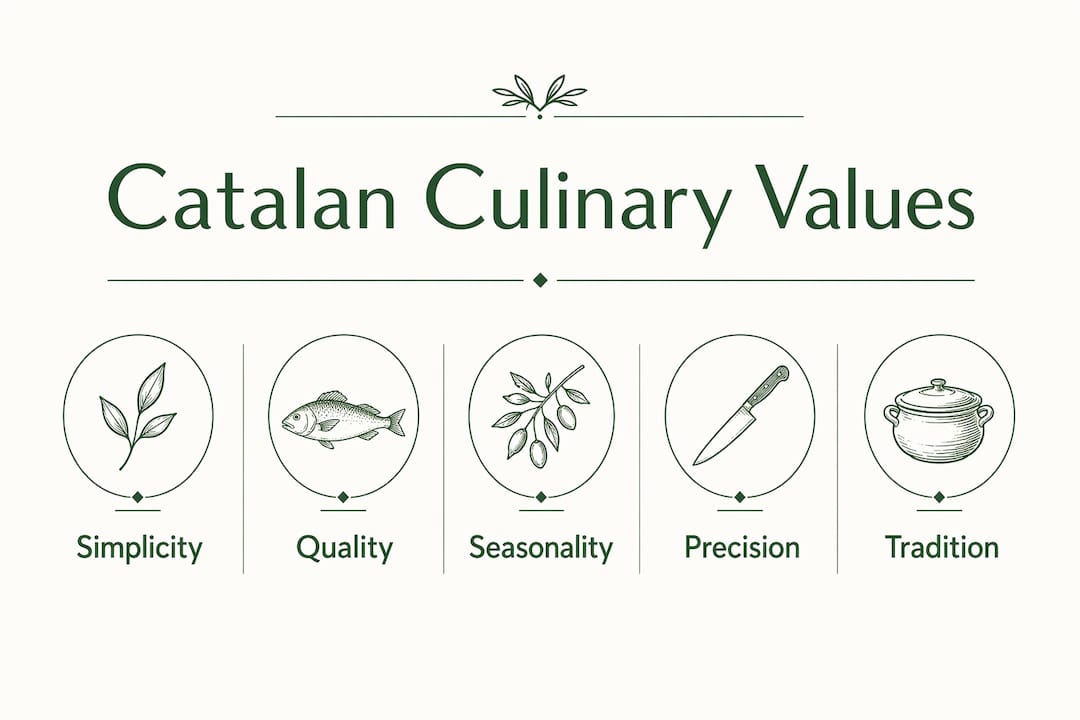
Catalan cooking values simplicity and quality because the cuisine’s entire identity rests on one conviction: a great ingredient, treated with respect, needs nothing to hide behind. This is not a philosophy born in a culinary school. It grew from centuries of resourcefulness, geographic richness, and a stubborn refusal to be generic. The result is a cuisine where pa amb tomàquet, bread rubbed with ripe tomato and good olive oil, stands as a complete expression of culinary intelligence, not a starter waiting to be improved.
Three principles anchor this ethos:
-
Ingredient honesty: The cook’s job is to present each ingredient “completely and unmistakably like itself,” without heavy sauces or masking techniques.
-
Seasonal and local sourcing: Traditional Catalan dishes were built exclusively from what the land and sea offered at a given moment, a habit that seasonal local produce still defines today.
-
Cultural identity: Food here is an act of resistance and pride. Catalonia’s PDO and PGI products, from Siurana olive oil to Ganxet beans, are not marketing labels. They are territorial declarations.
-
Mar i muntanya tradition: The practice of combining sea and mountain ingredients in a single dish reflects geographic reality and culinary creativity working together.
-
Mediterranean diet principles: Balance, restraint, and seasonal rhythm are not modern wellness trends in Catalonia. They are the original operating system.
Table of Contents
- How geography and culture shaped Catalan culinary values
- What simplicity actually demands from a Catalan cook
- How contemporary Catalan chefs carry tradition forward
- How Elspescadors embodies these principles in practice
- How Catalan cuisine compares to other Mediterranean traditions
- Key Takeaways
- FAQ
How geography and culture shaped Catalan culinary values
Catalonia’s geographic diversity, from the Pyrenees to the Costa Brava, is the single biggest reason its cuisine developed such range without losing coherence. The mountains supply cured meats, wild mushrooms, aged cheeses, and game. The coast delivers fresh fish, anchovies, squid, and prawns. The inland plains grow the vegetables, legumes, and grains that tie everything together. No other region in the western Mediterranean pulls from three such distinct food environments within the same cultural frame.
That geographic reality produced the mar i muntanya tradition, dishes that pair seafood with meat or poultry in combinations that would seem odd elsewhere but feel inevitable here. Chicken with lobster, cuttlefish with meatballs, rice with both meat and seafood: these are not fusion experiments. They are the natural result of a cook working with what the land and sea both offered that week.
Festivals reinforce this seasonal logic in ways that go beyond the kitchen. The Festa del Trinxat in Puigcerdà each February celebrates a dish of cabbage, local potatoes, and pork belly, three ingredients that peak together in winter. The Sant Joan bonfire celebration in June centers on coca de llardons, a flatbread tied to the season’s ingredients. Food and calendar are inseparable here.
| Geographic zone | Key ingredients | Representative dishes |
|---|---|---|
| Pyrenees mountains | Wild mushrooms, cured meats, dairy | Trinxat, escudella, aged cheese preparations |
| Mediterranean coast | Fresh fish, anchovies, squid, prawns | Suquet de peix, sarsuela, grilled sardines |
| Inland plains | Legumes, vegetables, olive oil, wine | Pa amb tomàquet, romesco, coca de recapte |
| Delta and wetlands | Rice, eels, clams | Arròs del Delta, rice with seafood |
Catalonia holds various PDO products, including Ebro Delta Rice, Siurana Olive Oil, and Ganxet Beans, alongside several PGI products. Each label certifies a direct link between food and place, which is exactly what local gastronomy scholars identify as the foundation of any cuisine with genuine cultural depth.
What simplicity actually demands from a Catalan cook
Simplicity in Catalan cooking is not minimalism. It is discipline. The cuina de barca tradition, cooking done aboard fishing boats by a dedicated cook called the ranxer, used only what was durable and at hand: dried legumes, rice, potatoes, onions, tomatoes, and the fish too bony or small to sell at market. The constraint forced ingenuity. Suquet de peix, now served in fine restaurants, started as a twenty-minute pot meal eaten standing on deck.
That origin story matters because it explains why Catalan cooks treat simplicity as a skill, not a shortcut. Presenting an ingredient without distraction means the ingredient has nowhere to hide. A mediocre tomato ruins pa amb tomàquet. A poor-quality olive oil collapses the whole dish. The cook who chooses simplicity is betting entirely on sourcing.
- Picada: A ground paste of almonds, hazelnuts, garlic, and herbs that adds depth without masking the main ingredient.
- Sofrito: A slow-cooked base of tomato, onion, and garlic that builds flavor from the ground up.
- Alioli: An emulsion of garlic and olive oil, made without egg in its traditional form, that demands both good oil and patience.
- Romesco: Roasted peppers, tomatoes, and nuts ground together, a sauce that showcases rather than covers.
Pro Tip: When cooking a Catalan-style dish at home, buy one ingredient at its absolute peak quality and build the rest of the dish around it. The Catalan approach starts with the ingredient, not the recipe.
The Catalan culinary philosophy holds that honesty and sophistication are not opposites. A dish that tastes completely like its main ingredient is harder to make than a dish that tastes like its sauce. That is the intellectual core of why Catalan cooking values simplicity and quality together, not as separate virtues but as the same demand.
How contemporary Catalan chefs carry tradition forward
Modern Catalan chefs do not treat tradition as a museum piece. They treat it as a living argument. At Les Cols in Olot, chefs Fina Puigdevall and Martina Puigvert have built a two-Michelin-star kitchen around what they call “the mystical cuisine of the landscape,” starting with humble local ingredients from La Garrotxa and working outward from there.
At Sexto in Lleida, chef Àngel Esteve runs a short, ever-changing menu that responds directly to what local producers bring in. His view on the limits of reinterpretation is precise: “The moment you can no longer perceive the main ingredient, I think the thread of tradition has been lost.” That single sentence captures the Catalan culinary principle better than most cookbooks manage in a chapter.
Catalonia’s designation as a World Region of Gastronomy 2025, the first European region to receive this title, reflects how seriously the international food community takes this tradition. The designation highlights the work of farmers, fishermen, and chefs who have kept the cuisine rooted while allowing it to grow. Catalan culinary creativity is inseparable from preserving local memory and nature, not abandoning it.
How Elspescadors embodies these principles in practice
Elspescadors sits in the Poblenou district of Barcelona, in Plaça de Prim, a historic neighborhood that still carries the texture of working-class maritime life. The restaurant’s focus on traditional Catalan maritime cuisine is not a branding decision. It is a commitment to the same values that produced suquet de peix on fishing boats centuries ago.
At Elspescadors, the daily menu follows the catch, not the other way around. Seasonal, locally sourced seafood arrives fresh, and the kitchen’s job is to honor it with technique that reveals rather than transforms.
The restaurant’s approach reflects the core Catalan culinary principles in concrete ways:
- Daily fresh catch: The menu changes with what the sea offers, keeping the kitchen honest about seasonality.
- Traditional rice dishes: Preparations like arròs mar i muntanya connect directly to the geographic and cultural heritage of the region.
- Refined technique on humble foundations: The same discipline that the ranxer practiced on a fishing boat, using restraint to let the ingredient speak, runs through every dish.
- Tasting menus: Designed to move through regional flavors in sequence, giving each ingredient its moment without competition.
For anyone wanting to understand why Catalan cooking values simplicity and quality, a meal at Elspescadors is a more direct answer than any explanation. The local ingredients on the plate carry the argument themselves.
How Catalan cuisine compares to other Mediterranean traditions
Every Mediterranean cuisine claims to value fresh, local ingredients. The difference with Catalonia is the degree of intellectual rigor behind that claim. Italian cooking, for instance, is deeply regional and ingredient-focused, but it tends toward richness, building flavor through butter, cream, or long-cooked ragùs. Greek cuisine leans on olive oil and herbs but rarely pushes the technique of restraint as far as Catalonia does. Provençal cooking shares the Mediterranean pantry but gravitates toward aromatic complexity.
Catalan cuisine is unusual in its insistence that the cook’s skill shows most clearly in what is left out. The Llibre de Sent Soví, written in 1324, already demonstrated this: a cuisine in full conversation with itself, not borrowing confidence from neighboring traditions. That historical depth, combined with the geographic range from Pyrenees to coast, gives Catalan cooking a specificity that most Mediterranean cuisines reach for but rarely achieve with the same consistency.
Where other Mediterranean traditions celebrate abundance, Catalan cuisine celebrates precision. That is the distinction worth understanding.
Key Takeaways
Catalan cooking values simplicity and quality because the cuisine’s identity depends on letting each ingredient speak for itself, a discipline rooted in geography, history, and cultural pride.
| Point | Details |
|---|---|
| Simplicity is a skill, not a shortcut | Presenting an ingredient without distraction demands better sourcing and more precise technique than adding complexity. |
| Geography drives ingredient variety | From the Pyrenees to the Mediterranean coast, Catalonia’s three food zones produce the range that defines mar i muntanya cooking. |
| PDO and PGI labels carry cultural weight | Catalonia’s PDO and PGI products certify a direct link between food, place, and tradition. |
| World Region of Gastronomy 2025 | Catalonia became the first European region to receive this designation, recognizing its living culinary heritage. |
| Elspescadors applies these values daily | Fresh catch, traditional maritime recipes, and seasonal tasting menus put Catalan culinary principles into practice at the table. |
FAQ
Why does Catalan cooking avoid complex sauces?
Catalan culinary philosophy holds that a great ingredient should taste completely like itself, and heavy sauces obscure rather than reveal. The discipline of restraint is considered the harder and more honest cooking choice.
What makes pa amb tomàquet a good example of Catalan values?
Pa amb tomàquet requires only bread, ripe tomato, olive oil, and salt, but each element must be excellent. It demonstrates that simplicity and sophistication are the same demand, not opposites.
How does Catalonia’s geography influence its cuisine?
Catalonia draws ingredients from three distinct zones: the Pyrenees mountains, the Mediterranean coast, and the inland plains. That range produced the mar i muntanya tradition of combining sea and mountain ingredients in a single dish.
What is cuina de barca and why does it matter?
Cuina de barca was the practical cooking done aboard Catalan fishing boats, using durable, humble ingredients to feed the crew. Dishes like suquet de peix originated there, and the tradition’s resourcefulness still shapes how Catalan cooks think about using ingredients fully.
How does Elspescadors reflect Catalan culinary principles?
Elspescadors builds its menu around daily fresh catch and seasonal seafood, using traditional maritime recipes and refined technique to honor the ingredient rather than transform it, which is the core of Catalan culinary tradition.