Natural wine is made from organically or biodynamically farmed grapes with as little intervention in the cellar as possible. Conventional wine is made with the full range of permitted additives and techniques. In Spain and the EU, “natural” has no legal definition, so the difference lives in how the producer works, not in a protected word on the label. Once you know that, the choice at the table gets easier, and with seafood it comes down to the dish, not the philosophy.
This guide is for diners, not winemakers. It covers what each style involves, what you can and cannot trust on a label, how the glass tastes, and how to order well when the plate in front of you is a Catalan rice dish or a daily catch.
TL;DR
- Natural wine means organic or biodynamic grapes, native yeasts and no additions or corrections. Conventional wine may use added yeasts, sulfites, filtration and other permitted adjustments.
- “Natural wine” is not a defined category in EU law, and Spain’s food-quality coordination body has ruled that the phrase cannot appear on wine labels.
- All wine contains some sulfites. The difference is how much is added, which can range from nothing to several hundred milligrams per liter.
- Natural wines vary more: some are cloudy, lively and layered, others show faults. Conventional wines are more predictable.
- With seafood, acidity and freshness matter more than the label: dry whites, xarel·lo, sparkling Brut nature and fino or manzanilla are classic matches.
Table of Contents
- How each wine is grown and made
- Is “natural wine” an official category in Spain?
- Natural, organic, biodynamic and conventional side by side
- Sulfites, additives and what the bottle tells you
- How they taste: variety against consistency
- Choosing for seafood and Catalan rice dishes
- Eat Catalan seafood at Els Pescadors
- Our view
- FAQ
- Sources
How each wine is grown and made
Start in the vineyard, because that is where the two styles begin to separate.
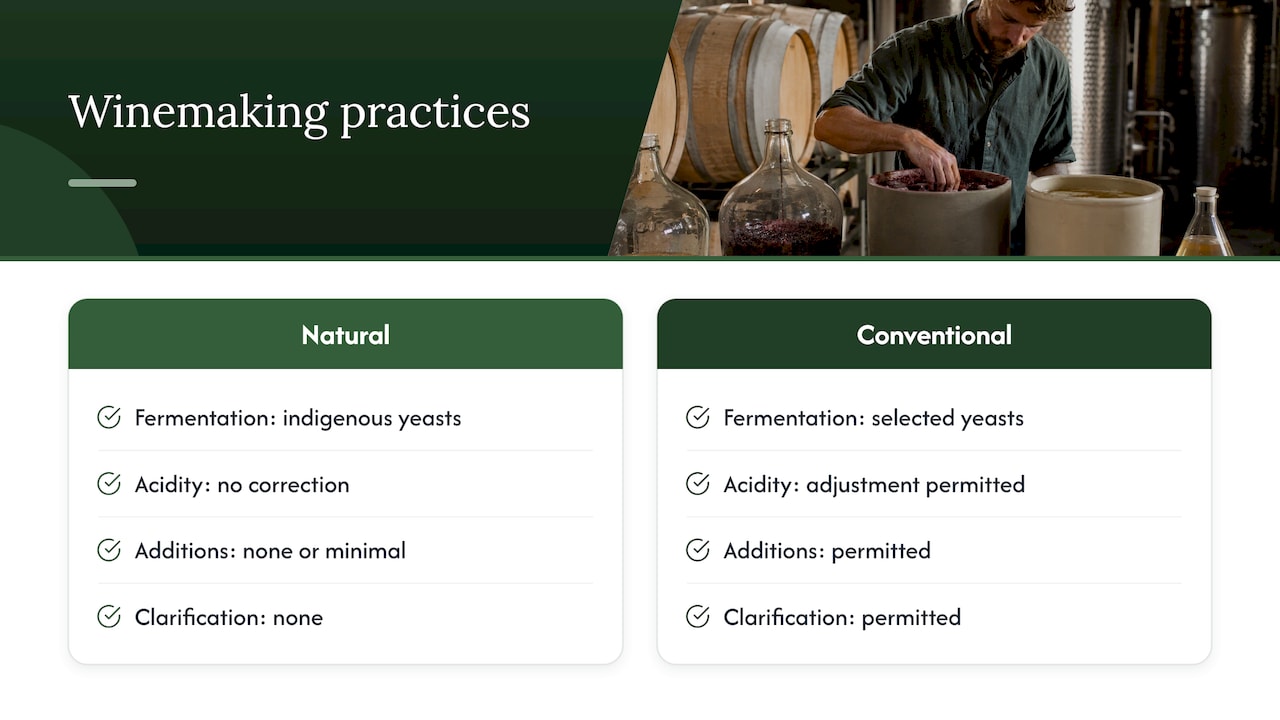
A natural wine is generally made from manually harvested grapes from organically or biodynamically managed vineyards, fermented with the indigenous yeasts on the grape skins and with no additions. After the wine settles and is decanted, some producers use a simple cloth filter, but fine membrane filtration is out, which is why many bottles look hazy.
A Spanish academic definition says the same thing in more technical terms: grapes from organic or biodynamic vineyards, minimal cellar intervention, and a ban on certain physical processes and on enological additives of any kind. A Basque Culinary Center oenologist describes it as must with no correction of acidity, sugars or nutrients, spontaneous fermentation, no filtration or clarification, and sulfites, if any, only in small amounts just before bottling.
Conventional winemaking is the broader tradition. Spanish law defines wine as the natural foodstuff obtained exclusively by the alcoholic fermentation of fresh grapes or grape must, and within that definition a winemaker may select commercial yeasts, adjust acidity, add sulfur dioxide as a preservative, clarify and filter. These tools exist to deliver a clean, stable, repeatable bottle year after year.
WSET, the global wine education body, calls natural wine an ethos rather than a style. That is a useful way to read it. Two natural wines can taste nothing alike, just as two conventional wines can. What they share is a set of choices, and those choices demand a lot of the grower: with no safety net in the cellar, the grapes must arrive healthy, ripe and disease-free.
Is “natural wine” an official category in Spain?
No, and this is the point most diners are never told.
The European Commission stated in a 7 September 2020 letter that “natural wine” is not defined in EU legislation and is not one of the grapevine-product categories listed in Regulation (EU) 1308/2013. Such a product can only be marketed as plain “wine”. The same letter warns that the phrase could lead an average consumer to think the product is higher quality or healthier than ordinary wine.
Spain went a step further. According to the Spanish enology federation, the country’s Mesa de Coordinación de la Calidad Alimentaria agreed in January 2024 that the mention “Vino Natural” cannot be used on labels or presentation, because with no set production conditions it is ambiguous and could cover very different products at each producer’s discretion.
What exists instead are private standards. Per the Basque Culinary Center, only two private associations certify natural wine: the French AVN, which allows up to 30 mg of added sulfites before bottling, and SAINS, which allows none. Neither is an official EU scheme. In 2021 a Bierzo winery became the first in Spain to obtain the French Vin Méthode Nature certificate, which requires organic, biodynamic or regenerative viticulture and no additives.
In practice, when a menu or a server says “natural”, you are hearing a description of how the producer works, not a guarantee backed by a public register. It is a perfectly good conversation starter. Just treat it as one.
Natural, organic, biodynamic and conventional side by side
These words overlap, which is why they confuse people. Organic is the only one with an official EU framework.
| Conventional | Organic (vino ecológico) | Biodynamic | Natural | |
|---|---|---|---|---|
| Legal status in the EU | Standard wine rules | Official term, EU organic regulation | Private certification | No legal definition |
| Vineyard | Any permitted practice | Certified organic viticulture | Organic plus a lunar-calendar, whole-farm philosophy | Usually organic or biodynamic |
| Cellar | Full list of authorized practices | Organic winemaking rules, lower sulfite limits | Varies by certifier | Minimal intervention, no additions |
| Label | Plain “wine” | Euro-leaf and control-body code | Certifier logo | “Natural” not permitted on Spanish labels |
On the organic side, Spain’s CAAE certification body explains that “vino ecológico” has been the official EU term since 1 August 2012 and requires both certified organic grapes and organic winemaking, with the euro-leaf logo and the control-body code. A wine made from organic grapes but vinified outside those rules counts as conventional and cannot advertise its organic character.
So an organic wine is not automatically natural, and a natural wine is not automatically certified organic. The overlap is large, but the words are not interchangeable.
Sulfites, additives and what the bottle tells you
Sulfites are the most misunderstood part of this debate. Every wine contains them, because up to 10 mg per liter is produced naturally during fermentation. Conventional winemaking usually adds more as a preservative; natural winemaking adds little or none.
The spread is wide. An IPNA researcher quoted in El País notes that a wine can contain more than 60 possible ingredients, with sulfite levels ranging from zero to 400 mg/l, and that the bottle alone does not tell you what the producer did.
What Spanish labels must show has changed. Under EU Regulation 2021/2117, applicable since 8 December 2023, wine labels must show energy value per 100 ml, highlight allergens such as sulfites, and state the alcohol degree, with the full ingredient list and nutrition table allowed through a QR code. A regional labeling guide adds that the statement “Contiene sulfitos” is required when the wine contains more than 10 mg/l of sulfur dioxide.
Two practical points follow. First, “contains sulfites” appears on almost every bottle, natural or not, so it tells you little about style. Second, the QR ingredient list does not cover processing aids, which El País reports make up about half of what can be added to wine. If you have a sulfite allergy, tell your server before ordering, and speak to your doctor about what level is safe for you.
How they taste: variety against consistency
This is what most people really want to know. The honest answer is that natural wine is a wider range.
At its best it can be lively, with what the Basque Culinary Center calls an “electric” texture and layered flavors. Because it is unfiltered, many are cloudy, and some smell closed or cider-like when first poured and need time in the glass to open. The same source advises patience: small imperfections can turn into interesting, pleasurable complexity, while persistent faults such as vinegar or nail-polish notes will not fade.
A 2024 study in OENO One compared 24 Spanish and French red wines, 12 self-described natural and 12 conventional. The natural wines showed higher volatile and total acidity and turbidity, and lower total and free sulfur. Only 45% showed off-odors, while 55% grouped with the conventional wines, so the sensory line between the two styles was not clear-cut.
What does that mean for you at a table?
- Natural wine rewards curiosity. Expect more texture, more acidity and more surprise. Give a glass ten minutes before judging it.
- Conventional wine rewards precision. Expect a clean, stable profile that tastes like its grape and region, bottle after bottle.
- The label does not predict quality. Producer, vintage and how well the wine suits the food matter more than which camp it belongs to.
If you are new to natural wine, order by the glass first. Our guide to wine pairing versus wine by the glass explains how to compare styles without committing to a whole bottle.
Choosing for seafood and Catalan rice dishes
Here the decision gets practical. Seafood is delicate, salty and often served raw or lightly cooked, so what the wine needs is freshness, acidity and a clean finish. Both styles can deliver that.
For shellfish, a Spanish wine publication recommends dry or barrel-aged whites, sparkling whites, and finos or manzanillas, and for raw molluscs such as oysters, dry whites, Brut nature or Brut sparkling, and finos or manzanillas. For a local angle, Vinos y Restaurantes notes that xarel·lo’s citrus acidity and freshness complement the sweetness and saline notes of oysters, and that the grape also suits fish, shellfish and rice dishes. Xarel·lo is a Catalan white grape, so it fits a Barcelona table almost by default.
A simple way to decide:
- Raw or lightly cooked shellfish: go for high acidity. A crisp conventional white or a bright, clean natural white both work. Avoid anything cloudy and funky that might drown the oyster.
- Grilled or pan-seared fish: a fuller white with some texture, from either camp.
- Rice dishes with a rich stock: a wine with more body and a touch of savory depth. This is where a skin-contact or unfiltered white can shine.
- Tasting menu: ask for a pairing so the style changes with each course. Our notes on how to pair seafood with wine walk through the logic course by course.
If you want to know how ordering works in a Spanish dining room, from reading the list to talking to the server, see wine service in Spain and how to use a sommelier and the wine list together. Describe what you like, name your budget and the dish, and let the conversation, not the label, do the work.
Eat Catalan seafood at Els Pescadors
The best way to learn what suits a dish is to sit down with the dish. At Els Pescadors, in Plaça de Prim in Poblenou, the kitchen works with daily fresh catch, seafood specialties and traditional rice dishes made from seasonal, locally sourced ingredients. The Menú de Temporada is €39 per person, and the Menú Degustación gives you a longer, multi-course route through the sea. Groups can look at the Menú para Grupos.
If you want to plan a long tasting-menu evening, our practical guide to the Catalan tasting menu explains what to expect, and you can book through elspescadors.com.
Our view
We cook Catalan maritime food: fresh fish, seafood and rice dishes built around what the sea and the season give us. In a dining room like ours, the question is never “natural or conventional?” first. It is “what is on the plate?”
That is the right order. A label on a bottle cannot tell you whether the wine will lift a plate of oysters or flatten it. Acidity, freshness and balance can. Start from the dish, then choose the style that serves it.
We also think the best seafood meals are the ones where you are not rushed. A seasonal menu or a tasting menu lets you taste the logic of the kitchen from the first course to the last, and gives a wine room to change with each plate. That is why we encourage guests to tell us what they like and let the meal unfold.
Natural wine is a conversation worth having, and so is conventional wine. At the table, both should do the same job: make the sea taste more like itself.
YellowRock
FAQ
Is natural wine healthier than conventional wine?
There is no official basis for saying so. The European Commission has warned that the word “natural” could mislead consumers into believing a wine is healthier or of higher quality than ordinary wine, which is part of why it is not a recognized category. Choose by taste and occasion. If you react to sulfites or have any health condition, ask your doctor.
Does natural wine have no sulfites?
Not quite. Every wine contains some sulfites because they form naturally during fermentation, up to about 10 mg per liter. Natural producers add very little or none, whereas conventional wines can have much more. Spanish labels must say “contains sulfites” above 10 mg/l of sulfur dioxide, so the phrase appears on most bottles.
Why is some natural wine cloudy?
Because it is usually not filtered or clarified in the way conventional wine is. The haze is suspended particles, and it is normal for many unfiltered wines. Some bottles also need a few minutes in the glass to open up and lose a closed or cider-like first impression.
Which wine goes best with seafood and rice dishes?
Choose freshness and acidity first. Dry whites, Catalan xarel·lo, Brut nature sparkling wines and finos or manzanillas are the classic matches for shellfish and fish, and the style matters less than the balance. Tell your server what you are eating and ask for a recommendation by the glass.
Can I order “natural wine” in a Spanish restaurant?
Yes, producers and restaurants still use the term in conversation and on lists, but it cannot be used as an official label mention. Spain’s food-quality coordination body ruled in January 2024 that the phrase is unregulated and misleading on labels. Ask the server to describe the producer’s approach instead.
Sources
- Natural wines: how are they made and what’s the deal with sulfites (The Conversation)
- Certification of Natural Wine: Policy (Frontiers in Sustainable Food Systems)
- El ABC de los vinos naturales (Gastronomía360, Basque Culinary Center)
- What the heck are natural wines anyway? (El País)
- What is natural wine? (WSET)
- European Commission letter on the labelling indication “natural wine”, 7 September 2020
- Mesa de Coordinación de la Calidad Alimentaria on “Vino Natural” (Federación Española de Enología)
- Preguntas frecuentes (CAAE)
- Normativa de etiquetado del vino: novedades clave (Ecoembes)
- Normativa de etiquetado 2024 (DO Valle de la Orotava)
- Sensory attributes and quality perception of red natural wines (OENO One)
- Guía de maridaje (Vinetur)
- Vinos y Restaurantes, issue 192