Socarrat is the thin, toasted layer of rice that forms at the bottom of a well-made paella once every drop of liquid has cooked away, leaving behind a caramelized, faintly crackling crust. It’s the product of controlled heat, not carelessness, and it’s what separates a forgettable rice dish from one worth scraping off the pan. Get it right and you get concentrated flavor and a textural contrast that soft rice alone can never deliver.
TL;DR:
- Using a wide, shallow pan and spreading the rice in a thin layer are essential for even liquid evaporation and crust formation.
- A collagen-rich broth and high-quality rice like bomba or Calasparra increase the chances of developing a reliable, flavorful socarrat.
- Relying on sound, specifically the faint crackling noise, is more accurate than timing to determine the perfect moment for the final high-heat burst.
- Stirring after spreading the rice prevents crust development, and removing the pan immediately after the crackle sound stops ensures the crust isn’t overcooked or burnt.
- Proper pan material, shape, and careful heat management are critical in achieving a well-formed, authentic socarrat every time.
Table of Contents
- What Is Socarrat, Exactly?
- Why Chefs Treat Socarrat as the Whole Point
- The Science Behind Socarrat: Maillard, Starch, Fat, and Collagen
- How to Get a Perfect Socarrat at Home
- Common Mistakes That Ruin Socarrat
- Tools, Rice, and Small Choices That Change the Outcome
- How Els Pescadors Approaches Socarrat in Service
- Why We Think Socarrat Deserves More Respect Than It Gets
- Sources
- FAQ
What Is Socarrat, Exactly?
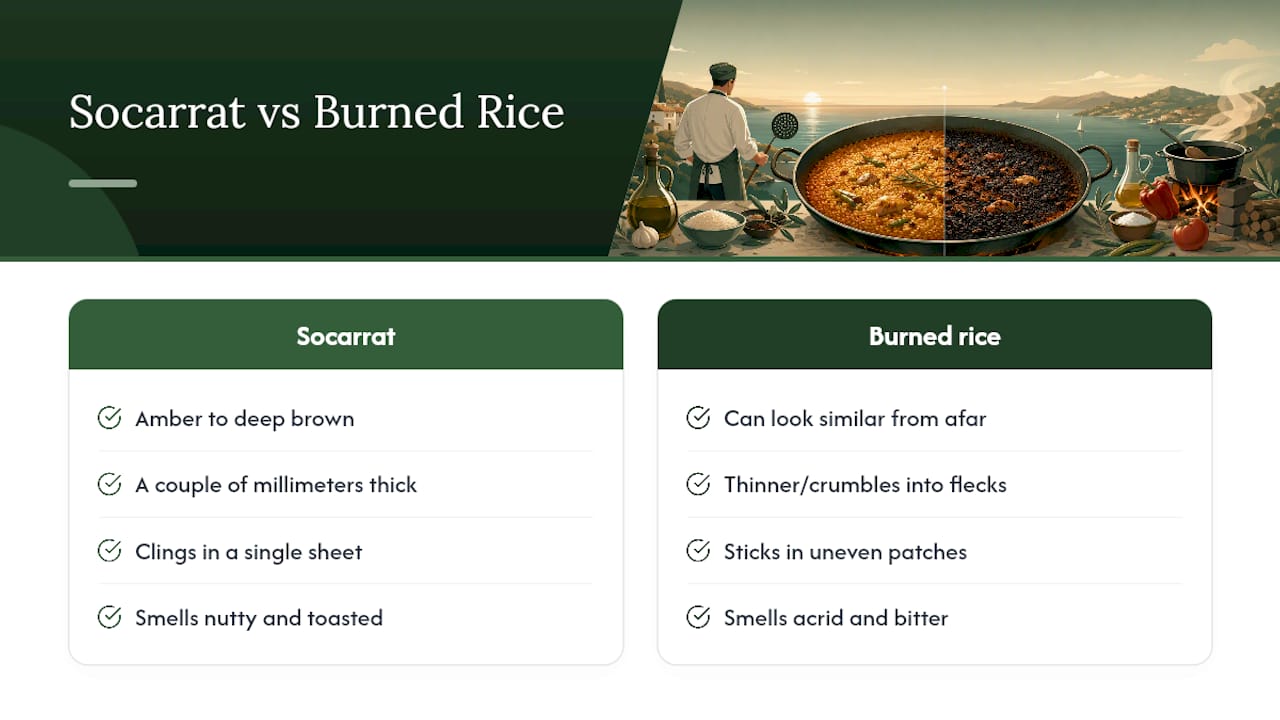
The word comes from Valencian, where socarrar means to singe or scorch lightly, and some regions call the same result torraet, meaning “toasted.” Neither term means burned. A proper socarrat looks amber to deep brown, runs only a couple of millimeters thick, and clings to the pan in a single sheet rather than crumbling into black flecks.
The sensory line between socarrat and scorched rice comes down to smell and texture. Socarrat smells nutty and toasted, almost like the crust on good bread. Burned rice smells acrid and bitter, and it tastes that way too, with a harsh, chemical edge that no amount of broth or sofrito can mask. Socarrat also pulls away from the pan in a crisp, cohesive layer once loosened with a spoon. Burned rice sticks in patches, tears unevenly, and often carries a black residue that contaminates the grains sitting above it. That distinction matters more than most home cooks realize, because the two can look deceptively similar from a few feet away.
Why Chefs Treat Socarrat as the Whole Point
Ask most Spanish chefs what makes a paella memorable, and the answer usually isn’t the seafood or the saffron. It’s the crust. Socarrat concentrates flavor the way a good sear concentrates flavor on a steak, and it gives the dish a contrast that soft, saturated rice simply cannot match on its own.
There’s also a social ritual built around it. Diners in Valencia and across coastal Spain still fight, half-jokingly, over who gets to rascar, or scrape, the crusty bottom layer once the top rice has been served. That tradition ties directly to paella’s roots as a communal dish meant to be shared straight from the pan. Chefs who understand this don’t treat socarrat as an accident of overcooking. They build their timing, their broth, and even their pan choice around producing it deliberately, every single service.
The Science Behind Socarrat: Maillard, Starch, Fat, and Collagen
Socarrat forms through the Maillard reaction, the same browning chemistry responsible for a seared steak crust or toasted bread. Sugars and proteins in the rice react under dry heat and rearrange into hundreds of new flavor compounds. That’s fundamentally different from burning, which is pure carbonization: carbon bonds breaking down and turning bitter rather than complex.
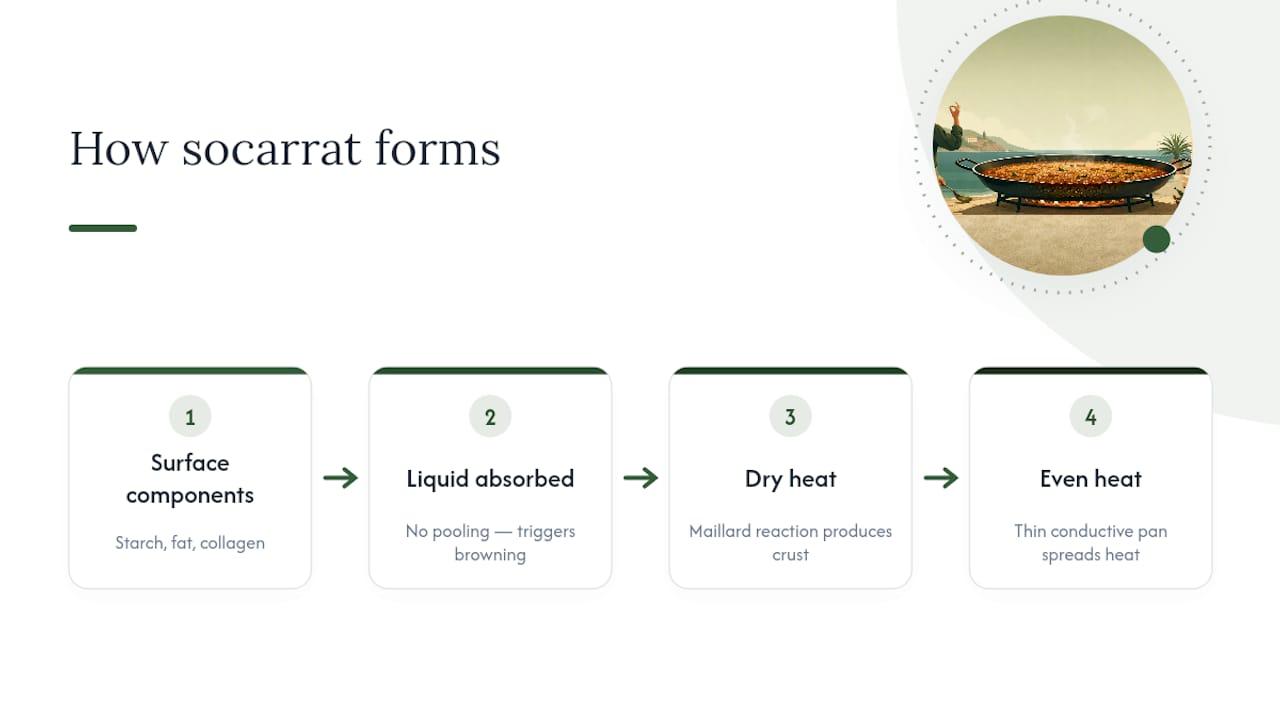
Three ingredients drive the reaction. Starch on the rice surface gelatinizes and then dries into a crisp shell. Fat, whether from olive oil, chicken skin, or seafood, helps conduct heat evenly and adds richness to the browning. Collagen from a good stock adds body and a subtle stickiness that helps the crust bind together instead of flaking apart. Crucially, no free liquid can remain on the pan floor when this happens. Even a small pool of broth insulates the rice and stops browning entirely, which is why chefs and food writers alike stress that full liquid absorption is the trigger point, not a fixed cooking time. Pan material matters here too. A thin, evenly conductive metal transfers heat consistently across the base, while thick or uneven pans create hot spots that burn one section while another stays wet.
How to Get a Perfect Socarrat at Home
You don’t need a professional kitchen to pull this off consistently. You need attention at the right moment, and a willingness to trust your ears over the clock.
- Pick a wide, shallow paellera. Spread the rice into a layer roughly 1 to 1.5 centimeters thick. A thinner layer in a wide pan lets liquid absorb and evaporate evenly, which is essential for socarrat to form across the whole bottom rather than in one lucky spot.
- Use a collagen-rich broth. Stock made from fish bones, shellfish shells, or chicken carcasses adds the body that helps the crust set properly. Measure your liquid carefully; too much delays the dry-out phase and risks overcooking the rice above it.
- Distribute the rice once, then stop touching it. Stirring after this point releases starch into the liquid, which keeps the bottom layer wet and gummy instead of letting it dry into a distinct crust.
- Listen for the crepitar. Once the boiling sound fades into a faint, dry crackle, the liquid is gone and the rice has hit the pan directly. That sound is your most reliable signal, more trustworthy than smell or sight at this stage.
- Raise the heat for 60 to 90 seconds. From the moment you hear that crackle, a short burst of higher heat is the finishing window most professionals rely on to lock in the crust without tipping into burnt territory.
- Rotate the pan over uneven burners. Home stovetops rarely heat a full paellera evenly. Turning the pan a quarter turn every 20 seconds during that final window spreads the heat instead of concentrating it in one quadrant.
- Pull it off the heat immediately. Residual heat keeps cooking the bottom layer even after the burner is off, so move the pan to a trivet the second the smell turns toasty rather than sharp.
Pro Tip: Set a kitchen timer for 60 seconds the instant you hear the crackle, but treat the timer as a backup, not a rule. Your nose and ears will usually tell you it’s ready a few seconds before the timer does, and those seconds are exactly what separate socarrat from a scorched pan.
If you want a full walkthrough of the rice and broth ratios that lead up to this final stage, Elspescadors’ step-by-step guide to authentic seafood paella covers the earlier cooking phases in detail.
Common Mistakes That Ruin Socarrat
Most failures trace back to one of a handful of habits, and they’re easy to fix once you know what to watch for.
- Stirring after the rice is spread out releases starch and keeps the bottom wet, blocking the dry crust from ever forming.
- Adding too much liquid delays the moment the pan floor goes dry, forcing you to either undercook the top rice or scorch the bottom while waiting.
- Using a non-stick or overly thick pan prevents the even, direct contact that drives proper browning.
- Skipping fat entirely leaves the rice surface dry and prone to burning rather than caramelizing smoothly.
- Walking away during the final minute is the single most common cause of a ruined crust, since socarrat can turn from perfect to burnt in under 30 seconds.
Tools, Rice, and Small Choices That Change the Outcome
Pan material isn’t a minor detail. Professional kitchens favor iron or carbon steel paelleras because they reach and hold high, even heat in a way non-stick coatings can’t match, and that direct metal contact is what drives the Maillard reaction at the pan floor.
Rice variety matters just as much. Bomba rice, grown around Calasparra, absorbs far more liquid than standard long-grain varieties and holds its shape without turning mushy, which gives you a wider margin for error during that final high-heat stage. Beyond the pan and rice, a few smaller choices tip the scales:
- A stock simmered with fish heads or shellfish shells adds the collagen that helps the crust bind.
- A moderate, even layer of olive oil, not a puddle, conducts heat without drowning the rice.
- Some professional kitchens use stabilizing agents like Irish moss in high-volume stock production, but that’s a commercial technique with no real benefit for a home cook making one pan at a time.
How Els Pescadors Approaches Socarrat in Service
Our kitchen in Poblenou treats socarrat as a timed, deliberate step, not a hopeful guess. Cooks track the sound of the pan closely during the final minute of every rice dish, adjusting burner position rather than extending cooking time when a paellera sits on uneven heat. That’s the same quadrant-rotation principle any home cook can borrow.
When a paella reaches the table, the crust gets scraped and presented as part of the dish, not hidden underneath it, because that crackling layer is often what guests remember most, making colorful meal presentations that much more appealing. Our focus on seasonal, locally sourced seafood and traditional Catalan rice technique means the broth going into every paella carries the collagen and depth that socarrat depends on, not shortcuts.
Why We Think Socarrat Deserves More Respect Than It Gets
Most home cooks treat socarrat as a bonus, something nice if it happens and no big deal if it doesn’t. We’d argue that’s backwards. The crust isn’t a garnish on the rice dish. In a lot of ways, it’s the reason the dish exists in its traditional form at all, going back to fishermen’s fires where the bottom of the pan browned by necessity long before anyone called it a delicacy.
One habit we lean on in service: never trust the clock over your senses. A timer tells you what usually happens. Your ears tell you what’s actually happening in that specific pan, on that specific burner, right now. If you’d rather taste a version dialed in over years of daily repetition than gamble on a Tuesday-night attempt, book a table and let us handle the crackle.
— YellowRock
Sources
- ¿Qué es el socarrat? Así puedes lograrlo en tus platillos
- Cómo conseguir el mejor socarrat en tu paella: trucos infalibles
- El desconocido truco que sirve para conseguir un socarrat perfecto en la paella | Cadena SER
FAQ
How Do You Make Socarrat in a Paella?
Spread the rice in a thin, even layer, avoid stirring once it’s distributed, and listen for the boiling sound to fade into a dry crackle. Raise the heat for about 60 to 90 seconds from that point, then remove the pan immediately.
What Is Socarrat Called in English?
There’s no direct English translation. English speakers typically just use the word “socarrat” itself, or describe it as the crispy, caramelized rice crust at the bottom of a paella.
How Do You Eat Socarrat?
Scrape it off the pan floor with a spoon or spatula once the top rice has been served, and eat it on its own or mixed back into a portion of rice. It’s traditionally shared, with everyone at the table taking a piece.
What’s the Easiest Way to Get Socarrat Rice at Home?
Use a wide metal paellera, a collagen-rich broth measured precisely, and bomba or Calasparra rice, which tolerates the extra heat exposure better than softer varieties. Listen for the crackle rather than relying on a timer, and pull the pan the moment you smell toasted grains instead of sharp, burnt ones.